Happy Money: The Science of Smarter Spending By Elizabeth Dunn & Michael Norton
This book flips the script on personal finance by shifting the focus from earning more to spending better. Drawing on rigorous behavioral science research, it explains that while income has a diminishing return on happiness, the way we utilize our resources has a massive impact on our well-being. It provides a blueprint for transforming money from a source of stress into a tool for joy.
Who May Benefit
- Professionals and Earners feeling unfulfilled despite financial stability.
- Business Leaders seeking to motivate employees beyond standard cash bonuses.
- Marketers looking to increase customer satisfaction and brand loyalty.
- Budget-Conscious Individuals wanting to maximize the emotional return on every dollar.
- Psychology Enthusiasts interested in the intersection of money and human behavior.
Top 3 Key Insights
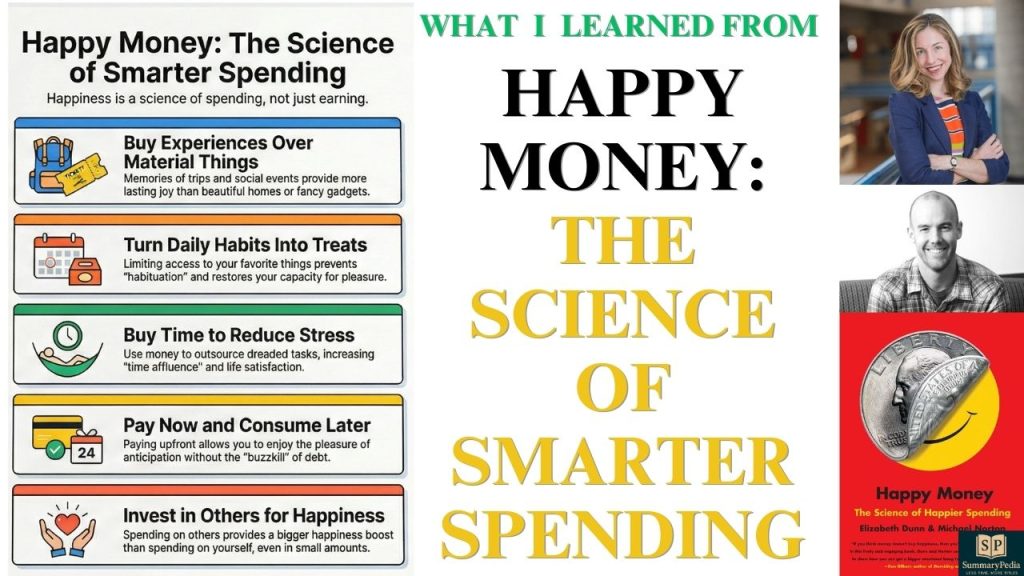
- Experiences Trump Things: Material goods suffer from adaptation and comparison; experiences foster social connection and age better in our memories, becoming more valuable over time,.
- Abundance Kills Joy: Constant access to pleasures numbs us to them. By voluntarily limiting access to favorite things (making them a “treat”), we reset our capacity for appreciation,.
- The “Pay Now” Advantage: Credit cards decouple payment from consumption in a way that hurts happiness. Paying upfront removes the “pain of paying” during the experience and allows for the joy of anticipation,.
4 More Takeaways
- Buy Back Your Time: Outsourcing dreaded tasks (like cleaning) improves happiness more than buying luxury goods, yet wealthier people often feel more pressed for time, not less,.
- The $5 Happiness Fix: You don’t need to be a philanthropist to benefit from giving. Spending as little as $5 on someone else boosts mood significantly more than spending it on yourself.
- Prosocial Bonuses Work: In the workplace, giving employees money to spend on teammates increases performance and sales significantly more than personal cash bonuses.
- The Commuting Paradox: A longer commute for a bigger house is a bad trade. Commuting is often the lowest point of the day emotionally, and a fancy car doesn’t fix the misery,.
Book in 1 Sentence
Money can buy happiness, provided you stop buying stuff for yourself and start buying experiences, time, and gifts for others,.
Book in 1 Minute
Most people operate under the illusion that earning more money is the key to a better life. However, research shows that once basic needs are met, additional income provides surprisingly little additional happiness. Happy Money argues that we are simply spending our money wrong. We over-invest in solitary material goods (like houses and electronics) that we quickly adapt to, rather than investments that yield emotional dividends.
The authors present five scientifically validated principles to increase the “happiness bang for your buck”: Buy Experiences, Make It a Treat, Buy Time, Pay Now, Consume Later, and Invest in Others. By shifting our spending habits—such as prepaying for vacations to enjoy the anticipation or buying a friend coffee instead of a new gadget—we can significantly improve our overall well-being without needing a raise.
1 Unique Aspect
The book introduces the counter-intuitive concept of “Pay Now, Consume Later,” arguing that the modern convenience of credit cards actually robs us of joy by keeping the “pain of paying” looming over us, whereas paying upfront allows us to experience the consumption as if it were “free”,.
Chapter-wise Summary
Chapter 1: Buy Experiences
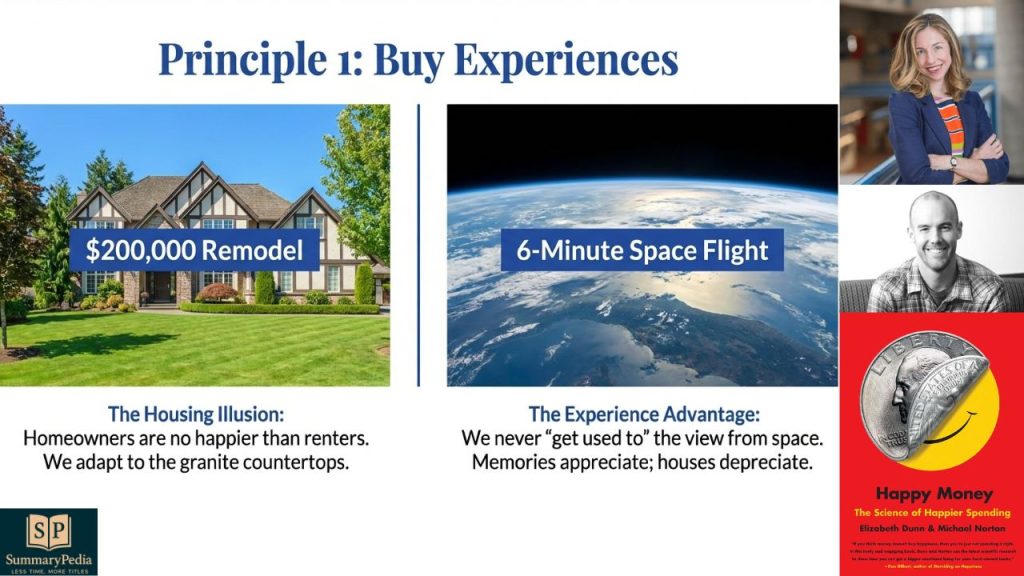
- “Things that were hard to bear are sweet to remember.” Material purchases, like a new house, often fail to increase overall happiness because we adapt to them quickly. In contrast, experiences—even those that are physically uncomfortable, like a muddy obstacle race—foster social connections and become central to our identity. Experiences are harder to compare than goods (avoiding buyer’s remorse) and tend to get better in our memory over time.
- Key Points: Memories beat stuff; Experiences define identity; Social connection is key.
Chapter 2: Make It a Treat
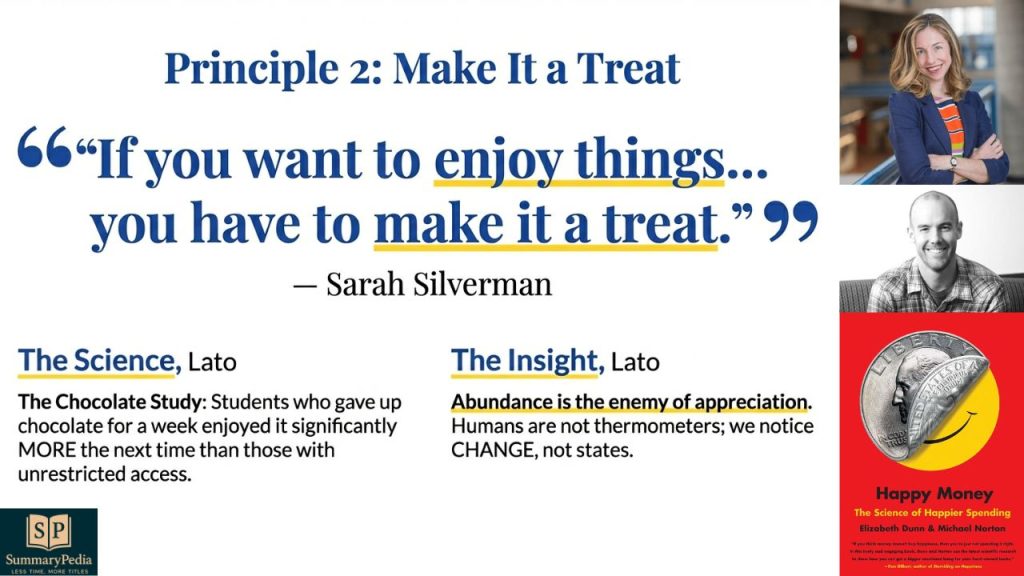
- “Abundance, it turns out, is the enemy of appreciation.” When a pleasure is always available, we stop noticing it. The authors explain that “habituation” is the enemy of happiness. By temporarily giving up our favorite indulgences (like a daily latte or season-specific candy), we can “re-virginize” our senses. Scarcity and novelty capture our attention, restoring the emotional punch of the experience.
- Key Points: Interruptions heighten pleasure; Scarcity creates value; Novelty prevents boredom.
Chapter 3: Buy Time
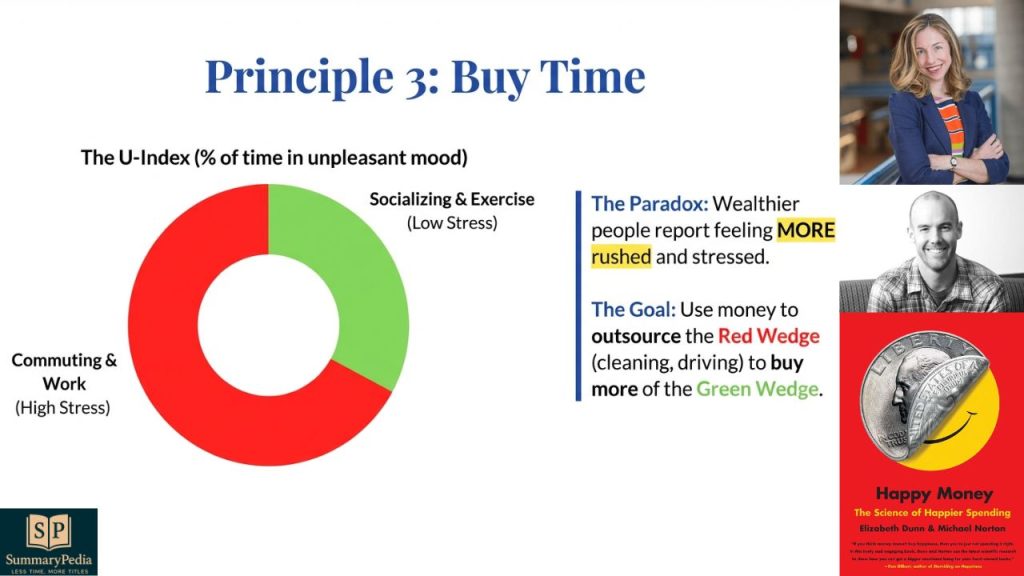
- “Money can transform the way we spend our time, freeing us to pursue our passions.” People often sacrifice time to save a few dollars (driving further for cheap gas), which is a happiness error. We should use money to outsource “U-index” activities—time spent in an unpleasant mood, like cleaning or commuting. Interestingly, feeling time-poor makes us less happy, and helping others can actually make us feel more “time affluent.”
- Key Points: Focus on time affluence; Outsourcing reduces stress; Commuting kills joy.
Chapter 4: Pay Now, Consume Later
- “There is nothing so evocative as the present.” Modern technology encourages “consume now, pay later,” which eliminates the joy of anticipation (what the French call se réjouir). By paying upfront, we build positive expectations and “drool factor.” Furthermore, paying later creates a “debt overhang” that ruins the consumption experience. Paying early frees us from the tyranny of sunk costs.
- Key Points: Anticipation enhances pleasure; Debt creates dread; Prepayment feels “free”.
Chapter 5: Invest in Others
- “Spending money on others provides a bigger happiness boost than spending money on yourself.” Giving is a universal happiness booster, observed in toddlers and adults across diverse cultures (from Canada to Uganda). The happiness return is highest when giving is a choice (not forced), creates a connection with the recipient, and makes a visible impact. This principle applies to individuals and corporations alike, where “prosocial bonuses” yield high ROI.
- Key Points: Giving is innate; Choice is essential; Impact drives joy.
Epilogue: Zooming Out
- “The goal is to wring the most happiness out of every $5.” The authors encourage readers to audit their spending habits not just by category (food, rent) but by principle. Governments and companies can also apply these principles to increase societal well-being, such as creating more parks (experiences) or improving tax systems to allow allocation choice (investing in others).
- Key Points: Audit spending habits; Shift small amounts.
10 Notable Quotes
- “Before you spend that $5… ask yourself: Is this happy money?”
- “Money often fails to buy happiness, does that mean that it can’t?”
- “We are happy with things, until we find out there are better things available.”
- “Abundance, it turns out, is the enemy of appreciation.”
- “People with more money do not spend their time in more enjoyable ways.”
- “What we owe is a bigger predictor of our happiness than what we make.”
- “Everything looks perfect from far away.”
- “The more they invested in others, the happier they were.”
- “Giving money away makes us feel that we must have a lot of money.”
- “If you want to enjoy these things… you have to make it a treat.”
About the Author
Elizabeth Dunn is an associate professor of psychology at the University of British Columbia. At age twenty-six, she was named a “rising star” in academia. Her research focuses on happiness and self-knowledge. Michael Norton is an associate professor of marketing at Harvard Business School. His work has been featured in the New York Times Magazine’s “Year in Ideas,” and Wired selected him as one of “50 People Who Will Change the World.” Together, they combine rigorous academic research with accessible behavioral science.
Frequently Asked Questions
- Q: Does earning more money ever increase happiness?
- A: Yes, but only up to an income of roughly $75,000. Beyond that, the impact on day-to-day happiness flattens out.
- Q: Why are experiences better than material goods?
- A: Experiences are harder to compare (preventing regret), foster social connections, and are viewed more positively in hindsight.
- Q: Can buying a house make me happy?
- A: Surprisingly, research shows home ownership has almost no detectible benefit for overall happiness, though it increases housing satisfaction,.
- Q: How does “making it a treat” work?
- A: By taking a break from a favorite indulgence (like coffee or chocolate), you reset your body’s adaptation, making the next consumption significantly more pleasurable.
- Q: Why is paying later bad for happiness?
- A: It eliminates the pleasure of anticipation and adds the stress of debt, which weighs heavily on relationships and mood.
- Q: How much do I have to give to feel happy?
- A: The amount matters less than the act. Giving even $5 produces the same happiness boost as giving $20.
- Q: Does this apply to business?
- A: Yes. Teams that receive money to spend on each other (prosocial bonuses) drastically outperform teams that receive personal bonuses.
- Q: What is “time affluence”?
- A: It is the feeling that one has sufficient time. It is a stronger predictor of job and life satisfaction than material affluence.
- Q: Why does giving make us feel wealthy?
- A: Giving money away signals to our brain that we have enough resources to spare, boosting our subjective sense of wealth.
- Q: Is trying to be happier a futile pursuit?
- A: Not if you have the right data. Using these science-backed principles is like using an expert surgeon rather than trying to operate on yourself.
Some concepts on the Book
Based on Happy Money, here are the psychological theories, effects, and phenomena presented in the book that, like the Benjamin Effect, explain how our minds process happiness, time, and spending.
1. Silverman’s Mantra
Named after comedian Sarah Silverman, this concept addresses the problem of habituation (getting used to things). Silverman realized that she loved certain indulgences (like pot or fart jokes) so much that she was terrified of getting tired of them. Her solution was to “Make it a treat”.
- The Theory: Abundance is the enemy of appreciation. When a pleasure is always available, we stop noticing it. By voluntarily limiting access to our favorite things, we reset our “cheerometer” and renew our capacity for pleasure,,.
2. The Big Ben Problem
This phenomenon explains why residents of London rarely visit Big Ben, while tourists flock to it.
- The Theory: When a pleasurable activity is always available, people perpetually postpone doing it, assuming they can do it “later.” This leads to locals missing out on happiness-boosting experiences in their own backyards. Introducing a limited time window (scarcity) often encourages people to finally seize these opportunities,.
3. The “Yes… Damn!” Effect
Coined by Gal Zauberman, this effect explains why we agree to do things in the future that we regret when the time actually arrives.
- The Theory: We view our time in the immediate present as scarce (“I’m too busy this Tuesday”), but we view our future time as abundant and open. Consequently, we overcommit to future obligations. When the date arrives, the “future” becomes the “present,” and we find ourselves just as busy as before, leading to the regret of “Damn, why did I say yes?”,.
4. The “Rosy View”
Also known as the fading affect bias, this explains why we often look back fondly on experiences that were actually unpleasant at the time.
- The Theory: Human memory acts like a kaleidoscope that filters out immediate annoyances (like mosquitoes or rain) while retaining the positive meaning of an event (like social connection). This confirms Seneca’s idea that “Things that were hard to bear are sweet to remember”.
5. The Drool Factor
This concept highlights the biological and emotional benefits of delaying consumption.
- The Theory: Delaying the consumption of a treat (like a Hershey’s Kiss) allows desire to build. This period of anticipation enhances the actual pleasure of consumption because the brain’s reward systems are activated by the wait. The delay essentially makes the treat taste better.
6. A Wrinkle in Time
Research suggests that our emotional processing of time is asymmetrical.
- The Theory: Future events provoke more emotion than identical events in the past. For example, people feel more negative emotion when thinking about helping a friend move in the future than they do remembering helping a friend move in the past. This also explains why vacationers are often happier in the weeks before a trip (anticipation) than in the weeks after.
7. The Pain of Paying
Behavioral economists use this term to describe the negative emotion associated with parting with money.
- The Theory: Spending money can activate the same regions of the brain associated with physical pain (the insula). This “pain” acts as a friction that reduces spending. Credit cards constitute a “scam” on the brain because they anesthetize this pain, decoupling the payment from the consumption and leading people to spend more than they would with cash,,.
8. The Labor Illusion
This phenomenon explains how businesses can make waiting more tolerable.
- The Theory: People are happier waiting for a service (like a flight search on Kayak.com) if they can see evidence that work is being done on their behalf. Customers actually prefer services that take longer—provided the service transparently shows the effort being exerted—over services that provide instant results without showing the work.
9. The Swimming Pool Paradox (Focusing Illusion)
This refers to the error people make when predicting how a major purchase will affect their happiness.
- The Theory: When contemplating a purchase (like a pool in the suburbs), the imagination focuses on the “foreground” features (pool parties, relaxation) and ignores the “background” reality (commuting, cleaning filters). This leads to the belief that the purchase will change one’s life more than it actually does. The book suggests using the “Tuesday Strategy” (imagining your specific activities on a normal Tuesday) to counteract this.
10. The Commuting Paradox
This paradox highlights a common error in decision-making regarding employment and housing.
- The Theory: People frequently accept jobs with longer commutes in exchange for a higher salary or a bigger house, assuming the extra money or space will compensate for the travel time. However, research shows this is a bad happiness trade-off. The distress of commuting is severe and daily, whereas the satisfaction from a higher salary or bigger house is often stable or fleeting. Consequently, people with longer commutes report lower overall life satisfaction, a phenomenon economists call the “commuting paradox”,.
11. The Easterlin Paradox
Named after economist Richard Easterlin, this is a famous puzzle in happiness research discussed in the book’s policy section.
- The Theory: While richer people within a country are generally happier than poorer people, economic growth (getting richer as a country over time) does not necessarily lead to an increase in the average happiness of its citizens. The book notes that in countries like the United States, rising incomes over the last few decades have not translated into rising happiness, partly because of how that extra money is spent,.
12. The Time-Ask Effect
This effect explains how the order of questions influences generosity.
- The Theory: When people are asked to donate time (e.g., “Would you be willing to volunteer?”) before being asked to donate money, they end up donating more of both. Asking about time triggers an emotional mindset focused on the “warm glow” of helping and personal identity, whereas asking about money triggers a cold, rational, economic mindset that suppresses generosity,.
13. Duration Neglect
This psychological principle explains why a two-week vacation isn’t necessarily twice as good as a one-week vacation.
- The Theory: The length of an experience has remarkably little impact on the pleasure people remember deriving from it. When looking back on an event, our memories are dominated by the peak intensity of the emotion (good or bad) and how the experience ended, rather than how long it lasted. This suggests we can maximize happiness by prioritizing short, intense, high-quality experiences over long, drawn-out ones,.
14. The Deadweight Loss of Christmas
Proposed by economist Joel Waldfogel, this concept applies economic theory to gift-giving.
- The Theory: Gift-giving is often economically inefficient because givers typically pay more for an item than the recipient would be willing to pay for it themselves. (e.g., You spend $100 on a sweater for your nephew, but he values it at only $20). This gap creates a “deadweight loss” of billions of dollars annually. However, the authors counter this by noting that a good gift provides “relational value” that a purely economic analysis misses.
15. The Cause Marketing Paradox
This phenomenon explains why buying “charity-linked” products can actually reduce overall generosity.
- The Theory: When companies link purchases to charity (e.g., “Buy this Red Bull and we’ll donate 50 cents”), it can “crowd out” direct charitable giving. Consumers feel they have already “done their part” by buying the product, leading them to donate less money overall. Furthermore, cause marketing focuses the consumer’s attention on the product (the “get”) rather than the giving, which diminishes the happiness typically derived from generosity,.
7. Time Famine (The Value-Scarcity Link)
This explains why wealthier people often feel more rushed.
- The Theory: We psychologically associate scarcity with value. Conversely, when something is valuable, we perceive it as scarce. As people earn more money, their time becomes more economically valuable. This high value creates a psychological perception that time is scarce, leading wealthier individuals to feel a “time famine” and report higher levels of stress and time pressure than those with lower incomes,.
How to Use This Book
Perform a “happiness audit” of your spending for one week. Instead of tracking every penny, categorize spending by the five principles. Look for opportunities to shift $5 from “stuff” to “experiences” or “others,” and try prepaying for your next weekend outing to enjoy the anticipation.
Conclusion
Stop chasing wealth and start optimizing your wallet. Happy Money proves that you don’t need a higher salary to have a richer life. Start today: Buy a coffee for a friend, prepay for a weekend treat, or outsource a chore you hate—and watch your return on happiness grow.