Dialed In: Do Your Best When It Matters Most by Dr. Dana Sinclair
Dialed In dismantles the myths of modern self-help—specifically that you need unwavering confidence and external motivation to succeed. Instead, Dr. Dana Sinclair offers a practical, psychological framework for emotional control, teaching readers how to perform at their peak by shifting focus from feelings to actions. It is an essential guide for anyone who needs to deliver results under high pressure, regardless of their field. The Book also available as Dialed In: How to Perform Under Pressure.
Who May Benefit
- Athletes and Coaches seeking to improve consistency and manage game-day nerves.
- Business Leaders and Executives looking to enhance decision-making and handle difficult personnel.
- Medical Professionals, particularly surgeons, who must maintain precision under extreme stress.
- Students preparing for high-stakes exams or presentations.
- Parents wanting to support their children’s performance without adding unnecessary pressure.
Top 3 Key Insights
- Confidence Is a Preference, Not a Necessity: You do not need to feel confident to perform well; you simply need to focus on the task at hand.
- Motivation Cannot Be Outsourced: True drive comes from within; relying on others for a “pep talk” is a recipe for inconsistency,.
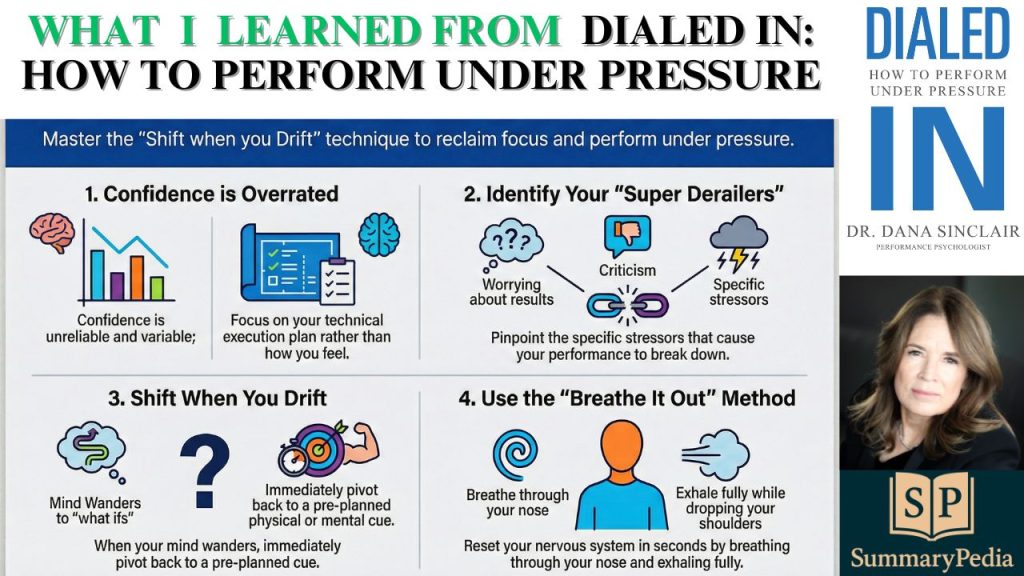
- Shift When You Drift: Performance falters when the mind wanders to results or fears; the key is to recognize the drift and shift focus back to specific actions,.
4 More Takeaways
- Fear Is Manageable: Everyone feels fear; the goal is to have a plan to manage it rather than trying to eliminate it.
- Character Trumps Talent: “Red flag” behaviors—like a lack of impulse control—will eventually destroy organizational culture, regardless of talent,.
- Breathing Is a Performance Skill: Controlled breathing is the most effective tool to physically lower tension and clear the mind instantly,.
- Action Over Emotion: Specific “performance cues” (telling yourself what to do) override emotional noise and anxiety.
Book in 1 Sentence
Dr. Dana Sinclair provides a proven three-step framework to master pressure, debunking the need for confidence and teaching readers to execute actions over emotions,.
Book in 1 Minute
Dialed In argues that talent gets you in the game, but a distracted mind kicks you out. Dr. Dana Sinclair, a renowned performance psychologist, reveals that consistent high performance isn’t about entering a magical “zone” or feeling supreme confidence. Instead, it is about emotional control. The book outlines a clear process: identify your “hot spots” (distractions), apply four core mental skills, and create a structured plan to execute when pressure mounts.
Sinclair emphasizes that feelings like fear and self-doubt are normal. The problem arises when we let those feelings dictate our actions. By using tools like “Breathe It Out,” “Smart Talk,” and “Performance Cues,” anyone can stabilize their mind. The ultimate goal is to create a simple “Go-To Plan”—often short enough to fit on a Post-it Note—that acts as a force field against distraction, ensuring you perform your best when it counts,,.
1 Unique Aspect
Sinclair introduces the concept of the “Red Flag” character assessment, arguing that individuals with low impulse control and high self-centeredness (Red Flags) cannot be “fixed” and will inevitably degrade performance cultures, suggesting avoidance or removal is the only viable strategy,.
Chapter-wise Summary
Chapter 1: Why Are Some People Better?
“Talent doesn’t tell the whole story.” Talent helps, but it is not the predictor of long-term success. The difference between those who fade and those who excel lies in their “performance style”—how they naturally behave under pressure. Whether you are assertive, passive, or a perfectionist, understanding your natural tendencies allows you to modify your approach to get better results.
- Key Point: Know your natural behaviors to stop them from tripping you up.
- Key Point: Talent is potential; performance style determines if you reach it.
Chapter 2: The Difference Makers
“I am encouraging you to change it up, for that specific event… where you want to excel.” You cannot change your personality, but you can change your actions in specific moments. Small adjustments—”difference makers”—can have huge impacts. Strategies include taking action despite hesitation, slowing down to reduce anger, listening longer to avoid assumptions, and dropping obsessive details to focus on the big picture,,.
- Key Point: Slow down to regain control.
- Key Point: Listen longer to gather better data.
Chapter 3: The F Word
“Fear of failure is powerful and prevalent. It is an unavoidable part of a striving life.” Fear often manifests as self-sabotage, excuses, or “freak-outs”,. Rather than trying to banish fear, Sinclair advises creating a “Freak-out Plan”—specific steps to take when panic sets in. This ensures that even if you are scared, your performance remains grounded in action rather than emotion.
- Key Point: Fear is relative; it finds everyone.
- Key Point: Create a “Freak-out Plan” to manage high-fear zones.
Chapter 4: Confidence Is Overrated
“Performing is about what you do, not about how you feel.” Feeling confident is a luxury, not a requirement. Many elite athletes win gold medals while feeling terrified or doubtful. Sinclair warns against “confidence crushers” like perfectionism and making excuses. The solution is to focus on competence—doing the job—which often generates confidence as a byproduct,.
- Key Point: You don’t need confidence to succeed.
- Key Point: Focus on competence, not feelings.
Chapter 5: You Can’t Outsource Your Own Motivation
“I can’t give you motivation, no one can.” Motivation is a desire, not a strategy. It must come from within; relying on others for pep talks is unsustainable. A lack of motivation is often a mask for fear of failure or a sign that you genuinely do not want the goal. Effective performers move past wanting it to doing the work required to get it,.
- Key Point: Motivation is a desire, not a reliable strategy.
- Key Point: Don’t use lack of motivation as an excuse.
Chapter 6: Superstitions Aren’t Super
“Superstitions are an indicator of how anxious and distracted you are.” Superstitions (like lucky hats) are anxiety-driven attempts to control the uncontrollable. They waste energy. In contrast, routines are structured actions that prepare the mind and body for execution. Sinclair urges readers to replace superstitions with deliberate routines that settle the mind,.
- Key Point: Superstitions distract; routines prepare.
- Key Point: Have a transition from routine to execution.
Chapter 7: Bad Advice and Good Communicating
“Just relax out there… The problem with these common comments is that the advice simply doesn’t work.”, Vague advice like “focus harder” or “trust yourself” is useless. Good communication requires specific, prescriptive feedback that tells a person what to do (e.g., “watch your tempo” instead of “don’t rush”),. Effective communicators listen longer, minimize defensiveness, and focus on solutions rather than personality conflicts.
- Key Point: Give specific, actionable directions.
- Key Point: Avoid defensiveness; listen to solve.
Chapter 8: When in Charge of Somebody, Watch It
“Some parents don’t know the difference between a healthy nudge and a destructive shove.” Parents and leaders often interfere with performance by projecting their own anxieties or living vicariously through others,. Good mentors foster independence, allowing performers to solve problems on their own. They provide unconditional support rather than punishment disguised as criticism,.
- Key Point: Promote autonomy and self-reliance.
- Key Point: Don’t make support conditional on winning.
Chapter 9: Why Character Counts
“Character is the horsepower driving their daily decisions and actions.” Sinclair introduces “Red Flags”—individuals who lack impulse control and self-discipline. These traits are toxic to organizational culture and rarely change. Organizations often overlook character for talent, a costly mistake. Leaders must identify these flags early and either avoid hiring them or have a strict exit strategy,.
- Key Point: Red flags destroy performance culture.
- Key Point: Avoid hiring for talent if character is missing.
Chapter 10: Shift When You Drift!
“The most important skill for a performer to develop is to be process oriented, not results driven.” This chapter introduces the core “Process.” Performance fluctuates between “good days” (automatic focus) and “bad days” (distracted/tense). The key skill is catching yourself when you drift into distraction and shifting back to the plan. This requires a three-step framework: Identify hot spots, use skills, and create a plan.
- Key Point: Be ready to shift focus when distracted.
- Key Point: The 3-Step Process: Hot Spots, Skills, Plan.
Chapter 11: Hot Spots: Figure Out What Messes You Up
“If you can’t say what is in the way… you won’t learn how to get around it.” “Hot spots” are the specific distractions that derail performance, such as worrying about results, fear of judgment, or dwelling on mistakes,. Identifying “super derailers”—the top barriers—is the first step toward neutralizing them.
- Key Point: List your distractions to manage them.
Chapter 12: Skill 1: Get Calm and Stay There
“Breathing is a natural sedative and is undervalued as a tool for managing the tension.” Tension ruins performance. The most effective tool is “Breathe It Out”: breathe through the nose, slow it down, and exhale fully,. This physical action forces the body to relax and clears mental clutter instantly.
- Key Point: Breathe through the nose; exhale fully.
- Key Point: Manage tension to stay under a 5/10.
Chapter 13: Skill 2: Forget How You Feel, It’s About What You Do
“Performance cues… are what you need to complete the task well.” Ignore feelings and focus on “Performance Cues”—short, precise phrases that tell your body what to do (e.g., “move your feet,” “listen,” “shoulders down”). These cues keep the brain occupied with execution rather than worry.
- Key Point: Use 2-3 precise instructional cues.
- Key Point: Drill down to the “tough bits”.
Chapter 14: Skill 3: Talk Your Way Through It
“Facts help you stay focused on what is true and real.” Replace negative chatter with a “Facts List”—concrete evidence of past success and preparation. Follow this with “Smart Talk,” which is directive and constructive (e.g., “I can do this,” “Stick to the game plan”) rather than empty affirmations.
- Key Point: Create a Facts List to ground yourself.
- Key Point: Use Smart Talk to direct action.
Chapter 15: Skill 4: Keep Daydreaming
“Daydreaming with a purpose… can quickly help you settle, plan good things, and pull you toward a desired outcome.” Focused daydreaming is mental rehearsal. Sinclair identifies five types: Chill (relaxing), Skill (practicing technique), Highlight (reviewing success), Fight-back (recovering from errors), and Step-it-up (envisioning new levels of success),.
- Key Point: Brief, frequent mental practice works best.
- Key Point: Visualize fixing mistakes (Fight-back imagery).
Chapter 16: Stick to the Plan
“Your plan is a force field between you and a poor performance.” Consolidate the skills into a “Go-To Plan.” This short plan has three sections: Warm-up (to settle in), During (cues to use in action), and #1 Focus (the single most important reset button). Keep it simple enough to fit on a Post-it Note,.
- Key Point: Structure: Warm-up, During, #1 Focus.
- Key Point: Evaluate performance afterwards (1-10 scale).
Conclusion: Use Your Head
“Talent does not ensure success… but a distracted mind kicks you out.” Pressure is unavoidable, but performing well is about making emotions work for you. By using your head to breathe, plan, and execute, you can achieve consistency and satisfaction.
10 Notable Quotes
- “Talent gets you in the game, but a distracted mind kicks you out.”
- “You don’t need confidence to succeed… Confidence is more of a preference than a need.”
- “Motivation is a desire, not a reliable strategy for getting results.”
- “Superstitions are an indicator of how anxious and distracted you are.”
- “Performing is all about what you do—and the best way to perform is to know precisely how to act in the moment.”
- “Forget perfect… striving for it is a script for self-defeat.”
- “No organization can absorb a red flag without consequence.”
- “Shift when you drift.”
- “Calm + Do = Results.”
- “You can’t outsource your own motivation.”
About the Author
Dr. Dana Sinclair is a founder and partner of Human Performance International. A licensed psychologist with doctorates from the University of Cambridge and the University of Ottawa, she is a clinical assistant professor at the University of British Columbia. For over twenty years, she has served as a performance psychologist for elite athletes in the NFL, MLB, NBA, WNBA, NHL, and MLS, as well as Olympic medalists. Beyond sports, she consults for surgeons, business executives, and performing artists, helping them manage pressure and improve performance,.
Frequently Asked Questions
- Do I need to feel confident to perform well? No. Confidence is a feeling, not an action. You can perform excellently while feeling terrified by focusing on the task.
- Can someone else motivate me? No. Motivation comes from within. Others can encourage you, but they cannot give you the drive to act.
- What is a “Red Flag”? A person with low impulse control and self-centeredness who negatively impacts organizational culture and is unlikely to change.
- What is the most important skill in the book? Breathing (specifically “Breathe It Out”). It is the quickest way to physically lower tension and clear the mind.
- How do routines differ from superstitions? Routines are structured actions to prepare for performance; superstitions are anxiety-driven rituals based on the illusion of luck.
- What is a “Go-To Plan”? A concise list (often on a Post-it) containing your warm-up, key cues, and #1 focus to keep you on track during pressure.
- Is fear of failure bad? It is normal. It only becomes bad if it leads to self-sabotage or excuses. It should be managed, not feared.
- What are “Performance Cues”? Short, instructional phrases (e.g., “move your feet”) that tell your body exactly what to do to execute a task.
- What is “Smart Talk”? Constructive internal dialogue based on facts and instructions, rather than vague positive affirmations.
- How long should mental practice take? It can be very brief—seconds to a minute. Frequency is more important than duration.
How to Use This Book
Identify your top 3 “hot spots” (distractions). Then, create a “Go-To Plan” on a small index card or phone note. Include a breathing step for warm-up, 2-3 performance cues for the event, and a single “#1 Focus” to reset yourself if you panic. Review it before every high-stakes moment.
Conclusion
Dialed In proves that you don’t need to be fearless to be great—you just need a plan. Stop waiting for confidence to arrive and start focusing on what you can do. Build your plan, breathe it out, and dial in today.