The Alchemist by Paulo Coelho
The Alchemist is a modern classic that weaves a magical fable about Santiago, a shepherd boy who journeys from Spain to the Egyptian desert in search of buried treasure,. Through his quest, Coelho explores the profound idea of the “Personal Legend”—our true purpose in life—and the universal obstacles of fear and conformity that prevent us from achieving it,. It is a timeless guide for anyone seeking to listen to their heart and recognize the opportunities life presents,.
Who May Benefit
- Dreamers and Entrepreneurs looking for the courage to take risks.
- Professionals feeling stuck or seeking a career change.
- Spiritual Seekers interested in the interconnectedness of life.
- Young Adults facing uncertainty about their future paths.
- Anyone navigating a major life transition or loss.
Top 3 Key Insights
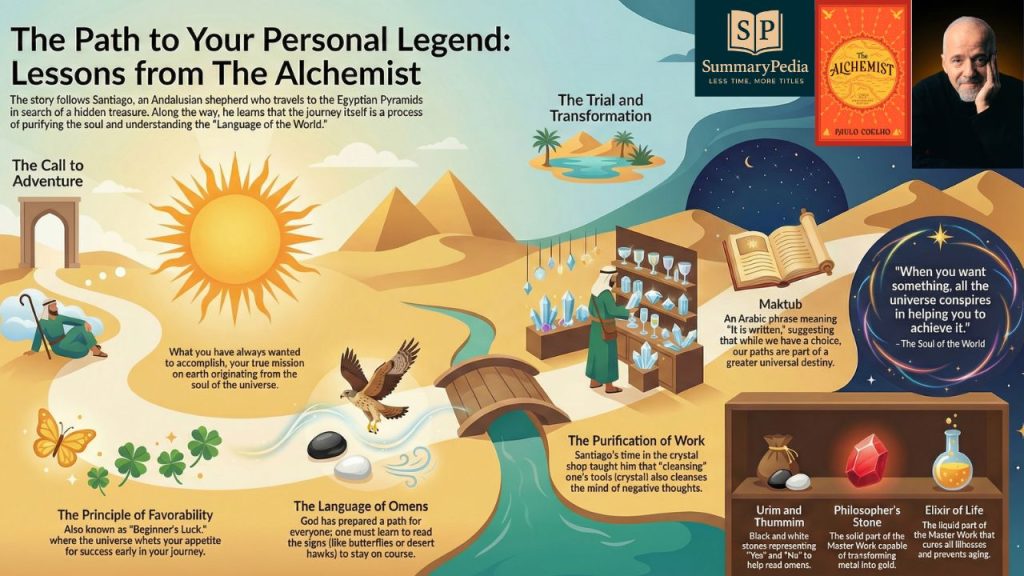
- Pursue Your Personal Legend: Your only real obligation is to realize your destiny, a desire originating in the soul of the universe.
- The Universe Conspires: When you truly want something, the entire universe works to help you achieve it.
- Fear is the Obstacle: The fear of suffering is worse than the suffering itself; pursuing dreams creates encounters with God.
4 More Takeaways
- Live in the Present: Happiness is found by concentrating on the present moment, rather than dwelling on the past or future,.
- Read the Omens: God leaves signs along your path to guide you toward your treasure.
- Maktub (It Is Written): Fate and free will coexist; your story is written by the same hand that wrote the world,.
- Transformation: True alchemy is evolving yourself to become better, which improves everything around you.
Book in 1 Sentence A lyrical fable about a shepherd discovering that when you pursue your destiny, the universe conspires to help you find it,.
Book in 1 Minute Santiago is an Andalusian shepherd who longs to travel rather than become a priest. After recurring dreams of treasure near the Pyramids, he meets a mysterious King who encourages him to pursue his “Personal Legend”,. Santiago sells his sheep and travels to Africa, where he is robbed and forced to work in a crystal shop for a year,.
Rich but unfulfilled, he joins a caravan across the desert, meeting an Englishman seeking the secrets of alchemy. At an oasis, Santiago meets the Alchemist and falls in love with Fatima,. He learns that love should not stop a man from his destiny. Guided by the Alchemist, Santiago learns to listen to his heart and read the “Soul of the World”. Ultimately, he discovers that the treasure he sought was back where his journey began, proving the journey itself was the true gold.
1 Unique Aspect Coelho integrates the concept of the “Soul of the World”—a spiritual unity binding all things—arguing that individual success contributes to the evolution of the entire universe,.
Chapter-wise Summary
Prologue
- Quote: “I weep for Narcissus, but I never noticed that Narcissus was beautiful. I weep because, each time he knelt beside my banks, I could see, in the depths of his eyes, my own beauty reflected.”
- Summary: The Alchemist reads a variation of the Narcissus myth. In this version, the lake weeps for Narcissus not because he is dead, but because the lake can no longer see its own beauty reflected in his eyes. This short fable sets the tone for the book, suggesting that we find truth and beauty through our connection with others and the world around us. It introduces the theme of spiritual reflection and the interconnectedness of all things,.
- Chapter Key Points:
- Beauty is often a reflection of oneself.
- Nature possesses a soul and perspective.
Part One: The Shepherd’s Choice
- Quote: “It’s the possibility of having a dream come true that makes life interesting.”
- Summary: Santiago, a shepherd, enjoys his simple life but dreams of travel. After a recurring dream about treasure, he consults a Gypsy and then meets Melchizedek, the King of Salem,. The King explains “Personal Legends”—what one has always wanted to accomplish—and gives Santiago two stones, Urim and Thummim, to read omens,. Santiago sells his flock to follow his dream to Africa but is immediately robbed in Tangier. He realizes he must choose between being a victim or an adventurer.
- Chapter Key Points:
- Personal Legends are our life’s mission.
- Beginner’s luck helps us start our journey.
- When you want something, the universe conspires to help.
Part One: The Crystal Merchant
- Quote: “Every blessing ignored becomes a curse.”
- Summary: Stranded in Tangier, Santiago works for a Crystal Merchant who fears achieving his own dream of visiting Mecca because he believes he will have nothing left to live for. Santiago introduces innovation to the shop, increasing sales significantly. Over a year, he learns Arabic and earns enough money to buy a new flock or return home,. However, he decides to continue toward Egypt, realizing he can always return to being a shepherd, but might not get another chance to see the Pyramids.
- Chapter Key Points:
- Fear of change paralyzes dreams.
- Making decisions opens currents of energy.
- Maktub: “It is written”.
Part Two: The Desert and The Englishman
- Quote: “The closer one gets to realizing his Personal Legend, the more that Personal Legend becomes his true reason for being.”
- Summary: Santiago joins a caravan crossing the Sahara and meets an Englishman obsessed with books and alchemy. As they travel through tribal wars, Santiago learns the “Language of the World” by observing the desert and the silence,. They arrive at the Al-Fayoum oasis, where the Englishman seeks a famous Alchemist. Santiago meets Fatima at a well and falls instantly in love, recognizing her as his soulmate through the universal language.
- Chapter Key Points:
- Intuition is the soul’s immersion in the universal current.
- Love is the universal language.
- The Soul of the World binds all things.
Part Two: The Alchemist and The Soul of the World
- Quote: “You must understand that love never keeps a man from pursuing his Personal Legend.”
- Summary: Santiago predicts an attack on the oasis by reading the flight of hawks, saving the tribe,. The Alchemist finds him and offers to guide him to the Pyramids, teaching him that true love (Fatima) will wait for him to complete his journey. On the way, they are captured by a warring tribe. To survive, Santiago must turn himself into the wind. He communicates with the desert, wind, and sun, realizing his soul is part of the Soul of God, and performs the miracle.
- Chapter Key Points:
- Listen to your heart; it knows all things.
- The darkest hour is just before dawn.
- Fear of failure prevents achieving dreams.
Epilogue
- Quote: “Life really is generous to those who pursue their Personal Legend.”
- Summary: Santiago reaches the Pyramids and weeps with joy, but finds no treasure. While digging, he is beaten by refugees who mock his dream. One attacker reveals his own dream of treasure under a sycamore tree in a Spanish church—the exact spot where Santiago started. Santiago realizes the treasure was home all along but the journey gave him wisdom and love. He retrieves the gold and prepares to return to Fatima,.
- Chapter Key Points:
- True treasure is often where we started.
- The journey matters as much as the destination.
- Everything written happens for a reason.
10 Notable Quotes
- “And, when you want something, all the universe conspires in helping you to achieve it.”
- “It’s the possibility of having a dream come true that makes life interesting.”
- “There is only one thing that makes a dream impossible to achieve: the fear of failure.”
- “The secret of happiness is to see all the marvels of the world, and never to forget the drops of oil on the spoon.”
- “Tell your heart that the fear of suffering is worse than the suffering itself.”
- “One is loved because one is loved. No reason is needed for loving.”
- “Wherever your heart is, that is where you’ll find your treasure.”
- “Every search begins with beginner’s luck. And every search ends with the victor’s being severely tested.”
- “When we love, we always strive to become better than we are.”
- “Maktub… It is written.”
About the Author
Paulo Coelho is a Brazilian author born in Rio de Janeiro. His life mirrors his characters; he explored various professions and experienced a spiritual awakening while walking the Road of Santiago de Compostela in 1986,. This pilgrimage inspired his writing. The Alchemist, published in 1988, became an international phenomenon, selling over 150 million copies and becoming the most translated book by a living author,. Coelho is a member of the Brazilian Academy of Letters and a United Nations Messenger of Peace.
Frequently Asked Questions
- What is a Personal Legend? It is what you have always wanted to accomplish; your mission on earth,.
- What does “Maktub” mean? It is an Arabic word meaning “It is written,” signifying fate and God’s plan.
- What are Urim and Thummim? Two stones (black for “yes,” white for “no”) used to read omens when one cannot read them naturally.
- What is the Soul of the World? A spiritual force that connects all things; when you want something, you are close to it.
- Does Santiago find the treasure? Yes, he finds a chest of gold and jewels at the abandoned church where he first dreamed.
- Who is the Alchemist? A 200-year-old wise man living at the Al-Fayoum oasis who possesses the Elixir of Life,.
- What is the Emerald Tablet? The most important text in alchemy, containing the Master Work written on a single emerald,.
- Why does the Alchemist leave Santiago? To let Santiago complete his Personal Legend alone, proving he learned the lessons.
- What is the “World’s Greatest Lie”? The belief that at a certain point, we lose control of our lives to fate.
- Why did Santiago have to travel if the treasure was at home? To see the Pyramids and learn the lessons required to understand the treasure’s value.
Theories Presented
The book The Alchemist presents several philosophical and spiritual theories centered on self-discovery, destiny, and the interconnectedness of the universe. These theories are conveyed through the protagonist’s journey and his interactions with various mentors.
The Theory of the Personal Legend The central concept of the book is the “Personal Legend,” which is defined as what a person has always wanted to accomplish. The book posits that when people are young, they all know what their Personal Legend is, and at that age, everything is possible.
- The Soul of the Universe: A core tenet of this theory is that “when you want something, all the universe conspires in helping you to achieve it”,. This desire is said to originate in the soul of the universe and represents a person’s mission on earth.
- The World’s Greatest Lie: The book warns against “the world’s greatest lie,” which is the belief that at a certain point, people lose control of their lives to fate. This force convinces people that their Personal Legend is impossible to realize.
- The Principle of Favorability: The book introduces the “principle of favorability,” also known as “beginner’s luck.” This theory suggests that when one first strives for their Personal Legend, a force ensures early success to whet the appetite for the journey ahead,,.
The Soul of the World and Interconnectedness The book presents the theory that “all things are one”. This concept is referred to as the “Soul of the World”.
- Universal Connection: The text theorizes that everything on earth—whether mineral, vegetable, or animal—has a soul and is being continuously transformed.
- Evolution: The theory of alchemy presented extends beyond chemistry to spiritual evolution. It suggests that when humans strive to become better than they are, everything around them becomes better as well. The goal of alchemy is to bring spiritual perfection into contact with the material plane.
The Universal Language and Omens The book posits that there is a “Language of the World” that is understood by everyone in their heart, which requires no words,.
- Communication: This language is described as the language of enthusiasm, love, and purpose. It allows for communication between different parts of creation, such as a boy and the desert.
- Omens: A key theory is that God has prepared a path for everyone, and one must learn to read the “omens” left along this path. These omens are considered the language of God. The text suggests that the universe is constantly trying to speak to individuals through these signs.
The Theory of Love The book presents a specific theory on love, distinguishing it from possession.
- Love and Destiny: It argues that true love never stops a man from pursuing his Personal Legend. If a person abandons their dream for another, it is not “true love” that speaks the Language of the World.
- Transformation: Love is described as the force that transforms and improves the Soul of the World.
Maktub and the Present Moment
- Maktub: The Arabic word Maktub, meaning “it is written,” is used to describe the theory that destiny is written by an all-knowing hand,. This concept suggests that one need not fear the unknown because everyone’s life story is written by the same hand.
- Living in the Present: The book theorizes that the secret to life lies in the present. If one concentrates only on the present, they will be happy, as life is simply “the moment we’re living right now”.
The Wisdom of the Heart Finally, the book theorizes that one must listen to their heart because it comes from the Soul of the World and will one day return there. Although the heart may be afraid of suffering, the book teaches that “the fear of suffering is worse than the suffering itself” and that no heart suffers when it is in search of its dreams.
How to Use This Book
Read this book not as a novel, but as a mirror for your own life. Identify your “Personal Legend,” watch for “omens” in your daily routine, and realize that your current struggles are tests preparing you for your success.
Conclusion
The Alchemist is a reminder that your dreams are valid and necessary. The universe is waiting for you to take the first step. Identify your Personal Legend today and trust that the world will help you achieve it.