Tiny Habits: The Small Changes That Change Everything by Dr. B.J. Fogg
Change is a constant in life, yet it can often feel daunting. Whether you want to adopt a healthier lifestyle, learn new skills, or improve your productivity, the journey toward transformation can be challenging. In his groundbreaking book, Tiny Habits: The Small Changes That Change Everything, behavioral scientist Dr. B.J. Fogg presents a universal framework that simplifies the process of behavior change. By focusing on the concept of “tiny habits,” Fogg offers a practical and effective approach to help you instill lasting change in your life.
This blog post will provide a comprehensive overview of the key concepts in Tiny Habits, including the Fogg Behavior Model, the steps for behavioral design, and how to implement tiny habits for substantial transformation.
Tiny Habits: The Small Changes That Change Everything by BJ Fogg, PhD, reveals that lasting change doesn’t rely on willpower or motivation, but on designing small, easy-to-do behaviors. By solving the problem of the “disconnect between want and do,” it offers a scientifically proven framework to seamlessly wire new habits into your daily life. Today, this matters because our culture wrongly shames individuals for failed resolutions, when the real culprit is a flawed approach to change.
Super Summary
Who May Benefit
- Professionals wanting to boost productivity without burnout.
- Individuals struggling with long-term diet or fitness goals.
- Parents seeking to build positive household routines.
- Leaders designing wellness or behavioral programs.
- Anyone feeling defeated by past failures to change.
Top 3 Key Insights
- Behavior happens when Motivation, Ability, and a Prompt (B=MAP) converge.
- Emotions, not repetition, create habits; celebrating small wins wires them in.
- Fickle motivation is unreliable; making behaviors radically easy ensures consistency.
4 More Takeaways
- Anchor new behaviors to existing routines using “The Power of After”.
- “Untangle” bad habits systematically by removing prompts or increasing difficulty.
- Match yourself with “Golden Behaviors” you actually want to do.
- “Starter Steps” bypass resistance by keeping expectations tiny.
Book in 1 Sentence Tiny Habits proves that building long-lasting positive behaviors requires starting small, finding natural prompts, and celebrating instantly to hack your brain’s reward system.
Book in 1 Minute In Tiny Habits, Stanford behavior scientist BJ Fogg dismantles the myth that lasting change requires immense willpower or massive leaps. Instead, he introduces Behavior Design, revealing that all human behavior is driven by three converging elements: Motivation, Ability, and Prompts (B=MAP). Since motivation is highly unreliable, the secret to success is making desired behaviors incredibly easy and anchoring them to existing daily routines. Fogg also uncovers a hidden truth: emotions, not sheer repetition, are what wire habits into our brains. By instantly celebrating a tiny action—like flossing one tooth or doing two push-ups—you create a feeling of success (“Shine”) that guarantees the habit sticks and eventually grows into transformative life changes.
One Unique Aspect The concept of “Shine”—a deliberate, instant celebration after a tiny behavior—is profoundly unique, hacking the brain’s dopamine reward circuitry to rapidly encode new habits through positive emotion rather than tedious repetition.
Chapter-wise Summary
Introduction: Change Can Be Easy (and Fun)
“Tiny is mighty. At least when it comes to change.”
Fogg introduces the core premise that the inability to change is a design flaw, not a personal failing. He dispels the myths surrounding willpower and the “Information-Action Fallacy,” advocating instead for a flexible, scientifically-backed system called Behavior Design. By stripping away self-judgment and making aspirations exceptionally small, anyone can create positive change. He proposes starting with the “Maui Habit”—saying “It’s going to be a great day” every morning—to immediately practice feeling successful and bypassing the unreliability of motivation.
Chapter Key Points:
- Change is a design problem.
- Information alone doesn’t change behavior.
- Embrace the “Maui Habit” today.
Chapter 1: The Elements of Behavior
“A behavior happens when the three elements of MAP—Motivation, Ability, and Prompt—come together at the same moment.”
Fogg unveils his universal Behavior Model (B=MAP), explaining that every action—from donating to charity to scrolling social media—relies on these three elements. Motivation and Ability compensate for each other; if motivation is low, the behavior must be extremely easy. Furthermore, no behavior occurs without a prompt, making prompts the critical spark. By mapping actions on the Action Line, you can stop blaming yourself for failures and instead systematically troubleshoot behaviors by first checking the prompt, then ability, and lastly motivation.
Chapter Key Points:
- B=MAP drives all behavior.
- Prompts are absolute prerequisites.
- Troubleshoot prompts and ability first.
Chapter 2: Motivation—Focus on Matching
“Motivation is like a party-animal friend. Great for a night out, but not someone you would rely on to pick you up from the airport.”
Fogg warns against the “Motivation Monkey,” explaining that motivation is complex, fluctuating, and unreliable for long-term change. Instead of relying on this fickle force, the chapter outlines a practical Behavior Design process: clarify your aspiration, use “Magic Wanding” to brainstorm a “Swarm of Behaviors,” and execute “Focus Mapping”. This helps you match yourself with “Golden Behaviors”—actions that are highly effective and that you actually want to do, effectively neutralizing the need for high motivation.
Chapter Key Points:
- Motivation fluctuates unpredictably.
- Generate a “Swarm of Behaviors.”
- Match with “Golden Behaviors.”
Chapter 3: Ability—Easy Does It
“If you want to do a habit consistently, you’ve got to adjust the most reliable thing in the B=MAP model—ability.”
Simplicity changes behavior. When motivation drops, ease of execution ensures consistency. Fogg introduces the “Ability Chain,” consisting of time, money, physical effort, mental effort, and routine. To make a behavior radically easy, you must identify the weakest link in this chain. You can simplify actions by increasing skills, obtaining tools, or making the habit tiny. Tiny behaviors take two forms: a “Starter Step” (e.g., just putting on walking shoes) or “Scaling Back” (e.g., flossing just one tooth).
Chapter Key Points:
- Simplicity drives consistent habits.
- Identify Ability Chain weak links.
- Use Starter Steps or Scale Back.
Chapter 4: Prompts—The Power of After
“No behavior happens without a prompt.”
Prompts are the invisible drivers of our actions. Fogg categorizes them into Person Prompts (internal urges), Context Prompts (environmental cues), and Action Prompts (existing routines). Action Prompts, termed “Anchors,” are the most reliable way to trigger new habits. By utilizing “the power of after,” you can sequence a new tiny behavior immediately following an established routine. Creating a “Tiny Habit Recipe” requires pinpointing the “Trailing Edge” of an existing habit to serve as a highly specific cue for the new action.
Chapter Key Points:
- Action Prompts (Anchors) are superior.
- Utilize “the power of after.”
- Identify specific Trailing Edges.
Find the greatest list of Super Anchors with Tiny Behaviors: The Art and Science of Making Improvement Automatic. It’s FREE.
Chapter 5: Emotions Create Habits
“Emotions create habits. Not repetition. Not frequency. Not fairy dust. Emotions.”
Fogg shatters the myth that repetition alone builds habits. True habit formation relies on brain chemistry, specifically the release of dopamine when you experience a “reward prediction error”. By instantly celebrating a tiny habit with a physical or verbal cue, you intentionally generate a feeling of success called “Shine”. This authentic, positive emotion is the ultimate habit fertilizer. Waiting for a delayed incentive won’t work; the celebration must be immediate to successfully hack your brain’s reward circuitry.
Chapter Key Points:
- Emotions directly create habits.
- Instantly celebrate to feel “Shine.”
- Immediate rewards beat delayed incentives.
Chapter 6: Growing Your Habits from Tiny to Transformative
“When you apply the Tiny Habits method consistently, your habits will scale naturally.”
Over time, Tiny Habits expand in two ways: they either grow (doing more of the same behavior) or multiply (spawning new, related behaviors). Fogg details how tiny successes lower fear and build hope, raising overall motivation and allowing individuals to tackle harder challenges. He introduces the “Skills of Change,” encompassing Behavior Crafting, Self-Insight, Process, Context, and Mindset. By mastering these skills and embracing a shifted identity, small successes naturally cascade into profound, life-altering transformations.
The Seven Steps of Behavioral Design
In Tiny Habits, Fogg outlines seven steps for effective behavioral design, organized into three phases. These steps help you integrate the MAP elements to ensure successful habit formation.
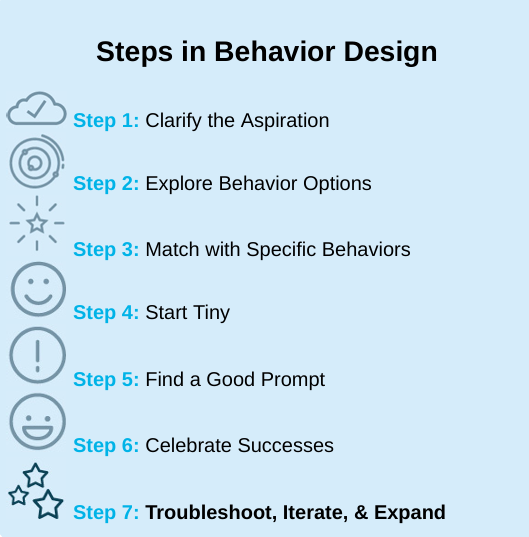
1. Clarify Your Aspirations
Start by identifying your goals and the changes you want to achieve. Clarifying your aspirations sets the foundation for the entire process.
2. Magic Wanding
Explore different behavioral options by brainstorming what you would do if there were no limitations. This step encourages creative thinking and opens up possibilities for change.
3. Find Your Golden Behaviors
Utilize behavioral matching and focus mapping to identify specific behaviors that will help you achieve your goals. These are the key actions that will have the greatest impact on your aspirations.
4. Design a Tiny Action
Create an action that is so small and easy to perform that it becomes a “tiny habit.” This action should align with your motivation and be simple enough to fit seamlessly into your routine.
5. Design a Good Prompt
Select an appropriate prompt that will remind you to perform the tiny habit. The prompt should fit naturally into your existing routine, making it easier to remember.
6. Celebrate Success
After completing your tiny habit, take a moment to celebrate the achievement. This positive reinforcement creates a sense of accomplishment, which Dr. Fogg refers to as “Shine.” Celebrating reinforces the habit and encourages you to continue.
7. Troubleshoot and Expand
As you progress, troubleshoot any challenges you encounter and iterate on your habits. Gradually expand your tiny habits into larger, more significant changes as you build confidence and competence.
Chapter Key Points:
- Habits naturally grow and multiply.
- Tiny successes build profound momentum.
- Shift your identity incrementally.
Chapter 7: Untangling Bad Habits: A Systematic Solution
“Picture a tangled rope that’s full of knots. That’s how you should think about unwanted habits.”
“Breaking” a bad habit is the wrong analogy; they must be systematically “untangled”. Fogg introduces the Behavior Change Masterplan, starting with creating new positive habits to build skills and shift identity. Next, individuals must isolate specific bad habits rather than focusing on vague abstractions. To disrupt them, systematically remove, avoid, or ignore the prompt. If that fails, make the behavior harder to do by altering the Ability Chain. Only as a last resort should you try to adjust motivation or swap the behavior.
Chapter Key Points:
- Untangle, don’t “break,” bad habits.
- Remove or avoid the prompts.
- Make unwanted behaviors intensely difficult.
Chapter 8: How We Change Together
“The habits we create and perpetuate matter.”
Behavior Design isn’t just an individual pursuit; it’s a tool for groups, families, and organizations. Fogg details how leaders can drive group change either as a “Ringleader” (facilitating open, collective Behavior Design sessions) or as a “Ninja” (subtly implementing the principles behind the scenes). By identifying a shared aspiration, mapping Golden Behaviors, streamlining ability, and fostering an environment that celebrates success, organizations can alleviate burnout, improve communication, and fundamentally alter culture. It reinforces that people change best when they feel successful.
Chapter Key Points:
- Design change for entire groups.
- Lead openly or implement ninja-style.
- Feedback must create “Shine.”
Conclusion: The Small Changes That Change Everything
“Habits may be the smallest units of transformation, but they’re also the most fundamental.”
Prompted by personal tragedies and a profound sense of duty, Fogg reflects on his mission to share Behavior Design globally. He reiterates that knowing how behavior actually works allows us to filter out ineffective self-help noise. Ultimately, utilizing Tiny Habits isn’t just about personal optimization; it’s about sharing a scientifically sound, shame-free framework with others to build a more empowered, deeply connected society. Small, joyful shifts can indeed change the world.
Chapter Key Points:
- Share Behavior Design with others.
- Reject shame-based self-help methods.
- Tiny changes ripple globally.
10 Notable Quotes
- “Tiny is mighty. At least when it comes to change.”
- “Our approach to change is [the problem]. It’s a design flaw—not a personal flaw.”
- “You change best by feeling good—not by feeling bad.”
- “Simplicity changes behavior.”
- “Motivation is like a party-animal friend. Great for a night out, but not someone you would rely on to pick you up from the airport.”
- “Emotions create habits. Not repetition. Not frequency. Not fairy dust. Emotions.”
- “Help people do what they already want to do.”
- “Your Behavior Chain is only as strong as its weakest Ability Factor link.”
- “No behavior happens without a prompt.”
- “Habits may be the smallest units of transformation, but they’re also the most fundamental.”
Explore 100 more insightful quotes from this book here
About the Author
BJ Fogg, PhD, is a behavioral scientist, author, and the founder of the Behavior Design Lab at Stanford University. For over two decades, Fogg has researched human behavior, pioneering the Fogg Behavior Model (B=MAP) which explains how motivation, ability, and prompts converge to drive human action. His groundbreaking work has profoundly influenced Silicon Valley; his former students include the co-founders of Instagram, and he has extensively trained industry innovators in health, wellness, and digital product design. Beyond his academic and corporate influence, Fogg created the Tiny Habits Academy, personally coaching tens of thousands of individuals to implement sustainable life changes without relying on sheer willpower. Renowned for his highly optimistic, shame-free approach to self-improvement, Fogg splits his time between Northern California and Maui, continually seeking to empower global change through accessible, scientifically proven behavioral systems.
Deep Diving
Frequently Asked Questions:
- What is the B=MAP model? Behavior occurs when Motivation, Ability, and a Prompt converge simultaneously.
- Why does motivation fail? Motivation fluctuates unpredictably like a wave; it’s unreliable for long-term consistency.
- What is a “Tiny Habit”? A radically small behavior, like flossing one tooth, that requires almost zero willpower.
- What is a “Golden Behavior”? An effective behavior you actively want to do and can easily execute.
- What is an “Anchor”? An existing daily routine used as an Action Prompt for a new habit.
- What is “Shine”? The authentic, positive feeling of success generated by immediate celebration.
- Do habits take 21 days to form? No. Emotions, not just repetition, dictate how quickly habits form.
- How do I break a bad habit? “Untangle” it systematically by removing prompts and making the behavior physically/mentally difficult.
- What is the “Maui Habit”? Saying “It’s going to be a great day” the moment your feet touch the floor every morning.
- Can I use Tiny Habits on others? Yes, by helping them do what they already want to do and celebrating their successes.
Theories and Concepts:
- The Fogg Behavior Model (B=MAP): The fundamental principle that Behavior is the result of Motivation, Ability, and Prompts happening at once.
- The Action Line: The curved line on the Behavior Model graph; behaviors prompted above this line succeed, while those below it fail.
- Information-Action Fallacy: The flawed belief that simply giving people information will alter their behavior.
- Focus Mapping: A brainstorming method to identify “Golden Behaviors” based on impact and feasibility.
- The Ability Chain: The five factors making a behavior hard: time, money, physical effort, mental effort, and routine.
- Reward Prediction Error: A neurochemical dopamine release occurring when an unexpected positive emotion (“Shine”) reinforces a new behavior.
- Spectrum of Automaticity: The scale measuring how behaviors shift from deliberate decisions to automatic habits through emotional reinforcement.
Books and Authors:
- Shel Silverstein: Mentioned in the context of his poem about Melinda Mae eating a whale “one bite at a time,” illustrating the power of incremental progress over the “go big or go home” myth.
- Marie Kondo (The Life-Changing Magic of Tidying Up): Fogg cites her book’s global success not as a tool motivating people to clean, but as an instruction manual that skillfully teaches the specific ability and steps to tidy.
- Ramit Sethi: Mentioned in a Tiny Habit recipe example regarding reading about personal finance to build better college routines.
Persons:
- Mike Krieger & Kevin Systrom: Fogg’s former students who co-founded Instagram by perfectly applying Behavior Design (making photo sharing incredibly simple and rewarding).
- Amy: An educational-media writer who used Tiny Habits (like writing her top priority on a Post-it note) to save her business and build resilience during a bitter divorce.
- Juni: A radio host who successfully untangled her deep-seated sugar addiction by addressing her grief and incrementally redesigning her environment.
- Linda (Fogg-Phillips): BJ Fogg’s sister, who utilized the “Maui Habit” and “Celebration Blitzes” to overcome severe family tragedies and bankruptcy, eventually becoming a Tiny Habits coach.
- Sukumar: An IT expert who scaled a tiny two-push-up habit into a transformative 50-push-up routine, fundamentally shifting his identity to beat a 17-year weight struggle.
How to Use This Book:
Use this book as a personal laboratory for experimentation. Map out your aspirations, scale behaviors down to ridiculously easy “Starter Steps,” anchor them to existing routines, and deliberately celebrate. Troubleshoot failures systematically by tweaking prompts and ability, eliminating self-judgment entirely.
Once you grasp the core concepts of the Fogg Behavior Model, tiny habits, and behavioral design, you can apply these principles to various aspects of your life:
- Untangling Unwanted Habits: Use the three phases of behavioral design to break free from bad habits.
- Collective Behavior Change: Implement behavioral changes at a group level, either by co-designing changes with others or subtly influencing their behaviors.
- Creating Small Changes: Focus on multiple small changes that can snowball into transformative results.
Want to be the best 1% achiever! Find the 1% Blueprint resources here.
Conclusion:
Transforming your life doesn’t require heroic willpower; it requires smart, compassionate behavior design. Stop judging yourself, start mapping your tiny habits today, and watch your daily routines shift the world around you. Design your first tiny habit today and instantly celebrate your way to success!