The Things You Can See Only When You Slow Down by Haemin Sunim
Most professionals are stuck in a ‘technician’s trap’—running faster but achieving less. This guide provides the system to move beyond the whirlwind and reclaim your executive focus.
Welcome to this book summary episode on The Things You Can See Only When You Slow Down by Haemin Sunim. This work addresses the modern epidemic of burnout by teaching that our reality is shaped entirely by where our mind chooses to focus,. It solves the problem of chronic busyness by showing that when we slow down, we move beyond the “whirlwind” of our thoughts to discover a core of peace and clarity.
Who May Benefit
- Overwhelmed professionals seeking work-life balance and mental clarity.
- Individuals struggling with negative emotions like anger, hatred, or jealousy.
- Those navigating difficult relationship dynamics, betrayal, or heartbreak,.
- Students and young adults searching for their true calling and identity.
- Spiritual seekers looking for universal wisdom that transcends religious boundaries.
Top 3 Key Insights
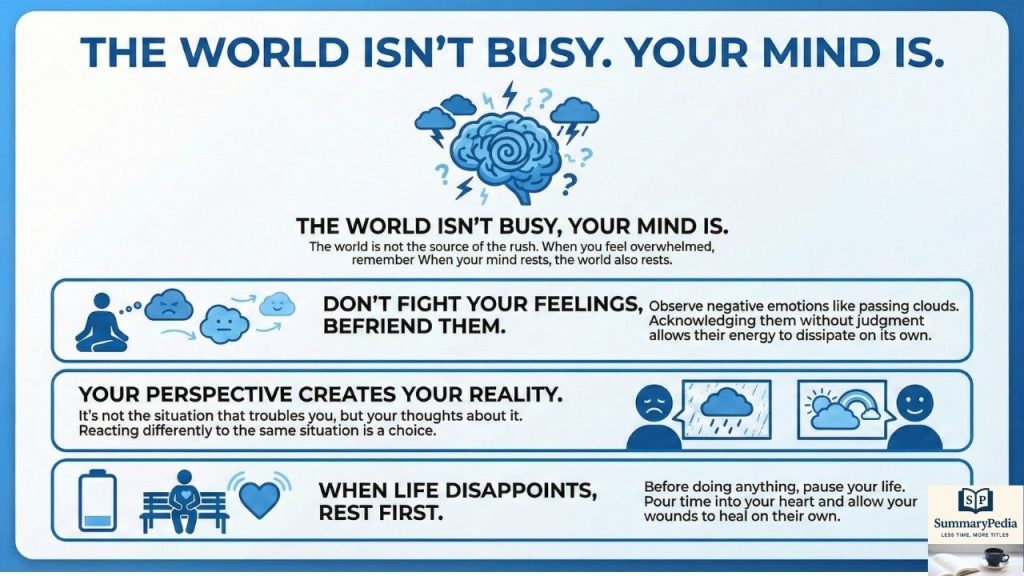
- Your mind’s state dictates your reality; when you rest your mind, the external world rests with you.
- Befriend negative emotions by witnessing their raw energy without attaching to static linguistic labels.
- True effectiveness requires tempering overzealous passion with the wisdom to see others’ needs.
4 More Takeaways
- Maintain relationships like a fireplace: stay close for warmth, but leave space to avoid burning out.
- Forgiveness is a necessary act of self-liberation to free yourself from emotional bondage.
- Find happiness in ordinary hours, like commuting or chores, rather than only extraordinary achievements.
- Skilled leadership involves delegation and listening over the trap of micromanagement,.
Book in 1 Sentence
A Zen monk’s guide to mindfulness, offering bite-sized meditative insights to help busy people find peace, self-compassion, and stronger relationships,.
Book in 1 Minute
Haemin Sunim explores how the frantic pace of modern life often stems from a restless mind rather than external circumstances. Acting as a “healing mentor,” the book guides readers through eight core areas—including rest, mindfulness, passion, and relationships—to show that the world we perceive is a limited reflection of our mind’s specific interests,,. By cultivating a “silent observer” within, we can witness negative emotions without being swept away by them,. The text offers a mindset of radical acceptance, encouraging us to love our own “ordinariness” and forgive those who have hurt us for our own liberation,. Ultimately, it offers the outcome of becoming “one with the truth” through a playful, relaxed embodiment of wisdom rather than constant, exhausting striving.
1 Unique Aspect
The book utilizes a “healing mentor” approach, combining personal essays with short, bite-sized meditative prompts intended to be lingered over,. It bridges the gap between traditional Zen training and the digital world by adapting social media teachings into a structured guide for calm.
Chapter-wise Summary
This book helps overwhelmed high-performers achieve mental clarity without burning out on the corporate treadmill.
CHAPTER 1: Rest
“When your mind rests, the world also rests”.
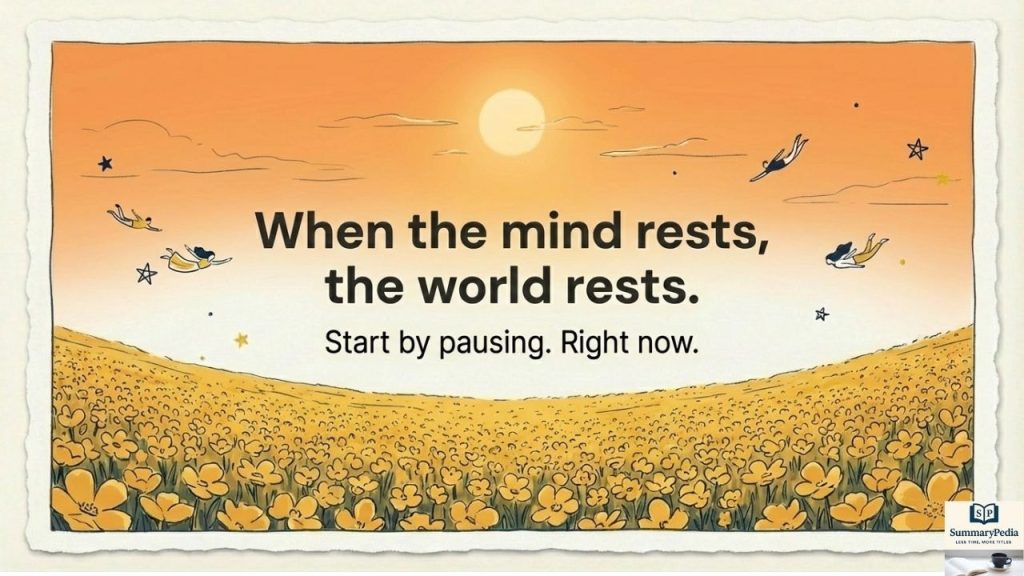
Sunim posits that “mind” and “world” are not independent; rather, the boundary between them is thin and porous. We perceive a limited reality based on what our mind cares about; therefore, what our mind focuses on becomes our world,. If we feel busy and overwhelmed, it is often our mind that is a “whirlwind,” not the world itself. By choosing where to focus, we can experience a world that corresponds to a peaceful internal state,.
- Mind projects reality.
- Rest starts internally.
- Perspective creates stress.
CHAPTER 2: Mindfulness
“Observe and befriend [your emotions]”.
The author advises against suppressing negative emotions, which only causes them to resurface later with more force. Instead, one should peel off linguistic labels like “anger” and witness the raw, changing energy behind them. By observing these feelings dispassionately, like clouds passing in a wide-open sky, we realize they are temporary and not a defining part of our self,. This inward focus allows us to find a still center.
- Witness raw energy.
- Detach from labels.
- Embrace the witness.
CHAPTER 3: Passion
“Being right isn’t nearly as important as being happy together”.
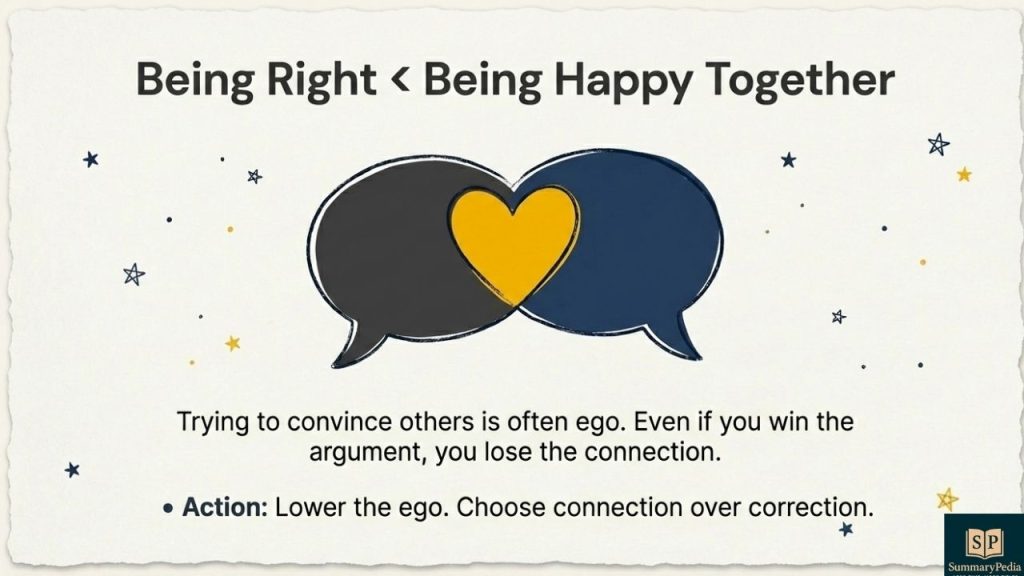
Sunim reflects on his early career as a professor, sharing how his overzealousness was actually “poisonous” to his students. He emphasizes that eagerness does not always equate to effectiveness; sometimes, overflowing passion can get in the way of achieving desired outcomes if we fail to see the needs of others. Maturity involves curbing the ego’s desire to be right and focusing instead on working harmoniously with those around us,.
- Eagerness ≠ effectiveness.
- Curb the ego.
- Work harmoniously.
CHAPTER 4: Relationships
“The best revenge is love”.
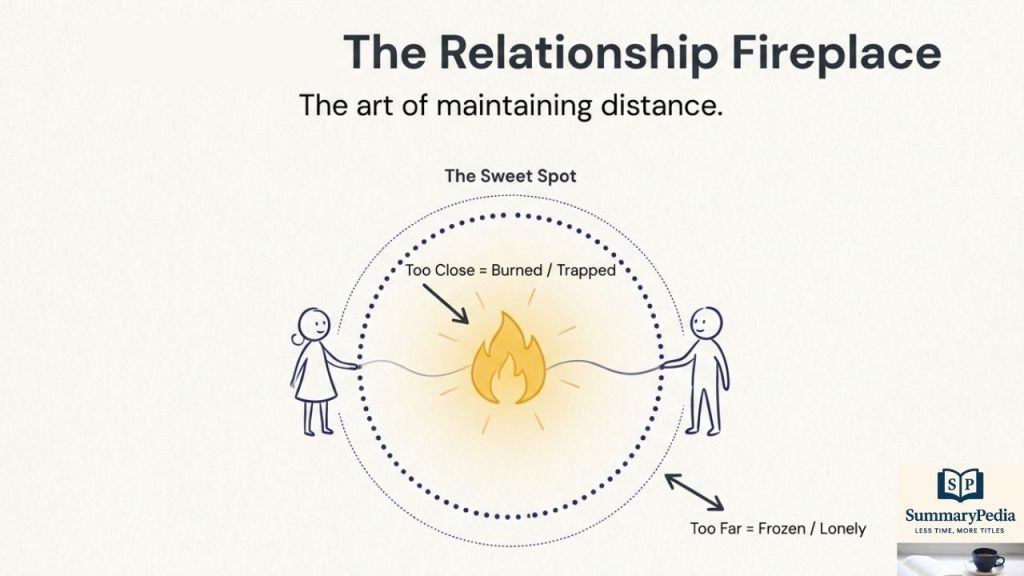
Maintaining healthy relationships requires a balance of warmth and distance, much like sitting by a fireplace; too close, and you get burned; too far, and you feel no warmth. Sunim argues that pride is the primary source of conflict and that treating others with humility can avoid most “battles of wills”. Furthermore, forgiveness is presented as a gift to oneself, allowing a person to be free from emotional bondage.
- Fireplace balance.
- Forgive for freedom.
- Humility avoids conflict.
CHAPTER 5: Love
“Love means loving someone the way she is”.
Through the lens of Kahlil Gibran’s poetry and his own “first love,” Sunim explores love as an uninvited guest that arrives and leaves regardless of our will,. He stresses that real love involves accepting another’s “ordinariness” and unique self without attempting to “improve” them based on personal desires,. Love is the power to stop the world for a moment and find beauty in the present.
- Release demands.
- Love is presence.
- Accept ordinariness.
CHAPTER 6: Life
“There are many more ordinary hours in life than extraordinary ones”.
Sunim argues that identity should be rooted in a person’s current vision and skills rather than their past background or prestigious alma mater,. He encourages finding joy in “ordinary hours”—waiting in line or commuting—rather than only searching for extraordinary milestones,. He also shares “three liberating insights,” including the realization that people are not as interested in us as we think, which frees us to follow our own hearts,.
- Ordinary hours matter.
- Beyond social markers.
- Dream big, start small.
CHAPTER 7: The Future
“Live your life not to satisfy others, but to fulfill what your heart desires”.
Finding a calling requires self-awareness, which is best gained by interacting with a wide range of people and trying various real-life experiences like internships or volunteering,. Sunim shares how a single word of encouragement from a teacher changed his entire life trajectory. He advises readers to take a “leap of faith” rather than waiting for 100 percent certainty, which rarely comes,.
- Experience builds awareness.
- Encouragement transforms lives.
- Don’t overthink, leap.
CHAPTER 8: Spirituality
“Faith is overvalued while practice is undervalued”.
Truth has a universal quality that allows people of different traditions to recognize it. Sunim highlights similarities between Buddhist meditation and Christian silent prayer, arguing that true spirituality focus on changing one’s heart rather than sticking to outward rituals,. He urges readers to cultivate critical, emotional, and spiritual intelligence to avoid the traps of cults or a lack of empathy.
- Universal truth exists.
- Practice over ideology.
- Humble self-checking.
10 Notable Quotes
- “When your mind rests, the world also rests”.
- “The world we see is not the entire universe but a limited one that the mind cares about”.
- “Pure attention without judgment is… the expression of love”.
- “No person is always good or bad”.
- “Humility is a sign of inner strength and wisdom”.
- “Being right isn’t nearly as important as being happy together”.
- “If you lower your head, you won’t bump into trouble”.
- “Demonstrations of love are small, compared with the great thing that is hidden behind them”.
- “Knowledge wants to talk. Wisdom wants to listen”.
- “You are the owner of your life. Value yourself first”.
About the Author
Haemin Sunim is one of the most influential Zen Buddhist teachers and writers in South Korea, where his books have sold over three million copies. Born in South Korea, he moved to the United States to study film, but found himself pulled toward the spiritual life. He was educated at UC Berkeley, Harvard, and Princeton, blending rigorous academic training with formal monastic discipline in Korea. Sunim served as a professor of Buddhism at Hampshire College in Massachusetts for several years before returning to Seoul,. He is widely known as a “healing mentor” due to his massive social media presence—reaching over a million followers on Twitter and Facebook,. His work is celebrated for providing simple, straightforward guidance on overcoming the stresses of modern life through mindfulness, self-compassion, and deep human connection.
How to Use This Book
Read this book slowly rather than quickly, allowing time to reflect on each chapter. Use the meditation prompts and color illustrations as calming interludes during your busy day. Apply the “three liberating insights” to stop worrying about others’ opinions and prioritize your own heart’s desires.
Conclusion
Haemin Sunim reminds us that wisdom arises naturally when we stop chasing the world and start noticing what is already there. By befriending the “silent observer” within, we find the peace necessary to navigate a hectic life with grace and authenticity,. Slow down today and see the beauty you’ve been missing!