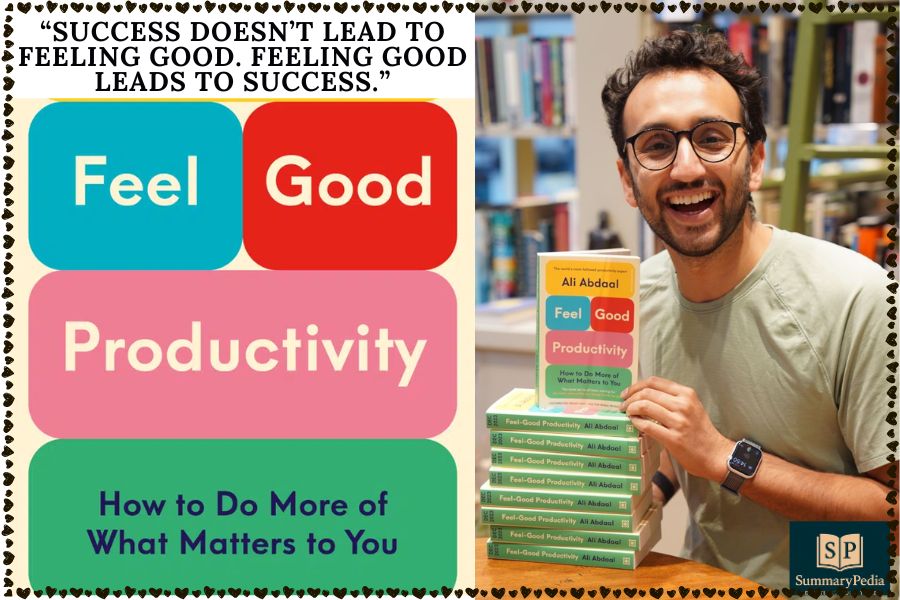
Feel-Good Productivity by Ali Abdaal
Are you tired of feeling burned out by the relentless grind of traditional productivity? Ali Abdaal’s Feel-Good Productivity offers a revolutionary approach, arguing that success doesn’t lead to happiness, but the reverse: feeling good drives achievement. This book matters today because it provides a highly structured and sustainable alternative to the exhausting cycle of simply working harder.
Who May Benefit
- Overworked professionals and junior doctors.
- Chronic procrastinators and those battling inertia.
- Students seeking better performance and motivation.
- Entrepreneurs/Business leaders focused on culture.
- Individuals seeking sustained happiness and energy.
Top 3 Key Insights
- Success stems from feeling good, not constant suffering; well-being drives focus and motivation by leveraging the three Energizers: Play, Power, and People.
- Overcome procrastination by employing the Unblock Method, which tackles emotional barriers like uncertainty, fear, and inertia head-on rather than relying solely on motivation or discipline.
- Ensure long-term achievement and avoid burnout by developing Sustainers: learning to conserve energy, recharge effectively, and align actions with core personal values.
4 More Takeaways
- Use the Comrade Mindset to foster relational energy, treating peers as allies working toward shared goals rather than competitors.
- Reduce friction in your environment and use the five-minute rule to overcome the starting obstacle of inertia.
- Reframe failures as non-disastrous data points to lower the stakes and foster a playful, experimental approach to life.
- Boost motivation by setting NICE goals (Near-term, Input-based, Controllable, Energizing) over rigid, outcome-focused SMART goals.
Book in 1 Sentence
Productivity flourishes when fueled by positive emotions, using Play, Power, and People to overcome emotional barriers and achieve sustainable success.
Book in 1 Minute
This book challenges the “work harder” myth, tracing the author’s journey from a burnt-out junior doctor drowning in paperwork to discovering the science of Feel-Good Productivity. Drawing on psychology (like Fredrickson’s “broaden-and-build” theory) and neuroscience, it asserts that positive emotions drive success. The approach is divided into three parts: finding Energizers (Play, Power, People), removing Blockers (uncertainty, fear, inertia), and developing Sustainers (conserve, recharge, align). By focusing on well-being first, readers learn to cultivate motivation, creativity, and energy, leading to meaningful, long-term achievement without sacrificing happiness.
1 Unique Aspect
The book’s core insight is that productivity is an experimental journey, urging readers to become “productivity scientists” who test different tactics—like the “Batman Effect” or “Reitoff Principle”—to discover what uniquely enhances their mood and performance.
Chapter Summary
CHAPTER 1: PLAY
“In every job that must be done, There is an element of fun. You find the fun and snap! The job’s a game.”
Play is the first energizer, shifting life from feeling stressful to feeling fun, boosting creativity and productivity. Nobel laureate Richard Feynman rediscovered his passion for physics when he stopped working for significance and started playing with concepts like a wobbling plate, illustrating the power of curiosity. Integrating play involves finding adventure by adopting one of the 8 Play Personalities (like the Explorer or Creator) and seeking “side quests” in daily life. The “Magic Post-It Note” method, asking “What would this look like if it were fun?” allows you to inject enjoyment into mundane tasks. Crucially, play requires lowering the stakes by reframing failure as merely collecting “data points” rather than suffering penalties, fostering sincerity over crippling seriousness.
Chapter Key Points
- Play drives creativity and productivity.
- Embrace curiosity via “side quests”.
- Reframing failure lowers stakes.
CHAPTER 2: POWER
“Believing you can is the first step to making sure you actually can.”
Power, the second energizer, means personal empowerment—the sense that your job and life are in your control. This control is built by boosting self-confidence (or self-efficacy), a malleable trait that greatly affects performance. You can learn confidence by flipping the confidence switch (behaving as if you are competent, even if you don’t feel it internally) and employing the Social Model Method (vicarious mastery—gaining confidence by witnessing others succeed). To level up skills, adopt the Zen concept of Shoshin (beginner’s mind) to maintain curiosity and leverage the Protégé Effect (teaching others to deepen your own learning). The final step is taking ownership by focusing on how you do things, even when the what is dictated by others, and changing your mindset from “have to” to “choose to”.
Chapter Key Points
- Self-confidence is a learned skill.
- Adopt the beginner’s mind (Shoshin).
- Shift from “have to” to “choose to”.
CHAPTER 3: PEOPLE
“Life is more fun with friends around.”
People are the third energizer, providing vital relational energy that uplifts mood and motivation. Harness this energy by finding your scene and cultivating a Comrade Mindset, viewing peers as allies rather than competitors. Even working in synchrony—side-by-side on different tasks—can boost camaraderie. The Helper’s High confirms that giving help (Random Acts of Kindness) and asking for help (the Benjamin Franklin effect) energizes both parties, making requests a gift rather than a burden. Effective relationships require overcommunicating, especially by using an active-constructive approach to celebrate good news (capitalization) and offering candid feedback rooted in objective facts rather than subjective judgments.
Chapter Key Points
- Use the Comrade Mindset.
- Helping provides a “helper’s high”.
- Overcommunicate actively and constructively.
CHAPTER 4: SEEK CLARITY
“If you don’t know when you’re doing something, chances are you won’t do it.”
The first productivity blocker is uncertainty, which leads to “uncertainty paralysis” when we are overwhelmed by unknowns. The unblock method tackles this by seeking absolute clarity. First, ask “why?” by defining your ultimate mission or purpose (like military Commander’s Intent). Use the Japanese Five Whys method to ensure every task aligns with this deeper goal. Second, ask “what?” by setting NICE goals (Near-term, Input-based, Controllable, Energizing), focusing on the process rather than outcomes, which is particularly helpful if SMART goals cause stress. Use the Crystal Ball Method (a pre-mortem) to proactively identify potential obstacles before they derail the plan. Finally, ask “when?” using Implementation Intentions (“If X happens, then I will Y”) and rigorous Time Blocking to schedule your priorities.
Chapter Key Points
- Uncertainty causes decision paralysis.
- Define purpose with Commander’s Intent.
- Set NICE goals (Near-term, Input-based, Controllable, Energizing).
CHAPTER 5: FIND COURAGE
“It isn’t lack of talent or inspiration that’s holding you back. It’s fear.”
Fear, the second blocker, triggers the amygdala hijack, urging us to avoid perceived threats. Finding courage begins with knowing your fear through affective labelling—putting anxieties into words. Follow this by assigning yourself a positive identity label (e.g., “lifelong learner”) to replace paralyzing self-doubt. Next, reduce your fear by gaining perspective; the 10/10/10 rule helps stop catastrophic thinking by evaluating whether the failure will matter in 10 minutes, 10 weeks, or 10 years. To overcome fear of judgment, recognize the Spotlight Effect: we drastically overestimate how much others notice and care about our mistakes. In high-stakes moments, harness the Batman Effect by stepping into an alter ego (like Beyoncé’s Sasha Fierce) to channel courage and determination.
Chapter Key Points
- Label your emotions (affective labelling).
- Use the 10/10/10 rule to gain perspective.
- Overcome the Spotlight Effect.
CHAPTER 6: GET STARTED
“An object at rest stays at rest, while an object in motion stays in motion, unless acted on by an external imbalanced force.”
The final blocker is inertia, rooted in Newton’s First Law of Motion, proving that it takes more energy to start than to continue. Overcoming inertia involves reducing environmental and emotional friction. Environmental friction is reduced by tweaking your surroundings to make the desired activity the default choice, such as moving a guitar into the living room. Emotional friction is tackled using the five-minute rule: commit to a task for just five minutes, knowing you can stop afterward (though you often won’t). Cultivate a bias to action by defining the precise, concrete Next Action Step (e.g., “turn on laptop” instead of “write book”). Finally, support yourself long-term by tracking progress to maintain momentum and finding an accountability buddy to leverage social obligation.
Chapter Key Points
- Reduce friction to make starting easier.
- Use the five-minute rule consistently.
- Find an accountability buddy.
CHAPTER 7: CONSERVE
“Breaks aren’t a special treat. They’re an absolute necessity.”
This chapter addresses overexertion burnout, which stems from doing too much, too fast. The solution is to conserve energy, mirroring high-performing athletes like LeBron James, who strategically walk during games to ensure longevity. To do less, resist overcommitment by creating an Energy Investment Portfolio—limiting your active projects to single digits and applying the “hell yeah or no” filter to new requests. To resist distraction, add friction (making unwanted actions harder, like using a slow app overlay) and practice correcting course by embracing the mantra “Begin again”. Finally, break more by scheduling rest periods; highly productive workers often follow a 52-minutes-of-work-to-17-minutes-of-rest ratio, recognizing that breaks are a necessity to replenish self-regulatory resources.
Chapter Key Points
- Limit active projects (Energy Portfolio).
- Use friction to resist distractions.
- Schedule frequent, proper breaks.
CHAPTER 8: RECHARGE
“Nature replenishes our cognitive abilities and boosts our energy.”
Depletion burnout results from failing to use downtime effectively, often engaging in draining activities like “doomscrolling”. To truly rejuvenate, you must recharge creatively using CALM activities (Competence, Autonomy, Liberty, Mellowing). Hobbies or projects must be enjoyed purely for the process, with low stakes, to avoid turning rest into another form of work. Next, recharge naturally; research shows that connecting to nature—even just viewing a photograph of trees or listening to natural soundscapes—lowers stress and restores concentration. Finally, allow for mindless recharging by scheduling moments of “nothingness” to activate the Default Mode Network (DMN), which enables problem-solving and creativity. Embrace the Reitoff Principle to eliminate guilt by intentionally “writing off” a tired day for reset.
Chapter Key Points
- Use CALM hobbies for rest.
- Connect with nature frequently.
- Allow mind-wandering (DMN).
CHAPTER 9: ALIGN
“When people make decisions that align with their personal values and sense of self, they aren’t just happier; they’re more engaged with the tasks before them.”
Misalignment burnout occurs when our goals conflict with our core sense of self, requiring alignment for sustained feel-good productivity. Alignment starts with the long-term horizon: use the Eulogy Method (imagining your funeral) to identify intrinsic values and prioritize what truly matters over external rewards like money or status. On the medium-term horizon, use tools like the Odyssey Plan to sketch out radically different five-year paths and the Wheel of Life to visually assess alignment across health, work, and relationships. Then, focus on the short-term horizon by setting Three Alignment Quests each morning—small, proximate actions (like calling your grandma or going to the gym) that move you closer to your year-long goals. This entire process is an ongoing Alignment Experiment, requiring constant testing and learning.
Chapter Key Points
- Misalignment causes burnout.
- Define long-term values (Eulogy Method).
- Set Three Alignment Quests daily.
10 Notable Quotes
- “Success doesn’t lead to feeling good. Feeling good leads to success.”
- “Positive emotions are the fuel that drives the engine of human flourishing.”
- “No failure is ever just a failure. It’s an invitation to try something new.”
- “If the treatment isn’t working, question the diagnosis.”
- “I hated every minute of training, but I said, ‘Don’t quit. Suffer now and live the rest of your life as a champion.’”
- “Don’t be serious. Be sincere.”
- “We rise by lifting others.”
- “You don’t need to be a guru. You can just be a guide.”
- “You can focus on the small losses. Or you can celebrate the small wins.”
- “Everything can be taken from a man but one thing: the last of the human freedoms – to choose one’s attitude in any given set of circumstances, to choose one’s own way.”
About the Author
Ali Abdaal is a doctor, entrepreneur, and amateur magician known as the world’s most-followed productivity expert. He became fascinated by productivity science while struggling to juggle medical training at the University of Cambridge with building his business. His journey began when he struggled as a junior doctor in the UK’s National Health Service, realizing his “work harder” strategy was unsustainable and depressing. Since 2017, Abdaal has documented his journey toward a healthier, happier, more productive life online. In 2021, he took a break from medicine to focus full-time on popularizing the evidence-based science of human flourishing and high performance through videos, podcasts, and articles that have reached hundreds of millions globally.
How to Use This Book
Approach this book as a productivity scientist, testing the provided strategies and “experiments” in your own life to build a personalized toolkit for feeling good and achieving more.
Conclusion
Productivity isn’t a relentless race; it’s a practice of alignment, joy, and energy conservation. By harnessing the feel-good emotions that drive engagement and resilience, you transform daunting tasks into engaging challenges and ensure success is sustainable. Stop hustling your way to happiness, and start experimenting your way to a life you love. Your feel-good adventure begins now!