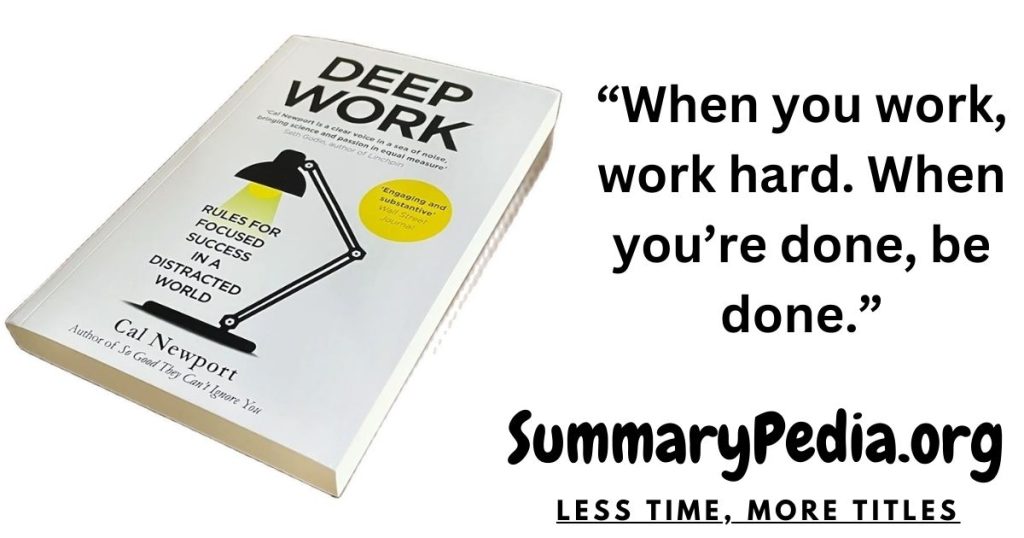
Deep Work: Rules for Focused Success in a Distracted World
In today’s fast-paced world, distractions are everywhere—emails, social media, and the constant buzz of technology often pull us away from tasks that demand deep focus. Deep Work: Rules for Focused Success in a Distracted World by Cal Newport reveals that the ability to focus without distraction on a cognitively demanding task is a rare, highly valuable skill. The book solves the modern problem of network tools fragmenting our attention and replacing meaningful productivity with superficial busyness. Mastering this skill matters today because, in a competitive global economy, deep work is the ultimate superpower required to learn hard things quickly and produce at an elite level.
Super Summary
Who May Benefit
- Knowledge workers seeking peak professional productivity.
- Creatives and writers struggling with digital distraction.
- Professionals wanting to master hard, complex skills quickly.
- Entrepreneurs looking to maximize high-value output.
- Students aiming for elite academic performance.
Top 3 Key Insights
- Deep work accelerates complex learning.
- Busyness is a false proxy for productivity.
- Network tools permanently reduce your concentration.
4 More Takeaways
- Willpower is finite; use deep work rituals.
- Embrace boredom to train focus.
- Assess tools using a strict craftsman approach.
- Schedule every minute to limit shallowness.
Book in 1 Sentence
Deep Work argues that unbroken concentration is a 21st-century superpower, offering a systematic guide to eliminating distraction and maximizing elite-level productivity.
Book in 1 Minute
Cal Newport’s Deep Work explores the urgent necessity of distraction-free concentration in a world obsessed with superficial digital engagement. The book is divided into two distinct parts: the idea and the rules. First, Newport establishes that deep work—cognitively demanding tasks that create new value—is becoming increasingly rare precisely as it becomes universally valuable in the new information economy. We are losing our ability to focus due to the siren song of social media, constant email, and open-plan offices.
Second, Newport provides four rigorous rules to help you rewire your habits: Work Deeply, Embrace Boredom, Quit Social Media, and Drain the Shallows. By adopting these philosophies, readers cultivate a mindset of intentionality. The outcome is not just an explosion of high-quality professional output, but a life rich with profound meaning and satisfaction.
One Unique Aspect
Unlike typical productivity advice that advocates for minor “digital detoxes,” Newport insists on structurally categorizing all work as either “deep” or “shallow”. He demands the implementation of rigid, almost monastic daily rituals to aggressively protect depth.
Chapter-wise Summary
Chapter-wise Summary
Chapter One: Deep Work Is Valuable
“If you don’t produce, you won’t thrive—no matter how skilled or talented you are.”
This chapter establishes that we are in the early throes of a “Great Restructuring” driven by digital technology. In this new economy, three specific groups will reap a disproportionate amount of the benefits: high-skilled workers capable of working with complex machines, superstars who are the absolute best in their field, and the owners who invest capital. To join the ranks of the high-skilled or the superstars, you must cultivate two core abilities. Because modern technologies change rapidly and are highly complex, you must be able to master hard things quickly. Furthermore, you must transform that learning into tangible value by producing at an elite level. Both of these abilities fundamentally depend on your capacity for deep work.
The Formula for Elite Production: To produce at an elite level, you must consolidate your work into intense and uninterrupted pulses. This leads to the core law of productivity:
- High-Quality Work Produced = (Time Spent) x (Intensity of Focus). By maximizing your intensity of focus during work sessions, you maximize the results produced per unit of time spent. Switching between tasks leaves an “attention residue” that significantly dampens your cognitive performance, proving that semi-distracted work is devastating to peak output.
In the new information economy, driven by a digital “Great Restructuring,” three specific groups are perfectly positioned to thrive and capture a disproportionate amount of wealth:
- The High-Skilled Workers: As technology rapidly advances, individuals who possess the ability to quickly master and work creatively with complex intelligent machines become incredibly valuable. Innovations like advanced analytics and data visualization amplify their data-driven reasoning, allowing them to extract highly lucrative results from these systems.
- The Superstars: High-speed networks and remote collaboration tools have destroyed regional barriers in the talent market. Instead of settling for local employees, companies can now seamlessly hire the absolute best individuals in the world. In this universally accessible “winner-take-all” market, elite performers capture the bulk of the rewards because top-tier talent cannot be replicated by simply combining multiple mediocre workers.
- The Owners: Individuals with capital to invest in the new technologies driving this economic shift enjoy unprecedented returns. Because modern digital companies require significantly less human labor to generate massive value (e.g., a billion-dollar tech startup employing only a dozen people), a much larger proportion of the generated wealth flows directly back to the investors who own the technology.
Chapter Key Points:
- Deep work accelerates complex learning.
- Attention residue destroys peak performance.
- Elite production requires intense focus.
Chapter Two: Deep Work Is Rare
“In the absence of clear indicators of what it means to be productive and valuable in their jobs, many knowledge workers turn back toward an industrial indicator of productivity: doing lots of stuff in a visible manner.”
Despite its immense value, deep work is becoming increasingly rare due to the rise of open-plan offices, instant messaging, and the expectation of constant connectivity. Businesses mistakenly encourage these depth-destroying behaviors because of the “metric black hole”—a reality where the negative impacts of distraction and the bottom-line value of deep work are exceedingly difficult to measure. Without clear metrics, knowledge workers fall back on “The Principle of Least Resistance,” defaulting to behaviors that are easiest in the moment, like rapid e-mail responses or standing meetings. Finally, an overarching “Cult of the Internet” creates a technopoly where any high-tech tool or social media network is automatically assumed to be inherently good and necessary, making the rejection of distraction seem culturally unacceptable.
Chapter Key Points:
- Busyness often masks unproductivity.
- Open offices destroy deep concentration.
- Metrics for depth are elusive.
Chapter Three: Deep Work Is Meaningful
“A deep life is a good life, any way you look at it.”
This chapter proves that a life built around deep work is fundamentally fulfilling by drawing on neuroscience, psychology, and philosophy. Neurologically, your worldview is constructed by what you pay attention to. Spending significant time in rapt attention on deep endeavors prevents your mind from noticing the smaller, less pleasant, and stressful trivialities that populate modern life. Psychologically, humans are at their best and happiest when their minds are stretched to their limits in a state of “flow”. Philosophically, adopting a craftsman’s approach to your knowledge work frees you from modern nihilism. Whether you are a blacksmith or a computer programmer, honing your skill allows you to uncover meaning and sacredness in your daily professional efforts.
Chapter Key Points:
- Focus dictates your life’s quality.
- Flow states maximize human happiness.
- Craftsmanship creates profound meaning.
Rule #1: Work Deeply
“The key to developing a deep work habit is to move beyond good intentions and add routines and rituals to your working life designed to minimize the amount of your limited willpower necessary to transition into and maintain a state of unbroken concentration.”
Because willpower is a finite resource that drains as you use it, you cannot rely on sheer motivation to concentrate. You must carefully design rituals and deploy robust frameworks to integrate deep work into your schedule.
The 4 Depth Philosophies (Framework): You must choose a scheduling philosophy that fits your specific career and lifestyle.
- The Monastic Philosophy: This approach attempts to maximize deep efforts by radically eliminating or minimizing all shallow obligations. It is ideal for those with a singular, highly valued professional goal (like a novelist or theoretical scientist) whose success depends entirely on doing one thing exceptionally well.
- The Bimodal Philosophy: This approach asks that you divide your time, dedicating clearly defined stretches to deep pursuits and leaving the rest open for shallow tasks. To achieve maximum cognitive intensity, the minimum unit of time for a deep stretch in this philosophy is at least one full day.
- The Rhythmic Philosophy: This approach generates a simple, regular habit to remove the friction of deciding when to go deep. A common implementation is the “chain method” (doing the work every day and marking it on a calendar) or setting a strict, non-negotiable starting time for deep work every single morning.
- The Journalistic Philosophy: This approach involves fitting deep work into your schedule wherever you can find free time. It requires you to switch your mind into a deep mode on a moment’s notice, which demands significant practice and high confidence in your abilities.
The 4 Disciplines of Execution (4DX Framework): Adapted from the business world, this framework helps you execute your deep work strategy effectively.
- Focus on the Wildly Important: Identify a small number of highly ambitious outcomes to pursue with your deep work hours. This simplicity focuses your energy and stokes your motivation.
- Act on the Lead Measures: Measure your success using “lead measures” (time spent in a state of deep work) rather than “lag measures” (like papers published), because lead measures are behaviors you can directly control in the short term.
- Keep a Compelling Scoreboard: Create a physical artifact in your workspace to publicly track your deep work hours. Tallying your hours and circling milestones visually connects your effort to tangible results.
- Create a Cadence of Accountability: Implement a regular rhythm of review, such as a weekly review session. Use this time to examine your scoreboard, celebrate successes, understand failures, and plan your schedule for the days ahead.
The Strict Shutdown Ritual (Step-by-Step Guide): To ensure your brain recharges its finite directed attention, you must completely disconnect from work at the end of the day. Incomplete tasks naturally dominate your attention (the Zeigarnik effect), so you must use a strict algorithm to close all open loops.
- Take a final look at your e-mail inbox to ensure no urgent responses are required.
- Transfer any new tasks scribbled throughout the day into your official task lists.
- Skim every task in every list and review your calendar for the next few days.
- Make a rough plan for the next day based on this review.
- Say a specific set phrase out loud, such as “Shutdown complete,” to signal to your brain that it is safe to release work thoughts.
Chapter Key Points:
- Willpower is a finite resource.
- Match a philosophy to your lifestyle.
- Execute goals like a business.
Rule #2: Embrace Boredom
“The ability to concentrate intensely is a skill that must be trained.”
You cannot simply decide to focus if your brain has been rewired to crave distraction. If you relieve every moment of potential boredom with a quick glance at your smartphone, your attention-selecting muscles atrophy. You must simultaneously train your concentration and wean your mind off its addiction to novelty.
Schedule Internet Blocks (Step-by-Step Guide):
- Keep a notepad near your computer at work.
- Schedule in advance exactly when you will use the Internet, and record the next allowed time on the pad.
- Avoid all network connectivity entirely outside of these specific times.
- If you desperately need online information during an offline block, you must wait. If waiting is impossible, change your schedule to make the next Internet block sooner, but enforce at least a five-minute gap of offline waiting before logging on.
Work Like Teddy Roosevelt (Framework): Inject occasional interval training into your workday by mimicking Theodore Roosevelt’s blistering study habits.
- Identify a deep task that is high on your priority list.
- Estimate how long it would normally take to complete.
- Give yourself a hard deadline that drastically reduces this estimated time.
- Commit publicly to the deadline or set a visible countdown timer.
- Attack the task with unwavering intensity, taking zero breaks for distraction, to beat the buzzer.
Meditate Productively (Step-by-Step Guide): Use periods where you are physically occupied but mentally free (like walking or commuting) to focus your attention on a single professional problem.
- Be wary of distractions and looping: When your mind rebels with unrelated thoughts or loops over known information to avoid deep thinking, gently redirect your attention back to the next step.
- Structure your deep thinking: First, carefully review the relevant variables for the problem and store them in your working memory.
- Next, define the specific “next-step question” you need to answer.
- Finally, consolidate your gains by clearly reviewing the answer you identified before starting the cycle over.
Chapter Key Points:
- Boredom builds concentration muscles.
- Schedule specific internet breaks.
- Productive meditation sharpens focus.
Rule #3: Quit Social Media
“These services are engineered to be addictive—robbing time and attention from activities that more directly support your professional and personal goals…”
Most people justify using social media by pointing to minor, random benefits—a mindset called the “Any-Benefit Approach”. This approach is dangerous because it ignores the massive negative drag these tools place on your finite time and attention. Instead, you should adopt the rigorous mindset of a skilled laborer.
The Craftsman Approach to Tool Selection (Framework): Identify the core factors that determine success and happiness in your professional and personal life. Adopt a network tool only if its positive impacts on these factors substantially outweigh its negative impacts.
- Identify your main high-level goals.
- For each goal, list the two or three most important, specific activities that help you satisfy it.
- Ask if using a specific network tool has a substantially positive, substantially negative, or little impact on your ability to perform these key activities.
- Keep the tool only if the benefits clearly outweigh the negatives.
Apply the Law of the Vital Few (80/20 Rule): In many settings, 80 percent of a given effect is due to just 20 percent of the possible causes. While a network tool might offer small benefits to the remaining 80 percent of your activities, it drains time away from the vital 20 percent of activities that actually drive your success. By redirecting your energy away from low-impact tools and reinvesting it in high-impact activities, you yield significantly larger benefits.
The Social Media Packing Party (Step-by-Step Guide):
- Ban yourself from all social media services for exactly thirty days.
- Do not formally deactivate the services, and do not announce online that you are signing off.
- After thirty days, ask yourself two questions: Would the last thirty days have been notably better if I had been able to use this service? Did people actually care that I wasn’t using it?
- If your answer is “no” to both, quit the service permanently.
Chapter Key Points:
- Reject the any-benefit mindset.
- Treat apps like craftsman tools.
- Focus only on vital activities.
Rule #4: Drain the Shallows
“Treat shallow work with suspicion because its damage is often vastly underestimated and its importance vastly overestimated.”
Shallow work is inevitable, but if left unchecked, it easily crowds out the limited hours you have available for deep work. You must aggressively tame the footprint of shallowness in your schedule.
Quantify the Depth of Every Activity (Formula): To determine if a task is shallow or deep, ask: “How long would it take (in months) to train a smart recent college graduate with no specialized training in my field to complete this task?”. If the answer is many months, the task leverages hard-won expertise and is deep; if it can be taught quickly, it is shallow.
Schedule Every Minute of Your Day (Step-by-Step Guide): We spend much of our day on autopilot, allowing the trivial to creep in.
- At the beginning of the workday, mark every other line on a notebook page with an hour of the day.
- Divide the hours into blocks (minimum 30 minutes) and assign specific generic tasks to each block.
- If your schedule is disrupted by bad estimates or unexpected interruptions, simply pause and redraw revised blocks for the remainder of the day.
- Use “overflow conditional blocks” when you are unsure how long a task will take, assigning an alternate shallow task to the block if you finish early.
Become Hard to Reach (E-mail Frameworks): You must break the social convention that every e-mail deserves a quick response.
- The Sender Filter: Do not provide a general-purpose e-mail address. Instead, provide an address that includes a strict FAQ or a list of conditions the sender must meet, transferring the burden of effort back to the sender.
- The Process-Centric Approach: When replying to e-mails, ask yourself, “What is the project represented by this message, and what is the most efficient process for bringing this project to a successful conclusion?”. Reply with a detailed description of the process, point out the current step, and assign specific dates and times for the next steps to immediately close the open loop.
- Professorial E-mail Sorting: Do not reply to a message if it is ambiguous, if it does not interest you, or if nothing really good would happen if you replied and nothing really bad would happen if you ignored it.
Chapter Key Points:
- Schedule every single minute.
- Set strict workday boundaries.
- Control your email accessibility.
10 Notable Quotes
- “Deep Work: Professional activities performed in a state of distraction-free concentration that push your cognitive capabilities to their limit.”
- “Shallow Work: Noncognitively demanding, logistical-style tasks, often performed while distracted.”
- “If you don’t produce, you won’t thrive—no matter how skilled or talented you are.”
- “To learn requires intense concentration.”
- “High-Quality Work Produced = (Time Spent) x (Intensity of Focus)”
- “The type of work that optimizes your performance is deep work.”
- “In a business setting, without clear feedback on the impact of various behaviors to the bottom line, we will tend toward behaviors that are easiest in the moment.”
- “Who you are, what you think, feel, and do, what you love—is the sum of what you focus on.”
- “The task of a craftsman… is not to generate meaning, but rather to cultivate in himself the skill of discerning the meanings that are already there.”
- “A deep life is a good life, any way you look at it.”
- “To leave the distracted masses to join the focused few…is a transformative experience.”
- “Spend enough time in a state of frenetic shallowness and you permanently reduce your capacity to perform deep work.”
- “You don’t need a rarified job; you need instead a rarified approach to your work.”
- “When you work, work hard. When you’re done, be done.”
- “The ability to concentrate intensely is a skill that must be trained.”
Explore 100 more insightful quotes from this book here
Deep Diving
Frequently Asked Questions:
- What is deep work? Professional activities performed in distraction-free concentration that push cognitive capabilities to their limit.
- What is shallow work? Noncognitively demanding, logistical-style tasks performed while distracted, creating little new value.
- Why is deep work becoming rare? Open-office plans, instant messaging, and the expectation of constant connectivity have fragmented modern attention.
- What is attention residue? The cognitive drag that occurs when you switch from one task to another; part of your attention remains stuck on the previous task.
- What is the metric black hole? The phenomenon where the negative impacts of distracting behaviors are impossible to measure, allowing them to persist in business culture.
- Can I just take a break from the internet? No, an occasional “digital detox” doesn’t rewire a brain addicted to distraction; you must systematically schedule internet use.
- What is the bimodal philosophy? Splitting your time between completely monastic deep work stretches and open, accessible shallow time.
- Should I quit social media entirely? You should evaluate it using the craftsman approach; if the negatives outweigh the core benefits to your life, quit it.
- What is fixed-schedule productivity? Setting a firm end to your workday (like 5:30 PM) and ruthlessly optimizing your schedule to meet that deadline.
- Do I need to be isolated to do deep work? Not always; the “whiteboard effect” shows collaborative deep work can push cognitive limits effectively.
Theories and Concepts:
- The Deep Work Hypothesis: The ability to perform deep work is becoming increasingly rare at the exact same time it is becoming increasingly valuable.
- Attention Restoration Theory (ART): Spending time in nature or away from directed attention tasks replenishes finite cognitive fatigue.
- The Zeigarnik Effect: Incomplete tasks dominate our attention until we create a trusted plan to complete them.
- Principle of Least Resistance: Without clear metrics, employees default to the easiest behaviors in the moment, like sending quick emails.
Books and Authors:
- Mason Currey (Daily Rituals): Explored the deeply regimented habits of great thinkers like Carl Jung and Charles Darwin to show how they worked.
- Nicholas Carr (The Shallows): Argued that network tools are chipping away our capacity for contemplation and concentration.
- Mihaly Csikszentmihalyi (Flow): Established through research that humans are happiest when their minds are stretched to the limit in voluntary effort.
- David Allen (Getting Things Done): Referenced for his task management processes and the critical productivity concept of “closing the loop”.
Persons:
- Carl Jung: Used a stone tower in Bollingen to engage in deep work, allowing him to produce thoughts profound enough to challenge Sigmund Freud.
- Nate Silver: Exemplifies the highly skilled worker who thrives in the modern economy by mastering complex data analysis machines.
- Adam Grant: Wharton professor who achieved elite academic success by strictly batching his teaching and research into deep, uninterrupted pulses.
- Jason Fried: Co-founder of 37signals (Basecamp) who successfully experimented with 4-day workweeks and month-long deep work sabbaticals.
How to Use This Book:
Audit your daily schedule, ruthlessly eliminate trivial digital distractions, and choose a deep work philosophy that fits your career. Use these guidelines as a strict operating system to transform your cognitive potential into elite, highly valued professional output.
Want to be the best 1% achiever! Find the 1% Blueprint resources here.
About the Author

About the Author Cal Newport is an Associate Professor of Computer Science at Georgetown University, specializing in the theory of distributed systems. (Note: Some background information in this section is sourced externally to provide a complete profile). Beyond his academic credentials, Newport is a highly influential author, blogger, and cultural critic focusing on the intersections of technology, work, and productivity. He runs the popular blog Study Hacks, which has grown into a major platform for his ideas on digital minimalism and career success. His major works include So Good They Can’t Ignore You, which challenges the traditional “follow your passion” advice, and Digital Minimalism, a follow-up to the philosophies introduced in Deep Work. Newport’s credibility lies not only in his rigorous research but in his personal execution of these principles; he consistently publishes top-tier academic papers, writes bestselling books, and maintains a thriving personal life—all while famously abstaining from social media and strict after-hours work.
Deep Work introduces the difference between Shallow and Deep Work. Few noteworthy points.
– Deep Work is a Good Work.
– Right to protect your attention.
– Process to evaluate Networking Tools, and Quit them as needed.
– Fix scheduled mindset.
– Sender Filter
Editorial Reviews
“As a presence on the page, Newport is exceptional in the realm of self-help authors.”―New York Times Book Review
“DEEP WORK accomplishes two considerable tasks: One is putting out a wealth of concrete practices for the ambitious, without relying on gauzy clichés. The second is that Mr. Newport resists the corporate groupthink of constant connectivity without seeming like a curmudgeon.”―Wall Street Journal
“As automation and outsourcing reshape the workplace, what new skill do we need? The ability to do deep work. Cal Newport’s exciting new book is an introduction and guide to the kind of intense concentration in a distraction-free environment that results in fast, powerful learning and performance. Think of it as calisthenics for your mind-and start your exercise program today.”―Daniel H. Pink, author of Drive and When
“DEEP WORK makes a compelling case for cultivating intense focus, and offers immediately actionable steps for infusing more of it into our lives.”―Adam M. Grant, author of Originals and Think Again
“Cal Newport is a clear voice in a sea of noise, bringing science and passion in equal measure. We don’t need more clicks, more cats, and more emojis. We need brave work, work that happens when we refuse to avert our eyes.”―Seth Godin, author of This is Marketing and The Practice
“Cal Newport offers the most well-informed and astute collection of practical advice I have seen for reclaiming one’s mental powers.”―Matthew B. Crawford, author of The World Beyond Your Head and Why We Drive
“Just when you think you already know this stuff, DEEP WORK hits you with surprisingly unique and useful insights. Rule #3 alone, with its discussion of the ‘Any-Benefit’ mind-set, is worth the price of this book.”―Derek Sivers, founder, Sivers.org
“Here lies a playbook for professionals of all stripes to achieve true differentiation in a crowded talent marketplace. Cal Newport’s latest shows why he is one of the most provocative thinkers on the future of work.”―Ben Casnocha, co-author of The Start-Up Of You
“Deep work is the killer app of the knowledge economy: it is only by concentrating intensely that you can master a difficult discipline or solve a demanding problem.”―The Economist
“This is a deep, not shallow, book which can enrich your life.”―The Globe and Mail
“In this strong self-help book, Newport declares that the habits of modern professionals-checking email at all hours, rushing from meeting to meeting, and valuing multitasking above all else-only stand in the way of truly valuable work.”―Publisher’s Weekly
“[A] worthwhile distraction.”―ValueWalk
“A wonderfully entangled, intertwined, and erudite series of strategies, philosophies, disciplines, and techniques to sharpen your focus and dive deep into your work.”―800-CEO-READ
“DEEP WORK is now one of my all-time favorite books, and I’m not joking when I say it was a life-changing read for me. I think it can be for you too.”―Brett McKay, author of The Art of Manliness
“What emerges most powerfully is the sense that it’s wrong to think of deep work as one more thing you’ve got to try to cram into your schedule. Truly committing to it, Newport suggests, transforms the rest of your time – so you’ll crank through shallow work faster, be more present in your home life, and eliminate time wasted switching between tasks. Depth, in short, isn’t at odds with a full life – it facilitates it. I’m persuaded.”―Oliver Burkeman, The Guardian
Conclusion:
In a world increasingly drowning in a sea of pings, swipes, and shallow busyness, your ability to focus is your greatest professional asset. Start small, implement the strategies outlined in this blog post, and watch as your ability to focus deeply transforms your productivity and overall quality of life. Master deep work today, and transform your career into a legacy of extraordinary value!