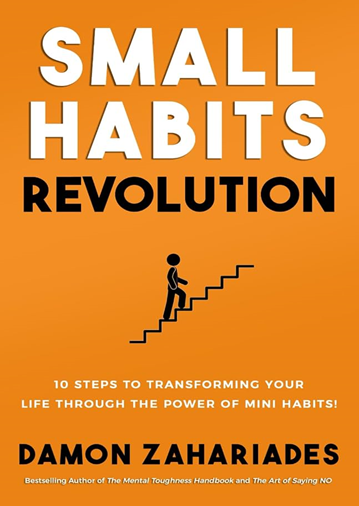
Small Habits Revolution: 10 Steps to Transforming Your Life Through the Power of Mini Habits! by Damon Zahariades
Small Habits Revolution: 10 Steps to Transforming Your Life Through the Power of Mini Habits! by Damon Zahariades is a practical action guide that shows readers how to establish positive, life-enriching routines that actually stick. Zahariades presents a systematic framework centered on starting with microscopic daily actions to seamlessly bypass the brain’s natural resistance to change. This book directly solves the frustrating problem of behavioral relapse by replacing fragile willpower and motivation with robust, automated daily loops. In today’s hyper-distracted and hectic digital world, mastering this mini-habit strategy is critical for anyone looking to reduce chronic stress, explode personal productivity, and reclaim focus.
Super Summary
Who May Benefit
- Professionals and entrepreneurs struggling with chronic distraction, office clutter, or low daily productivity.
- Individuals seeking to adopt healthy lifestyles, such as daily exercise, healthy eating, or proper hydration, without experiencing daunting resistance.
- Students, managers, and creators looking to dramatically sharpen their daily concentration and achieve consistent “flow states”.
- Anyone wanting to reduce stress, improve sleep quality, and foster deeper, more intimate bonds in their personal relationships.
- People who have repeatedly failed to maintain their New Year’s resolutions or long-term personal goals.
Top 3 Key Insights
- Microscopic actions eliminate the daunting cognitive resistance that typically causes massive behavioral changes to fail.
- Willpower is a strictly finite daily resource that is rapidly depleted by decision fatigue throughout the day.
- Automated loops built with reliable daily triggers and immediate positive rewards are the only way to ensure permanent habit sustainability.
4 More Takeaways
- Develop only one single habit at a time to prevent feeling overwhelmed.
- Leverage visual streak tracking like Seinfeld’s calendar strategy to maintain high psychological motivation.
- Anchor new behaviors onto existing daily routines using the power of habit stacking.
- Practice immediate self-forgiveness to quickly bounce back from inevitable daily slip-ups.
Book in 1 Sentence
Small Habits Revolution provides a highly actionable, ten-step blueprint to transform your life by replacing fragile willpower with automatic, microscopic daily routines.
Book in 1 Minute
Small Habits Revolution presents a highly practical, systematic blueprint for achieving permanent personal transformation by leveraging the immense power of microscopic behavioral changes. Damon Zahariades dismantles the widespread cultural misconception that self-improvement requires immense willpower or sporadic motivation, demonstrating instead that both are inherently unreliable, easily depleted mental states. The book outlines a fail-proof, step-by-step framework to establish robust habit loops by combining reliable daily triggers, microscopic physical actions, and immediate positive rewards. By keeping initial daily routines so simple that the brain cannot find an excuse to resist them, individuals can easily bypass cognitive friction and allow positive behaviors to grow deep neurological roots. Ultimately, this action guide shifts your focus from intimidating long-term outcomes to consistent daily execution, offering the exact mindset and tools required to build an exceptionally productive, healthy, and deeply rewarding lifestyle.
One Unique Aspect
The book’s most distinctive contribution is its complete rejection of motivational “cheerleading” in favor of a highly structured, step-by-step engineering approach to behavioral design. By focusing on practical habit stacking and visual streak tracking, Zahariades treats personal growth as a manageable, mechanical system rather than an exhausting emotional battle.
10 Steps to Transforming Your Life
The 10-step blueprint outlined in the book to help you establish positive, life-enriching routines that last is as follows:
- Step 1: Clarify the Goal You Want to Achieve with Your New Habit. Before choosing a habit, you must first define the specific, detailed outcome you want to enjoy to ensure your actions have a clear purpose.
- Step 2: Identify the Habit You Want to Develop. Choose a highly specific behavior that directly aligns with and streamlines the achievement of your clarified goal.
- Step 3: Break Down Your New Habit to Its Smallest Iteration. Reduce the behavior to its absolute smallest physical iteration to remove mental friction. The goal is to make it so easy that your brain cannot find an excuse to say no.
- Step 4: Create a Cue to Trigger the Habit. Identify a stable, reliable trigger. The most effective approach is to anchor your new routine directly onto an existing, deeply ingrained habit.
- Step 5: Establish a Clear Objective. Assign a strict numeric value to your daily habit to define unambiguous, irrefutable success for each day.
- Step 6: Design a Plan to Slowly Increase Your New Habit. Create a progressive plan with tiny, incremental weekly increases so you do not have to rely on fragile willpower or mood.
- Step 7: Create a Simple Reward System. Set up small, immediate rewards that provide instant gratification to signal to your brain that the routine is worth repeating.
- Step 8: Perform the Habit at the Same Time Each Day. Execute the habit like clockwork at the exact same time so that your brain programs it as an automatic, default response.
- Step 9: Identify the Stumbling Blocks That Can Sabotage You. Anticipate the internal excuses and unpredictable external obstacles ahead of time so you are prepared to bypass them.
- Step 10: Monitor Your Progress Once a Week. Maintain a simple tracking system—such as a Google Sheets spreadsheet—to keep yourself strictly accountable, visually measure your consistency, and maintain high motivation.
Chapter-wise Summary
Chapter I: How Developing Healthy Habits Improves Your Quality Of Life
“Our habits define us. They determine who we are, how we work, and whether we achieve our goals.”
Damon Zahariades outlines how developing healthy, positive habits dramatically improves your overall quality of life across multiple dimensions. The author notes that we always act with purpose, and instilling good habits delivers tangible rewards such as lowered stress, enhanced focus, improved daily productivity, and deeper, stronger interpersonal relationships. It also leads to a greater sense of joy, better sleep quality, and superior physical health. Instead of leaving outcomes to chance, creating automatic routines helps you maintain steady progress. Zahariades shares his personal success of starting with just five daily pushups and gradually increasing them to twenty-five, demonstrating how starting small minimizes the daunting resistance we typically face when attempting life changes. This positive momentum naturally translates into stronger self-confidence, faster decision-making, increased creativity, and an unshakeable commitment to your goals.
- Chapter Key Points:
- Habits enhance lifestyle quality.
- Start small for momentum.
- Consistency drives goal achievement.
Chapter II: Triggers, Routines, Rewards, And Loops
“Every behavioral loop consists of a trigger, a routine, and a reward.”
In this chapter, the author introduces the core mechanics of how the human mind forms and reinforces habits, drawing from the fundamental framework of behavioral loops. Zahariades explains that habits do not develop in a vacuum; rather, they are driven by specific stimuli that we can consciously control and design. By understanding the mechanical transition from a trigger to a routine and finally to a gratifying reward, individuals can intentionally build healthy behaviors that stick. Zahariades illustrates this with his personal trigger of playing Chopin’s Prelude in E Minor on loop to immediately induce a focused “flow state” for writing. Since we are in complete control of our triggers and rewards, we can systematically construct circumstances that support our growth. Rather than relying on fleeting external factors, we can orchestrate behavioral loops to turn desired behaviors into automatic, deeply ingrained responses.
The Habit Loop & Trigger Framework
- Trigger (Cue): The specific cue or circumstance that prompts the brain to initiate a behavior. Zahariades highlights the five primary trigger categories:
- Time: Routine actions anchored to specific hours (e.g., brushing teeth at bedtime).
- Location: Setting-based triggers where the environment primes behavior (e.g., walking into the kitchen triggers looking for food).
- State of Mind: Emotional states or feelings that prompt actions (e.g., checking social media when bored).
- People: Behaviors triggered by social circles or specific associations (e.g., exercising with workout partners).
- Preceding Event: Relying on the completion of an existing habit to trigger the next action (e.g., flossing immediately after brushing).
- Routine: The actual sequence of actions performed in response to the trigger. Zahariades emphasizes breaking routines down to their smallest iteration to avoid failure.
- Reward: The positive reinforcement or gratification gained from performing the routine, which satisfies a craving and releases dopamine.
- Habit Loop: The closed 3-step cycle (Cue -> Routine -> Reward) that the brain remembers and seeks to repeat when the cue resurfaces.
- Keystone Habit: A foundational routine that naturally influences, supports, and triggers other positive behaviors (e.g., daily exercise encouraging healthy eating).
- Chapter Key Points:
- Loops drive behavioral automaticity.
- Control your triggers.
- Select immediate, satisfying rewards.
Chapter III: Motivation Vs. Willpower: Which One Dictates Your Success?
“Why doesn’t motivation work as a dependable prompt for consistent action?”
This section dismantles the common cultural myth that long-term success in habit formation depends heavily on motivation and willpower. Zahariades explains that motivation is an inconstant, short-lived, and highly unpredictable emotional state that ebbs and flows like a wave, making it an unreliable tool for designing new daily behaviors. Furthermore, internal resistance acts as the ultimate nemesis of motivation, causing it to evaporate when tasks feel like forced chores. Similarly, willpower is a finite, easily depleted mental resource subject to “decision fatigue,” meaning it steadily drains throughout the day as we make hundreds of mundane choices. Consequently, relying on willpower alone to sustain behaviors—especially during late-afternoon or evening hours—inevitably leads to failure. Real, lasting transformation occurs only when behaviors transition from conscious effort into automatic, unshakeable habits that bypass the need for motivation or willpower entirely.
The Willpower Depletion & Decision Fatigue Model
- Finite Willpower Resource: Willpower behaves like a fuel tank; you start the day with a fixed, full supply after resting, but it steadily drains with every decision made.
- Decision Fatigue: Discovered in landmark judicial studies, decision fatigue refers to the mental depletion that worsens with each choice rendered throughout the day. As the mental load increases, individuals lose the self-control required to resist immediate temptations, making late-day habits highly vulnerable to derailment.
- Automaticity Override: Entrenched habits require zero conscious motivation or willpower because they are deeply rooted as default daily processes, eliminating internal debates.
- Chapter Key Points:
- Motivation is fleetingly unreliable.
- Willpower depletes daily.
- Habits override conscious friction.
Chapter IV: 10 Steps To Forming Healthy Habits That Last!
“This simple 10-step plan will help you to develop any positive habit you desire.”
Zahariades presents his centerpiece blueprint: a fail-proof, sequential system designed to seamlessly integrate any healthy behavior into your lifestyle. The primary reason most people fail to form habits is because they set goals that are far too daunting, which triggers intense internal resistance. By systematically clarifying your precise objectives and reducing your desired actions to their absolute smallest physical iterations, you remove the psychological barriers to entry. This systematic plan guides you to establish reliable triggers, implement progressive plans for incremental increases, and utilize simple reward systems that provide immediate gratification. Performing your habit at the exact same time each day builds automatic neural connections, while anticipating setbacks and tracking your weekly progress ensures long-term compliance. Following these ten steps systematically takes the guesswork out of personal transformation.
The 10-Step Habit Formation Blueprint
- Step 1: Clarify the Goal: Define the specific, specific outcome you want to achieve with your new habit rather than keeping it vague (e.g., specifying how many pounds to lose and why, such as having more energy).
- Step 2: Identify the Habit: Choose the exact behavior that directly streamlines the achievement of your clarified goal.
- Step 3: Break It Down: Reduce the habit to its absolute smallest physical iteration to remove all internal resistance (e.g., starting with just five pushups or reading three pages).
- Step 4: Create a Cue: Anchor your new habit to a reliable, existing daily routine to trigger the behavior automatically.
- Step 5: Establish an Objective: Assign a strict numeric value to your daily habit to define unambiguous, irrefutable success for each day.
- Step 6: Design an Incremental Plan: Map out a progressive plan to slowly and steadily increase the duration or repetitions of your habit over time (e.g., adding one pushup or three pushups per week).
- Step 7: Create a Reward System: Establish small, immediate rewards that provide instant gratification without undermining your ultimate goal.
- Step 8: Perform at the Same Time: Execute the habit at the exact same time every day to program it as an automatic, clockwork response to the trigger.
- Step 9: Identify Stumbling Blocks: Anticipate internal rationalizations and external obstacles in advance so you are mentally prepared to bypass them.
- Step 10: Monitor Progress Weekly: Establish a simple weekly tracking system (such as a Google Sheets spreadsheet) to keep yourself accountable and visually measure your growth.
- Chapter Key Points:
- Make behaviors ultra-simple.
- Anchor habits to cues.
- Track progress to stay accountable.
Chapter V: Seven Rules For Setting Yourself Up For Success
“The seven rules we’re going to cover in this section will help you to overcome this natural resistance.”
Adopting healthy habits is inherently difficult because the human brain naturally resists change, actively preferring to maintain the familiar status quo. To combat this neurological inertia, Zahariades establishes seven critical guidelines designed to maximize your likelihood of success. The foundational rule is to start incredibly small—making the task so simple that your brain cannot find a logical excuse to say no. Zahariades advises committing to a thirty-day challenge to firmly reinforce the behavioral pattern, while maintaining a singular focus by developing only one habit at a time to prevent feeling overwhelmed. Public accountability, morning execution to leverage peak energy, and weekly reviews of your core reasons provide additional motivational support. Crucially, the author stresses the importance of self-forgiveness, urging readers to renew their commitment after inevitable slip-ups rather than wasting mental energy on counterproductive self-blame.
The Seven Rules for Habit Success
- Rule #1: Start Small: Reduce behavioral changes to tiny adjustments to bypass the brain’s natural alarm system against change (e.g., flossing just one tooth).
- Rule #2: Commit for 30 Days: Challenge yourself to perform the habit daily for thirty consecutive days to deeply root the neural pathway.
- Rule #3: Develop One Habit at a Time: Focus entirely on a single behavioral change at a time, allowing its roots to grow deep before introducing another.
- Rule #4: Disclose Your Habit: Leverage public accountability by sharing your goals with supportive friends, family, or an accountability partner.
- Rule #5: Perform Early in the Morning: Execute your habit early in the morning when internal resistance is lowest and your willpower tank is full.
- Rule #6: Remind Yourself of Your Reasons: Set aside time once a week to consciously reflect on the deep personal reasons that inspired your habit in the first place.
- Rule #7: Forgive Yourself for Failure: Anticipate occasional setbacks; practice self-forgiveness, identify the cause of failure, and immediately resume the routine.
- Chapter Key Points:
- Brain resists massive changes.
- Singular focus prevents overwhelm.
- Self-forgiveness beats self-blame.
Chapter VI: How To Guarantee Your New Habits Will Last
“The most difficult part of developing new habits is making them last.”
Maintaining newly formed habits over the long term is a major challenge, as illustrated by the high failure rate of typical New Year’s resolutions. Zahariades explains that long-term failures occur because people attempt massive changes, lose sight of their core reasons, or fail to build a supportive daily environment. To guarantee permanent success, the author outlines highly effective, actionable strategies to lock habits in place. These strategies include selecting a reliable trigger that you fully control, leveraging the power of public accountability partners, and visually recording your daily streaks using Jerry Seinfeld’s famous calendar strategy. Additionally, Zahariades advocates for “habit stacking,” a powerful technique where you insert a new routine directly into an existing, deeply ingrained sequence of daily actions. By putting habits on calendars and reflecting on their positive benefits, you eliminate friction and ensure your routines endure.
The Habit Sustainability & Integration System
- Seven Reasons for Habit Failure:
- The routine represents too large a behavioral change.
- Beating oneself up over minor daily slip-ups.
- Focusing excessively on the end outcome rather than the daily routine itself.
- Losing track of the original purpose and reasons for the habit.
- Neglecting to create a supportive environment (e.g., keeping junk food in the house).
- Attempting to adopt too many habits at once.
- Lacking genuine commitment to the routine.
- Habit Stacking Framework: The practice of anchoring a new routine into an existing “habit stack”—a highly structured sequence of automatic daily behaviors (e.g., inserting five pushups directly into your morning bathroom routine after drying off but before getting dressed).
- Jerry Seinfeld’s Calendar Strategy: A visual reinforcement system using a yearly wall calendar. Each day you successfully perform your habit, you mark it with a big red “X”. As the chain of Xs grows longer, you become intensely motivated to perform your daily routine simply to “not break the chain”.
- Accountability Partner Selection Criteria:
- Willing to provide honest, constructive feedback.
- Sincerely supportive and shares or values your habit goals.
- Willing to connect regularly, preferably daily via text.
- Willing to challenge you to progress further.
- Ideally trying to adopt the same habit at the same pace.
- Chapter Key Points:
- Environment shapes habit success.
- Stack routines on existing habits.
- Don’t break the streak.
Chapter VII: Example Habits You Can Develop Using The Small Habits Strategy
“My goal in this section is to give you a springboard from which you can brainstorm new ways to improve your lifestyle.”
In the final chapter, Zahariades provides twenty-three practical, low-impact habit ideas to inspire and jumpstart your personal transformation journey. The author emphasizes that he does not seek to dictate which routines you must adopt, as you are the ultimate captain of your own ship. Instead, these examples serve as a highly actionable launchpad for personal brainstorming. The curated list spans diverse aspects of life, including healthy nutrition, regular exercise, active listening, mindfulness, and effective time management. Each habit is accompanied by a concrete, detailed breakdown of how to “start small” using the book’s mini-habit strategy. By starting with micro-actions that require minimal physical effort—such as drinking a single glass of water upon waking, reading for five minutes, or writing fifty words in a journal—you steadily build the momentum required to transform your daily lifestyle.
The 23 Small Habits Checklist & Launchpad
- Checklist of Recommended Mini-Habits:
- Eat Breakfast: Start by eating an apple or banana, then graduate to eggs.
- Active Listening: Focus intently on conversations, starting with short interactions with strangers.
- Daily Exercise: Schedule five pushups, crunches, or squats, increasing by one rep per week.
- Master Conversation: Limit interruptions and practice asking thoughtful, purposeful questions.
- Drink More Water: Drink a small glass of water upon waking, carrying a bottle to track ounces.
- Write in a Journal: Commit to writing fifty words a day, slowly increasing your word count.
- Compliment Strangers: Pay one sincere compliment a day to boost confidence and trust.
- Take Short Walks: Start with two five-minute walks daily, building up to an hour of walking.
- Read Non-Fiction: Read for five minutes daily, slowly building to a half-hour of reading.
- Declutter Workspace: Discard or put away just one item per day to build a clean desk habit.
- Smile at People: Smile at one extra person daily to lower stress and build friendliness.
- Practice Meditation: Sit quietly and focus on breathing for sixty seconds, adding one minute weekly.
- Wake Up Earlier: Set your morning alarm five minutes earlier each week to easily gain an hour.
- Express Gratitude: Write down three things you are thankful for each morning.
- Keep in Touch: Send one personal email per week to a friend to maintain relationships.
- Help People: Commit to performing one small act of daily kindness for a neighbor or stranger.
- Track Your Time: Log your daily activities for one day using free tracking tools like Toggl.
- Learn New Things: Read one short, educational web article daily to expand your knowledge.
- Save Money: Automatically transfer ten dollars from each paycheck to establish a savings habit.
- Use Time Chunking: Organize your workday into short chunks assigned to specific, focused tasks.
- Daily To-Do Lists: Draft a simple list of maximum three items the night before.
- Breathe Properly: Practice deep diaphragmatic breathing for a few minutes daily.
- Take Immediate Action: Practice making simple daily decisions within a strict ten-second limit.
- Chapter Key Points:
- Brainstorm personalized daily routines.
- Micro-steps eliminate initial friction.
- Steady progression yields transformation.
10 Notable Quotes
- “Our habits define us. They determine who we are, how we work, and whether we achieve our goals.”
- “Creating good habits is thus important if we hope to lead healthy, happy, rewarding lives.”
- “Make it so easy you can’t say no.”
- “The smaller you start, the less you’ll struggle in adopting and sustaining your new routine.”
- “Developing good habits isn’t a sprint; it’s a marathon.”
- “A good plan violently executed now is better than a perfect plan next week.”
- “Consistency and repetition are the keys to training ourselves to accomplish almost anything.”
- “Routines performed each day at the same time, prompted by the same triggers, become deeply-rooted habits.”
- “It’s easier to remain committed to your goals when you focus on the small habits that lead to them rather than the goals themselves.”
- “The core theme of Small Habits Revolution is to develop new habits by starting with tiny routines that cause zero discomfort.”
Explore 100 more insightful quotes from this book here
About the Author
Damon Zahariades is a corporate refugee, productivity expert, and prominent author who spent years enduring the distraction-laden environment of corporate meetings and office clutter before striking out on his own. Today, he is a leading voice in the time-management and self-improvement spaces, operating as the showrunner for the highly popular productivity blog ArtOfProductivity.com. Zahariades has authored an extensive catalog of practical, actionable guides, including To-Do List Formula, The Art of Saying NO, The Procrastination Cure, Morning Makeover, The Joy of Perfection, and The Time Chunking Method. His writing style is characterized by a refreshingly concise, fluff-free, and highly systematic approach to personal development, bridging the gap between rigorous psychological science and practical, everyday execution. Currently residing in Southern California with his supportive wife and their energetic dog, Damon also leverages his extensive copywriting and content marketing expertise to help growing businesses attract customers. His books have helped millions of readers worldwide overcome procrastination, establish life-enriching routines, and reclaim control of their time and energy.
Deep Diving
Frequently Asked Questions
- What is a mini-habit according to the book? A mini-habit is a behavior broken down to its absolute smallest, easiest physical iteration (like doing one pushup or reading three pages) to completely eliminate psychological resistance.
- Why is motivation insufficient for forming healthy habits? Motivation is an unreliable, short-lived emotional state that ebbs and flows unpredictably and evaporates instantly when confronted with internal resistance.
- What is the main problem with relying on willpower? Willpower is a finite daily resource that is rapidly depleted by decision fatigue throughout the day, leaving you vulnerable to temptations by evening.
- What are the three components of a behavioral loop? Every behavioral loop consists of a trigger (or cue) that prompts an action, the routine (the behavior performed), and a reward that reinforces the behavior.
- What is a keystone habit? A keystone habit is a foundational routine that naturally influences, supports, and triggers other positive behavioral shifts (like exercise encouraging healthy eating).
- What is “habit stacking”? Habit stacking is a method where you insert a new routine directly into an existing, deeply automatic sequence of daily habits.
- How does Seinfeld’s calendar strategy help sustain habits? It involves marking a yearly wall calendar with a red “X” for each successful day; seeing the growing, unbroken chain of Xs motivates you to perform the habit simply to avoid breaking the chain.
- Why should you perform new habits early in the morning? Mornings offer the lowest level of internal friction, fewer external distractions, and a fully charged tank of willpower.
- How long does it actually take to form a habit? There is no definite timeframe; while Maxwell Maltz’s 21-day rule was actually about surgical adaptation, a 30-day challenge is a practical milestone to firmly establish a routine.
- Why is tracking your progress weekly so important? Progress tracking (e.g., using Google Sheets) provides visual motivation, proves what you are capable of achieving, and keeps you strictly accountable to your daily goals.
Theories and Concepts
- Decision Fatigue: The progressive decline in decision-making quality and self-control that results from the cumulative mental load of making hundreds of choices throughout the day.
- The Motivation Wave: Concept coined by BJ Fogg explaining that motivation naturally rises and falls like a wave, making it a highly erratic foundation for building permanent daily behaviors.
- Diaphragmatic Breathing: Proper deep diaphragmatic breathing that maximizes oxygen delivery, releases tension, and lowers daily stress levels.
- The Time Chunking Method: A highly effective time management strategy that segments the workday into small, dedicated blocks of time assigned to specific tasks to foster deep work and prevent distractions.
Books and Authors
- “The Power of Habit” by Charles Duhigg: Referenced in the text for defining the fundamental components of the habit loop (trigger, routine, reward).
- Dr. Maxwell Maltz: Mentioned for his observations on plastic surgery patients taking 21 days to adjust to their new appearance, which was popularized (and misapplied) as the universal timeframe for habit formation.
- BJ Fogg (Stanford Persuasive Technology Lab): Cited for his research on the “motivation wave” and designing behavioral models.
- Jerry Seinfeld: The famous comedian whose calendar streak method—writing one joke a day and marking a red “X” to not break the chain—is presented as a premier sustainability strategy.
- Leo Babauta (ZenHabits.net): Quoted for his foundational productivity advice: “Make it so easy you can’t say no”.
Persons
- General George S. Patton: Quoted for his decisive military leadership philosophy: “A good plan violently executed now is better than a perfect plan next week”, and noted as a historical figure who kept a personal journal.
- Albert Einstein, Mark Twain, Thomas Edison, Herman Melville, Thomas Jefferson, Leonardo da Vinci, and Charles Darwin: Listed as exemplary, highly influential historical figures who consistently kept personal journals to organize thoughts, brainstorm ideas, and foster self-discipline.
How to Use This Book
Select one small habit from Chapter VII, break it down to its smallest physical step (like reading one page), anchor it to an existing morning routine, track your daily success on a calendar, and practice self-forgiveness to allow the habit to grow steadily over thirty days.
Want to be the best 1% achiever! Find the best-fit resources here.
Conclusion
Small Habits Revolution provides the definitive blueprint to break free from the exhausting trap of temporary motivation and build a life of automatic, effortless success. Stop waiting for the perfect moment of inspiration or relying on a depleted willpower tank to change your life. Pick just one microscopic habit today—whether it is a single pushup, a glass of water, or one page of reading—and start your personal revolution right now!