How to Live on Twenty-Four Hours a Day by Arnold Bennett
Arnold Bennett’s How to Live on Twenty-Four Hours a Day is a timeless guide to time management and self-improvement. Written in 1908, it speaks directly to people who feel trapped by routine and dissatisfied with how they use their time. Bennett offers simple but powerful strategies for making every hour count, showing that true fulfillment comes from how we spend our non-working hours.
Who May Benefit from the Book
This book will be valuable for:
- Employees stuck in repetitive jobs seeking more meaning in life
- Professionals balancing work and personal growth goals
- Students learning time discipline and self-study habits
- Entrepreneurs needing structure to use time effectively
- Anyone who feels life passes too quickly without purpose
Top 3 Key Insights
- Time is life’s most valuable resource, more important than money.
- Even busy people can create a “day within a day” for growth.
- Success comes from small, consistent steps rather than dramatic changes.
4 More Lessons and Takeaways
- Mental change, not rest, refreshes the mind, making leisure time productive.
- A consistent routine of seven and a half hours a week can transform one’s life.
- Reflection and self-examination are as vital as reading or studying.
- Avoid rigidity; programs should guide life, not imprison it.
The Book in 1 Sentence
A practical guide to transforming daily life by using spare hours wisely for self-cultivation, reflection, and disciplined growth.
The Book Summary in 1 Minute
Bennett teaches that everyone receives the same miracle: twenty-four hours a day. Unlike money, time cannot be saved, borrowed, or stolen, making it the most valuable resource. Most people waste their hours outside of work, treating them as unimportant. Bennett argues for creating a “day within a day” by using spare time for reading, reflection, arts, and self-improvement. Start small, stay consistent, and avoid over-ambition. Just seven and a half hours weekly, if well-used, can renew energy, expand knowledge, and bring true fulfillment.
The Book Summary in 7 Minutes
I. THE DAILY MIRACLE
The author notes that while there are many guides on “How to live on a given income of money,” he has never seen an essay on “How to live on twenty-four hours a day”. Time is far more precious than money, as money can be acquired, but no one can buy an extra minute of time. Time is an “inexplicable raw material” and its supply is a “daily miracle”. This commodity is unstealable, and everyone, rich or poor, genius or ordinary, receives exactly the same supply—twenty-four hours. Furthermore, one cannot borrow from the future; one can only waste the “passing moment”. Our happiness and ability to spin “health, pleasure, money, content, respect, and the evolution of your immortal soul” depend entirely on the right use of this daily allotment. We must realize the profound truth that we have always had, and always will have, all the time there is.
Key Points:
• Time is much more valuable than money.
• The daily supply of twenty-four hours is a miracle, granted equally to everyone.
• The effective use of time is the highest urgency, as all happiness depends upon it.
• The key realization is that we never shall have “more time”; we already possess all the time there is.
II. THE DESIRE TO EXCEED ONE’S PROGRAMME
The chapter addresses the “innumerable band of souls” haunted by the feeling that the years are passing without their lives being put into proper working order. This aspiration stems from a fixed idea that we ought to accomplish something in addition to our moral obligations, such as maintaining our family and earning a livelihood. This wish to “exceed formal programmes” is common to all men who have risen past a certain evolutionary level. Failure to satisfy this wish results in a “sense of uneasy waiting” that disturbs the soul. This desire often takes the shape of a literary aspiration, such as embarking on a course of reading. However, the author notes that literature does not comprise the whole field of knowledge, and the thirst for self-improvement can be satisfied in other ways.
Key Points:
• Widespread dissatisfaction stems from a feeling of not living life fully.
• This feeling is rooted in the desire to achieve something beyond necessary daily obligations.
• The universal desire for knowledge often manifests as a wish to read more.
• Literature is not the only source of knowledge or self-improvement.
III. PRECAUTIONS BEFORE BEGINNING
The author dispels the notion that he possesses a “wonderful secret” or “easy way” to achieve the ideal arrangement of the day. The most critical preliminary step is the calm realization of the extreme difficulty of the task, which demands “sacrifices and the endless effort”. If one is not prepared for discouragements and disillusion, they should not start. There is “no magic method of beginning”—one simply jumps in. Since time cannot be wasted in advance, there is no need to wait for tomorrow. A major warning is issued against initial ardour, which is “misleading and a treacherous thing” that often dies suddenly. It is vital to avoid attempting too much at the start, making allowances for human nature and accidents. In this endeavor, a petty success is preferable to a glorious failure, because failure inflicts a desperate wound on one’s self-respect. Therefore, the beginning should be “humble”.
Key Points:
• No easy, secret method exists for mastering time management.
• Success requires acknowledging the task’s extreme difficulty and preparing for endless effort and sacrifice.
• Beware of initial enthusiasm (ardour), which often leads to failure.
• Start small and quietly to avoid initial failure, thereby safeguarding self-respect.
• A petty success is always better than a glorious failure.
IV. THE CAUSE OF THE TROUBLE
Using the example of a typical London office worker (10 a.m. to 6 p.m.), the author pinpoints the fundamental error: the worker treats the eight working hours as “the day,” viewing the preceding ten and following six hours as merely a prologue and epilogue. This “utterly illogical and unhealthy” attitude kills interest in the sixteen “odd” hours. To live fully, the man must construct a “day within a day” running from 6 p.m. to 10 a.m.. During these sixteen hours, he is free to cultivate his body, soul, and fellow men, operating as independently as a person with a private income. Contrary to popular belief, giving full energy to these sixteen hours will increase the value of the business eight, because mental faculties require change, not rest, except during sleep. Time is commonly wasted during commutes, often walking to the station in a state of “mental coma”.
Key Points:
• The core mistake is viewing the eight working hours as the whole of one’s life.
• One must establish a “day within a day”—sixteen hours dedicated to self-cultivation.
• Full engagement in the “day within a day” improves professional work, as the mind requires change, not inactivity, to refresh.
• Time is wasted by treating daily periods, like commuting, as insignificant margins.
V. TENNIS AND THE IMMORTAL SOUL
The author objects to reading newspapers on the morning train, arguing that this wastes 30 or 40 consecutive minutes of “wonderful solitude” that should be used for better mental application. Upon arriving home, many people pretend to be tired, wasting six or more hours until bedtime, often spending forty minutes just “thinking about going to bed”. This fatigue is often feigned; when an exciting event is planned (like a theater trip), that feeling vanishes. The thought of an energetic activity planned for the evening provides a “glow and a more intense vitality to the whole day”. The author suggests arranging the evening so that a meal does not interrupt a clear expanse of time. He proposes dedicating ninety minutes every other evening (thrice a week) to “important and consecutive cultivation of the mind”. This time must be sacred. One must be prepared to say, “Sorry I can’t see you, old chap, but I have to work,” instead of excusing oneself for tennis, because tennis often feels “so much more urgent than the immortal soul”.
Key Points:
• The valuable, concentrated time of the morning commute should not be spent reading newspapers.
• Post-work fatigue is often psychological; energy is available for planned, exciting events.
• A minimum of ninety minutes every other evening should be set aside for sustained mental effort.
• This dedicated time must be treated as sacred and prioritized over leisure.
VI. REMEMBER HUMAN NATURE
The author advises the average person to limit their “super-programme” (the extra self-improvement work) to six days a week. He confirms that the total time marked for saving thus far is seven hours and a half a week (half an hour six mornings, one hour and a half three evenings). He contends that the full utilization of these 7.5 hours will act like physical exercise, quickening the entire life of the week and increasing zest for even “banal occupations”. Because changing habits is exceptionally difficult, and a failure damages self-respect, the beginning must be humble, quiet, and slow. To safeguard against accidents and human nature, the author suggests allowing much more time for the evening task than required (e.g., scheduling 9 p.m. to 11:30 p.m. for ninety minutes of work).
Key Points:
• The self-improvement program should generally run for six days a week.
• The secured time allotment is seven and a half hours a week.
• Using this time fully will enliven the activities of the entire week.
• To avoid the “almost disastrous effect of failure,” the start must be “very humble” and unostentatious.
• Allow buffer time in the evenings to accommodate for human nature and mishaps.
VII. CONTROLLING THE MIND
Controlling the thinking machine is “perfectly possible,” and since nothing hurts or gives pleasure outside the brain, control of the mind is supremely important. This mind control is the first element of a full existence. The best time for this practice is during the commute to the office. The method involves choosing a subject, concentrating on it, and bringing the mind back “by the scruff of the neck” whenever it inevitably wanders. Perseverance is the only secret, guaranteeing that one can “tyrannise over your mind” anywhere. This regular discipline can cure half the evils of life, particularly worry, which is a “miserable, avoidable, shameful disease”. The author suggests concentrating on a chapter of Marcus Aurelius or Epictetus, reading it the previous evening and reflecting on it the next morning.
Key Points:
• Mind control is possible and is the first element of a full existence.
• This practice should be exercised during the morning commute.
• Success comes from persistent effort in focusing the mind and forcing it back to the chosen subject.
• Mind control is the remedy for many life evils, especially “worry”.
• Concentration subjects should include practical philosophy, such as Marcus Aurelius or Epictetus.
VIII. THE REFLECTIVE MOOD
Concentration is merely a preliminary step; the long-term course of study must be self-study: “Man, know thyself”. The average man lacks the reflective mood to think about truly important things, like happiness, life direction, and the relationship between principles and conduct. Happiness is attained by developing reason and adjusting conduct to principles, not by procuring physical or mental pleasure. A life where conduct does not match principles is “silly”. This alignment can only be achieved through daily examination, reflection, and resolution. Reason plays a smaller role in our lives than we think; we are more instinctive, and reflection helps us become more reasonable. While books (like Pascal or Emerson) are helpful, they are no substitute for daily, honest self-examination. The solitude of the evening journey home is suggested as the ideal time for this reflective mood.
Key Points:
• The primary study, following concentration, is self-study: “Man, know thyself”.
• Happiness results from developing reason and aligning conduct with one’s principles.
• Daily reflection and self-examination are vital to ensure one’s behavior accords with one’s ethics.
• The reflective mood makes one less instinctive and more reasonable.
IX. INTEREST IN THE ARTS
It is a mistake to believe that literature is the only alternative to idleness. Knowledge can be acquired in vast non-literary fields. For example, one can cultivate an interest in music, even without being able to play, by studying the structure of the orchestra. Reading books on the subject, such as Mr. Krehbiel’s How to Listen to Music, changes the experience from a “beatific coma” to an astonishing intensification of interest. By specializing in a form of music or a specific composer over several evenings a week, a systematic knowledge can be built. This methodical approach applies to other arts, such as looking at pictures or judging architecture.
Key Points:
• Literature is not the only means of self-cultivation.
• Knowledge of the arts can be gained systematically, even without practical skills.
• Acquiring foundational knowledge (e.g., about the orchestra) transforms a passive experience into an active, intellectual one.
X. NOTHING IN LIFE IS HUMDRUM
Art is great, but the greatest perception is the continual realization of cause and effect—the perception of evolution. This philosophical study makes one “large-minded” and “large-hearted,” reducing the painfulness of life by eliminating the tendency to be constantly “shocked and pained” by life’s “curiousness”. The study of cause and effect enhances life’s picturesqueness, viewing everything (like the sea) as continuously developing. The author argues that nothing is humdrum. Even mundane jobs, like that of an estate agent’s clerk, can become enthralling and picturesque if studied through the lens of cause and effect (e.g., how the Tube rail affected rents in Shepherd’s Bush). A bank clerk could benefit immensely from reading Walter Bagehot’s Lombard Street. The entire field of daily habit and scene awaits to satisfy curiosity and help one gain “an understanding heart”.
Key Points:
• The most important perception is the continual realization of cause and effect (evolution).
• This study reduces life’s perceived unpleasantness and increases its picturesqueness.
• Nothing is humdrum.
• Studying one’s own profession through the filter of cause and effect (e.g., reading a scientific study about banking) can transform livelihood into a passionate endeavor.
XI. SERIOUS READING
Novels are excluded from “serious reading” because even good novels do not demand the necessary mental application or “feeling of strain” required for mental cultivation. Imaginative poetry is the highest form of literature, producing the severest mental strain and yielding the highest pleasure and wisdom. For beginners, the author recommends Hazlitt’s essay on “poetry in general”, followed by a narrative poem like E.B. Browning’s Aurora Leigh. If poetry proves antagonistic, one must settle for history (like The Decline and Fall) or philosophy (like Herbert Spencer’s First Principles). Two crucial suggestions for serious reading are: 1) Define the scope of efforts by choosing a limited subject, period, or author (e.g., John Keats or the French Revolution). 2) Think as well as read. Unless one gives at least forty-five minutes to “fatiguing reflection” upon what is read, the ninety minutes spent reading are largely wasted.
Key Points:
• Novels are excluded because they require little mental strain.
• Imaginative poetry is the highest form of literature, demanding the greatest mental effort.
• One must limit the scope of study to a defined subject or author.
• It is essential to think as well as read; forty-five minutes of careful reflection should follow the reading.
XII. DANGERS TO AVOID
The sincere aspirant must avoid several pitfalls:
1. The Prig: The first danger is becoming a “prig,” an “odious” person who gives airs of superior wisdom and has lost their sense of humor. One must remember that the earth functioned perfectly well before one’s schedule existed and should not chatter about one’s efforts.
2. Slavery to the Programme: The program must be respected but should not be worshipped as a fetish or allowed to create tragedy through excessive rigidity.
3. The Policy of Rush: Being obsessed with what to do next creates a feeling of living in a prison. The cure is not to break the program, but to initially attempt less. If one feels rushed, a palliative is to intentionally pass with exaggerated deliberation between tasks (e.g., consciously wasting five minutes).
4. Initial Failure: The chief danger is failure at the commencement, which kills the “newborn impulse”. The pace must be “absurdly slow” but regular, and achieving a chosen task, regardless of distaste, builds immense self-confidence.
5. Ignoring Taste: Initial occupations must be guided by one’s taste and natural inclination, not by perceived obligation.
Key Points:
• Avoid becoming a prig—an arrogant person who loses their sense of humor about their self-improvement.
• Do not let the program become a rigid fetish that dictates life; avoid excessive inflexibility.
• Combat the feeling of rush by attempting less, or by deliberately wasting time between tasks as a palliative.
• Ensure the initial pace is “absurdly slow” but regular to avoid the risk of early failure.
• The first chosen tasks must align with one’s natural inclination.
The Table of Bennett’s Core Recommendations
| Habit | Suggested Practice | Benefit |
|---|---|---|
| Early rising | Half an hour in morning | Builds calm start and discipline |
| Evening study | 90 minutes, 3 times a week | Creates consistent self-cultivation |
| Mind control | Focus on commute | Reduces worry, increases clarity |
| Reflection | Daily self-examination | Aligns principles and actions |
| Arts and reading | Music, poetry, history, philosophy | Enriches intellect and imagination |
The Essential Message
Bennett’s main idea is simple yet profound: life is shaped not by what we must do, but by what we choose to do with our free hours. By treating time as sacred and starting with a small, steady program, anyone can transform dull existence into a life of purpose and vitality.
Quotes from How to Live on Twenty-Four Hours a Day:
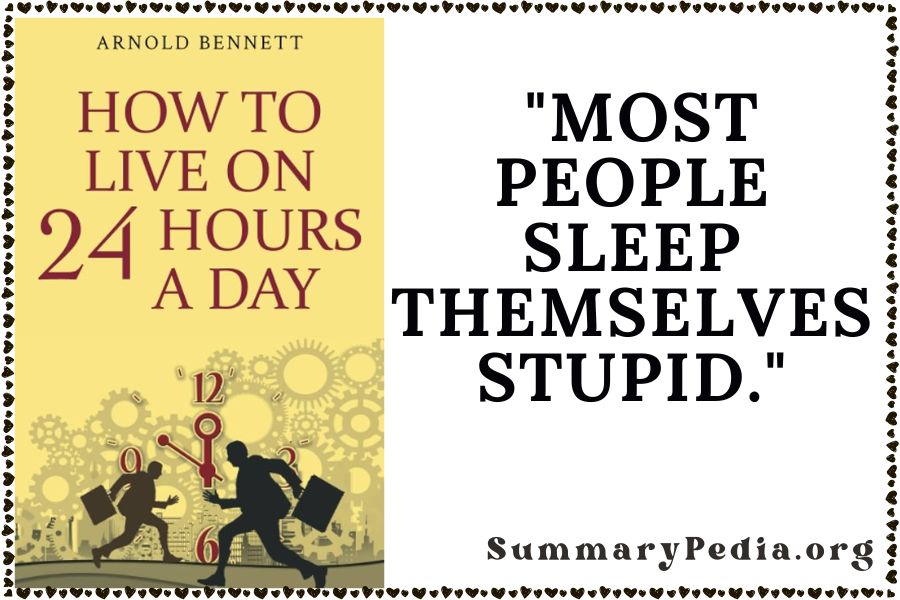
- “Most people sleep themselves stupid.”
- “Rise an hour, an hour and a half, or even two hours earlier; and—if you must—retire earlier when you can.”
- “Time is a great deal more than money.”
- “You cannot buy yourself a minute more time than I have, or the cat by the fire has.”
- “The supply of time is truly a daily miracle, an affair genuinely astonishing when one examines it.”
- “…your purse is magically filled with twenty-four hours of the unmanufactured tissue of the universe of your life!”
- “In the realm of time there is no aristocracy of wealth, and no aristocracy of intellect.”
- “You can only waste the passing moment. You cannot waste to-morrow; it is kept for you.”
- “Out of it [time] you have to spin health, pleasure, money, content, respect, and the evolution of your immortal soul.”
- “We never shall have any more time. We have, and we have always had, all the time there is.”
- “The real tragedy is the tragedy of the man who is braced to effort neither in the office nor out of it…”
- “The most important preliminary to the task… is the calm realisation of the extreme difficulty of the task, of the sacrifices and the endless effort which it demands.”
- “If you are not prepared for discouragements and disillusions; if you will not be content with a small result for a big effort, then do not begin.”
- “A glorious failure leads to nothing; a petty success may lead to a success that is not petty.”
- “If my typical man wishes to live fully and completely he must, in his mind, arrange a day within a day.”
- “One of the chief things which my typical man has to learn is that the mental faculties are capable of a continuous hard activity; they do not tire like an arm or a leg. All they want is change—not rest, except in sleep.”
- “The proper, wise balancing of one’s whole life may depend upon the feasibility of a cup of tea at an unusual hour.”
- “The control of the thinking machine is perfectly possible.”
- “Mind control is the first element of a full existence.”
- “The exercise of concentrating the mind… is a mere preliminary, like scales on the piano.”
- “Man, know thyself. The phrase is one of those phrases with which everyone is familiar, of which everyone acknowledges the value, and which only the most sagacious put into practice.”
About the Author
Arnold Bennett (1867–1931) was an English novelist, essayist, and playwright. Born in Staffordshire, he worked as a clerk before moving to London, where he began his literary career. Bennett is best known for his realistic portrayals of provincial life and his novels set in the “Five Towns.” Beyond fiction, he wrote influential essays on self-improvement and time management, including How to Live on Twenty-Four Hours a Day. His works reflect practical wisdom, humor, and an enduring belief in human potential.
How to Get the Best of the Book
Read a chapter at a time and apply its advice slowly. Start small, test the methods, and build habits steadily for lasting results.
Conclusion
Arnold Bennett shows that time is life’s true wealth. By using even a few hours weekly for growth, reflection, and self-cultivation, anyone can live more fully and meaningfully.