$100M Offers by Alex Hormozi
$100M Offers by Alex Hormozi reveals how to create business propositions so compelling that customers feel foolish declining them. It solves the core problem of struggling to acquire clients by shifting businesses away from commodity pricing toward value-based exclusivity. In today’s hyper-competitive marketplace, this book matters because it provides a reliable framework to turn advertising dollars into massive profits without ever competing on price.
Super Summary
Who May Benefit
- Founders struggling with thin profit margins.
- Marketers aiming to boost conversion rates.
- Service providers wanting to charge premium prices.
- Sales professionals seeking irresistible propositions.
- Local business owners looking to dominate markets.
Top 3 Key Insights
- Make offers so good people feel stupid refusing.
- Escape commoditization by competing solely on unique value.
- Master the Value Equation to maximize perceived worth.
4 More Takeaways
- Target a “starving crowd” experiencing massive pain.
- Charge premium prices to increase client commitment.
- Use scarcity and urgency to artificially increase demand.
- Reverse purchasing risk completely with creative guarantees.
Book in 1 Sentence Alex Hormozi’s $100M Offers provides a tactical blueprint for crafting irresistible, high-ticket business propositions that eliminate price competition and maximize profitability.
Book in 1 Minute In $100M Offers, Alex Hormozi details the exact frameworks he used to escape bankruptcy and generate over $100 million in sales. The book attacks the “commodity problem,” where businesses blindly compete on price and race to the bottom. Hormozi argues that exponential growth requires crafting a “Grand Slam Offer”—a proposition so uniquely valuable that it stands entirely in a category of one. He teaches entrepreneurs how to confidently charge premium prices, target a starving market, and drastically inflate perceived value through his psychological Value Equation. By mastering the levers of scarcity, urgency, stacked bonuses, iron-clad guarantees, and strategic naming, anyone can build an unbreakable customer acquisition machine. Ultimately, the book offers a profound mindset shift from merely selling basic services to engineering absolute certainty and irresistible desire.
One Unique Aspect This book translates subjective human desires into a quantifiable, mathematical formula known as “The Value Equation”. Instead of vague marketing advice, Hormozi provides psychological levers—like reducing perceived effort to zero—that directly correlate with how much a business can charge.
Chapter-wise Summary
Chapter 1: How We Got Here
“Magic will find those with pure hearts, even when all seems lost.”
Hormozi shares his painful origin story, finding himself nearly broke on Christmas Eve, owing his salesman $22,000, and losing his life savings to a deceptive partner. Facing bankruptcy and sheer desperation, he launched a final campaign for six gyms using a radically compelling new offer and his last line of credit. This single Grand Slam Offer generated $100,000 in a month, ultimately scaling his business to $120 million in sales. Mastering offer creation is a survival skill that turns failure into monumental success.
Chapter Key Points:
- Offers dictate your survival.
- Desperation breeds brilliant innovation.
- One offer changes everything.
Chapter 2: Grand Slam Offers
“Make people an offer so good they would feel stupid saying no.”
The secret to explosive sales isn’t necessarily being a skilled persuader; it’s having a proposition that is inherently undeniable. Hormozi introduces the “Grand Slam Offer” as the ultimate solution to the dual problems of not having enough clients and lacking cash. A Grand Slam Offer combines an attractive promotion, unmatchable value, a premium price, and an unbeatable guarantee. It creates a “category of one” where prospects stop comparing you to competitors, drastically increasing conversion rates and upfront cash collected.
Chapter Key Points:
- Overcome cash flow constraints.
- Sell in a category vacuum.
- Eliminate arbitrary price comparisons.
Chapter 3: Pricing: The Commodity Problem
“Think different.”
Business growth strictly requires getting more customers, increasing their average purchase value, or increasing their buying frequency. However, selling a “commodity”—a product indistinguishable from others—forces you into a price-driven race to the bottom where profit margins vanish. To grow effectively, you must shift to value-driven purchases by completely differentiating your product. A Grand Slam Offer breaks this cycle by multiplying response rates and closing percentages, turning advertising from an expense into a highly profitable investment.
Chapter Key Points:
- Commodities destroy profit margins.
- Value vastly outpaces price.
- Differentiate to comfortably survive.
Chapter 4: Pricing: Finding The Right Market — A Starving Crowd
“The seed that fell on good soil represents those who truly hear and understand God’s word and produce a harvest…”
Having the best product means absolutely nothing if you sell to the wrong audience. The most powerful advantage in any business is having a “starving crowd”. A great market requires four specific indicators: massive pain, robust purchasing power, easy targeting, and a growing population. Furthermore, entrepreneurs must ruthlessly commit to a narrow niche because specificity significantly increases your pricing power and ultimate profit margins.
Chapter Key Points:
- Seek out massive pain.
- Ensure strong purchasing power.
- Niches equal massive riches.
Chapter 5: Pricing: Charge What It’s Worth
“Charge as high a price as you can say out loud without cracking a smile.”
Most businesses mistakenly price their services based on competitors, resulting in market efficiency and zero sustainable margins. Hormozi advocates for the “Virtuous Cycle of Price,” proving that higher prices allow you to provide a superior product, which increases clients’ emotional investment and delivers better results. Furthermore, human psychology dictates that higher prices literally increase the perceived value of the product. You must confidently charge premium prices to fund an exceptional experience and scale rapidly.
Chapter Key Points:
- High prices increase commitment.
- Price implies inherent value.
- Compete on immense value.
Chapter 6: Value Offer: The Value Equation
“We question all of our beliefs, except for the ones we really believe in, and those we never think to question.”
To charge heinous amounts of money, you must understand how to engineer immense value. Hormozi introduces his central framework, The Value Equation, which mathematically dictates how much a prospect is willing to pay.
The Value Equation Framework: Value = (Dream Outcome x Perceived Likelihood of Achievement) / (Time Delay x Effort & Sacrifice)
- 1. Dream Outcome (Goal = Increase): This is the expression of the feelings and experiences the prospect envisions, such as status, beauty, or wealth. You must accurately depict their dream back to them so they feel completely understood.
- 2. Perceived Likelihood of Achievement (Goal = Increase): How confident the prospect is that your specific offer will actually work for them. Track records, social proof, and strong guarantees boost this variable.
- 3. Time Delay (Goal = Decrease): The time gap between the purchase and receiving the promised benefit. Fast wins are crucial. If you can reduce the true time delay to zero, your value approaches infinity.
- 4. Effort & Sacrifice (Goal = Decrease): The ancillary costs, physical exertion, and mental discomfort required to achieve the result. For example, liposuction costs $25,000 while a gym membership is $29 because surgery requires almost zero effort or sacrifice.
The greatest companies in the world focus entirely on minimizing the bottom of the equation (Time and Effort) because making things immediate and effortless drives unlimited pricing power.
Chapter Key Points:
- Increase the dream outcome.
- Minimize effort and time.
- Perception dictates reality.
Chapter 7: Free Goodwill
“He who said money can’t buy happiness, hasn’t given enough away.”
In a brief interlude, Hormozi asks the reader to leave an honest review of his book to help other entrepreneurs find it. He leverages the psychological principle of reciprocity, demonstrating how giving value away for free builds trust and helps others systematically.
Chapter Key Points:
- Reviews help other entrepreneurs.
- Give without any expectation.
- Goodwill successfully builds trust.
Chapter 8: Value Offer: The Thought Process
“If at first you don’t succeed, try, try, try again.”
Building a Grand Slam Offer requires shifting from “convergent thinking,” which seeks one single right answer, to “divergent thinking,” which generates multiple right answers to solve a problem. Hormozi uses the “Brick Exercise” to demonstrate how expanding your mind to see dozens of uses for a simple brick mimics the process of discovering new ways to deliver massive value to a client.
Chapter Key Points:
- Use divergent problem solving.
- Think of multiple solutions.
- Expand your delivery possibilities.
Chapter 9: Value Offer: Creating Your Grand Slam Offer Part I: Problems & Solutions
“ABC, Easy as 123 Ah, simple as doh reh mi”
Hormozi lays out the exact step-by-step framework for figuring out what your offer should be by converting roadblocks into assets.
Creating Your Offer Framework (Part I):
- Step #1: Identify Dream Outcome: Define exactly what the client wants to achieve, focusing on the destination rather than the vehicle (e.g., “Lose 20lbs in 6 weeks”).
- Step #2: List Problems: Write down every single obstacle, limiting thought, or point of friction a prospect will experience before, during, and after using your product. For example, in weight loss, problems include “buying healthy food takes too much time” or “cooking is confusing”. You must map these granular problems to the Value Equation buckets.
- Step #3: Solutions List: Transform every problem you listed into a solution. Simply add “How to” and reverse the obstacle. For example, “Buying healthy food is hard” becomes “How to make buying healthy food easy and enjoyable”. You must find a way to proactively solve every single problem a prospect might present.
Chapter Key Points:
- Clearly identify the dream.
- List absolutely all obstacles.
- Transform problems into solutions.
Chapter 10: Value Offer: Creating Your Grand Slam Offer Part II: Trim & Stack
“Cut! Cut! Cut!”
After listing solutions, you must figure out how to deliver them highly profitably using the “Sales to Fulfillment Continuum,” balancing what is easy to sell against what is easy to fulfill.
Creating Your Offer Framework (Part II):
- Step #4: Create Your Solutions Delivery Vehicles (“The How”): Use the Delivery Cube to brainstorm every possible way to deliver the solution:
- Level of Personal Attention: 1-on-1, small group, or 1-to-many?
- Level of Effort: Do it yourself (DIY), done with you (DWY), or done for them (DFY)?
- Medium: In-person, phone, email, text, Zoom?
- Consumption: Audio, video, written?
- Speed & Convenience: 24/7, 9-5, or 5 minutes?
- 10x to 1/10th Test: What would you provide if they paid 10x the price? What if they paid 1/10th?
- Step #5: Trim & Stack: Look at the cost and value of each delivery vehicle. Remove high-cost/low-value items. Focus heavily on creating high-value, “one-to-many” solutions (like calculators or recorded courses) that require a one-time effort but offer infinitely low delivery costs later. Finally, stack these optimized solutions into the ultimate high-value deliverable, giving them sexy names, and summing the massive total value to justify the price.
Chapter Key Points:
- Balance sales and fulfillment.
- Trim high-cost/low-value items.
- Stack high-value scalable deliverables.
Chapter 12: Enhancing The Offer: Scarcity
“Sold out.”
Scarcity is a function of quantity that artificially increases demand by limiting the supply of your product or service. When people know they cannot easily get something, the fear of missing out makes them desire it far more. Hormozi details three main types of scarcity: limiting seats/slots, limiting bonuses, and offering things that will “never be available again”. Service businesses can powerfully use Total Business Caps, Growth Rate Caps, or Cohort Caps to maintain exclusivity.
Chapter Key Points:
- Strategically decrease your supply.
- Limit your client capacity.
- Ensure you always sell out.
Chapter 13: Enhancing The Offer: Urgency
“Deadlines. Drive. Decisions.”
While scarcity restricts quantity, urgency restricts time. A defined deadline forces prospects to make a decision, successfully overcoming natural procrastination. Hormozi utilizes four favorite methods: Cohort-Based Rolling Urgency (frequent start dates), Rolling Seasonal Urgency (promotions tied to holidays), Pricing/Bonus-Based Urgency (expiring discounts), and the Exploding Opportunity (arbitrage value that decays rapidly over time).
Chapter Key Points:
- Deadlines actively force action.
- Use rolling cohort starts.
- Time-limit your added bonuses.
Chapter 14: Enhancing The Offer: Bonuses
“It’s all gravy baby”
Adding bonuses is infinitely superior to discounting a core offer because it expands the price-to-value discrepancy while maintaining your premium positioning. A single offer broken into component parts and stacked as a series of bonuses creates an overwhelming perception of value. When presenting bonuses, give them a benefit-driven name, explain how they solve a specific obstacle, and ascribe a justified price tag. You can also secure free bonuses by partnering with adjacent businesses, instantly inflating your offer’s value at zero cost.
Chapter Key Points:
- Never discount, add bonuses.
- Ascribe specific price tags.
- Leverage adjacent partner products.
Chapter 15: Enhancing The Offer: Guarantees
“You’re gonna like the way you look…I guarantee it.”
Reversing risk is the single greatest method to instantly increase the conversion of an offer. A strong guarantee easily offsets any slight increase in refunds by drastically multiplying total upfront sales. There are four main types of guarantees: Unconditional (“No Questions Asked”), Conditional (requires client action, like a “Service Guarantee”), Anti-Guarantees (explicitly stating “all sales are final” due to proprietary value), and Implied Guarantees (performance or revenue-share models). Stacking unconditional and conditional guarantees together creates ultimate buyer conviction.
Chapter Key Points:
- Reverse buyer risk completely.
- Stack multiple different guarantees.
- Tie refunds to conditions.
Chapter 16: Enhancing The Offer: Naming
“Implicit-egotism effect: we are generally drawn to the things and people that most resemble us.”
Over time, even the best offers fatigue, but you do not need to change your product; you simply need to change its name or “wrapper”.
The M-A-G-I-C Naming Formula:
- M – Make a Magnetic Reason Why: Tell the prospect exactly why you are running the promotion (e.g., Spring Sale, Grand Opening) to justify the deal.
- A – Announce Your Avatar: Call out your ideal prospect specifically so they feel seen (e.g., Local Moms, Salon Owners).
- G – Give Them A Goal: Articulate their specific dream outcome (e.g., Pain Free, Double Your Profit).
- I – Indicate a Time Interval: State the duration to expect results, if compliance allows (e.g., 21-Day, 6-Week).
- C – Complete With A Container Word: Use a word that implies a robust system or bundle (e.g., Bootcamp, Blueprint, Challenge, Fast Track).
By creatively rotating these M-A-G-I-C variables, you can generate unlimited marketing angles to keep your core offer evergreen.
Chapter Key Points:
- Constantly change the wrapper.
- Specifically call out avatars.
- Utilize strong container words.
Section V: Execution – Your First $100,000
“The first $100,000 is a bitch, but you gotta do it…”
Hormozi recounts the emotional relief of finally hitting $100,000 in his personal bank account after years of grueling entrepreneurial failure. Implementing a truly de-commoditized Grand Slam Offer is the fundamental building block that makes this financial milestone possible. Once you have a product that people desperately want, the subsequent step is learning how to generate leads and acquire customers profitably, which sets the stage for exponential scaling.
Chapter Key Points:
- Persevere through early struggles.
- Build de-commoditized offers first.
- Master lead generation next.
10 Notable Quotes
- “Outsized returns often come from betting against conventional wisdom, and conventional wisdom is usually right.”
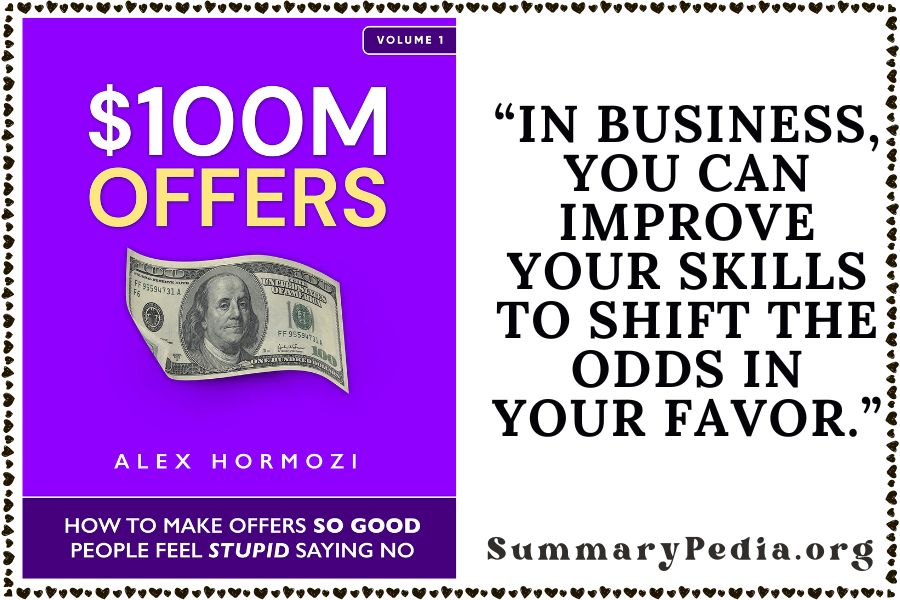
- “In business, you can improve your skills to shift the odds in your favor. Simply stated, with enough skill, you can become the house.”
- “The good news is that in business, you only need to hit one Grand Slam Offer to retire forever.”
- “The only way to conduct business is through a value exchange, a trade of dollars for value.”
- “A commodity, as I define it, is a product available from many places. For that reason, it’s prone to purchases based on ‘price’ instead of ‘value.'”
- “The pain is the pitch.”
- “There is no strategic benefit to being the second cheapest in the marketplace, but there is for being the most expensive.”
- “Desire is a contract you make with yourself to be unhappy until you get what you want.”
- “The longer you delay the ask, the bigger the ask you can make.”
- “Fear of loss is stronger than desire for gain.”
Explore 100 more insightful quotes from this book here.
About the Author Alex Hormozi is a highly successful entrepreneur, investor, and philanthropist. He founded Gym Launch, scaling it to over $120 million in revenue, and subsequently built a portfolio of highly successful companies spanning software, education, and e-commerce. He is the founder of Acquisition.com, a firm that invests in and scales companies generating $3M to $10M in yearly revenue. Known for his candid, no-nonsense approach to business and marketing, Hormozi has built a massive following on platforms like YouTube and through his podcast. His strategic frameworks are widely respected by business audiences for their extreme practicality, focus on psychological triggers, and dedication to raw profitability.
Deep Diving
Frequently Asked Questions:
- What is a Grand Slam Offer? It is an offer so inherently valuable and uniquely packaged that it eliminates price comparison and makes prospects feel stupid for saying no.
- Why shouldn’t I compete on price? Competing on price turns your service into a basic commodity, drastically shrinking margins until you can barely survive.
- What are the three ways to grow a business? You can get more customers, increase their average purchase value, and get them to buy more times.
- What is the Value Equation? It is (Dream Outcome x Perceived Likelihood of Achievement) divided by (Time Delay x Effort & Sacrifice).
- Why should I charge high prices? High prices allow you to deliver a superior service, attract better clients, and actually increase the perceived value of the product.
- How do I find the right market? Look for a “starving crowd” that possesses massive pain, purchasing power, easy targeting, and market growth.
- What is the difference between scarcity and urgency? Scarcity limits the physical quantity or supply of an offer, while urgency limits the time available to buy it.
- Why are bonuses better than discounts? Discounts actively devalue your core offer; bonuses increase the total perceived value while safely maintaining your price integrity.
- How does an anti-guarantee work? By stating “all sales are final,” you strongly imply the product is incredibly powerful or proprietary, attracting serious buyers.
- What do I do when my offer fatigues? Simply change the “wrapper” or name of the offer using the M-A-G-I-C formula, rather than changing the core operational fulfillment.
Theories and Concepts:
- The Commodity Problem: When products are perceived as identical, consumers naturally buy based on the lowest price. Grand slam offers shift this dynamic completely to a value-driven purchase.
- Sales to Fulfillment Continuum: The operational balance between making an offer incredibly easy to sell (doing everything for the client) versus easy to fulfill (making the client do the work).
- The Delicate Dance of Desire: Controlling your supply to always ensure it is slightly below market demand, thereby keeping the target audience perpetually ravenous.
Books and Authors:
- Dan Kennedy: Mentioned as a major influence on Hormozi regarding the core concept of “irresistible offers” and the immense power of premium niche pricing.
- Jason Fladlien: Referenced specifically for his brilliant insights on the power of bonuses and the immense effectiveness of outsized conditional guarantees.
Persons:
- Leila Hormozi: Alex’s wife and business partner, who provided crucial emotional support and trusted him during his lowest financial points before massive success.
- Travis Jones (TJ): A business organizer who gave Hormozi the pivotal advice to “Make people an offer so good they would feel stupid saying no”.
- Arnold Schwarzenegger: A lifelong hero of Hormozi’s, whose charity fundraiser provided an elite masterclass in applying extreme scarcity and exclusivity.
How to Use This Book: Map out your customer’s deep obstacles, creatively convert them into solutions, trim the high-cost items, and meticulously stack the rest into an irresistible bundle. Apply aggressive scarcity, a strong guarantee, and a M-A-G-I-C name.
Conclusion
Stop racing to the bottom by competing on price and start engineering undeniable value. Implement the exact frameworks in $100M Offers to transform your business into a category of one today!