
What are the Skills of Summary Writing
Summary writing requires strong comprehension, critical thinking, and concise communication skills. A good summary writer must be able to understand the main ideas and key points of a text and effectively condense them into a shorter, coherent version.
They also need to have the ability to prioritize information, extract the essential details, and present them in a clear and organized manner. Furthermore, summary writing demands proficiency in language and writing to effectively convey the original message without losing its essence.
In today’s fast-paced world, the skill of summary writing is highly valuable, allowing information to be quickly and easily disseminated to a broader audience. Effective summaries provide the essence of a larger body of work without sacrificing its core ideas.
Importance Of Summary Writing
Summary writing is an essential skill that involves condensing a piece of text or content into a concise and coherent form. It requires the writer to extract the main points and key details, presenting them in a clear and organized manner. The importance of summary writing lies in its ability to enhance comprehension and improve writing skills, making it a valuable tool for academic, professional, and everyday communication.
Enhances Comprehension
Summarizing content enhances comprehension by requiring the writer to analyze and synthesize information, distilling it into its most essential components. This process helps the reader to grasp the main ideas and important details more effectively, promoting better understanding and retention of the material. By summarizing, individuals can quickly grasp the key points of a text, enabling them to engage with the content more efficiently.
Improves Writing Skills
Engaging in summary writing can greatly improve an individual’s writing skills by honing their ability to select and organize information effectively. It encourages writers to develop clarity and conciseness, as they must convey the essence of a text within a limited space. Furthermore, summary writing cultivates the skill of paraphrasing and structuring ideas coherently, fostering better communication and ensuring that the writer conveys the intended message accurately.
Key Components Of A Good Summary
Identifying The Main Idea
A good summary begins with identifying the main idea of the text. It involves grasping the central message or argument and recognizing the key points that support it. This skill requires careful reading and comprehension, enabling the writer to extract the essence of the original content.
Condensing Information
Condensing information is a crucial aspect of summary writing. It involves the ability to express the main points concisely while retaining their significance. The writer should focus on capturing the essential elements and omitting extraneous details, ensuring that the summary is clear and to the point.
Maintaining Objectivity
In summary writing, maintaining objectivity is essential to present the content impartially. The writer should refrain from injecting personal opinions or bias, instead focusing on accurately representing the original material. This skill ensures that the summary reflects the author’s intent without subjective influence.
Techniques For Effective Summary Writing
Summary writing is a valuable skill that allows you to condense and clarify the main ideas of a text. Whether you’re a student tackling a reading assignment or a professional seeking to summarize important information, mastering summary writing techniques is essential. In this section, we will explore three key techniques to help you write effective summaries: Active Reading, Highlighting Key Points, and Paraphrasing.
Active Reading
- Focus: When reading a text, it’s important to approach it with an active mindset. Concentrate on absorbing the main ideas and concepts presented.
- Eliminate distractions: Find a quiet space where you can fully engage with the material. Turn off your phone and other devices that may divert your attention.
- Note-taking: While reading, jot down important points and ideas that stand out. These notes will help guide you in creating a concise summary later on.
- Ask questions: To ensure comprehension, ask yourself questions about the text. What is the author trying to convey? Why is this information significant?
Highlighting Key Points
Once you have finished reading the text, the next step is to identify and highlight the key points. This will be the foundation of your summary. Here’s how to effectively highlight:
- Focus on the main idea: Identify the central theme or argument of the text. This is usually found in the introductory paragraph or thesis statement.
- Identify supporting details: Look for evidence and examples that support the main idea. These details provide context and strengthen your summary.
- Use visual aids: Create a visual representation of the key points, such as a table or bullet points. This will help you organize the information and make the summary writing process easier.
Paraphrasing
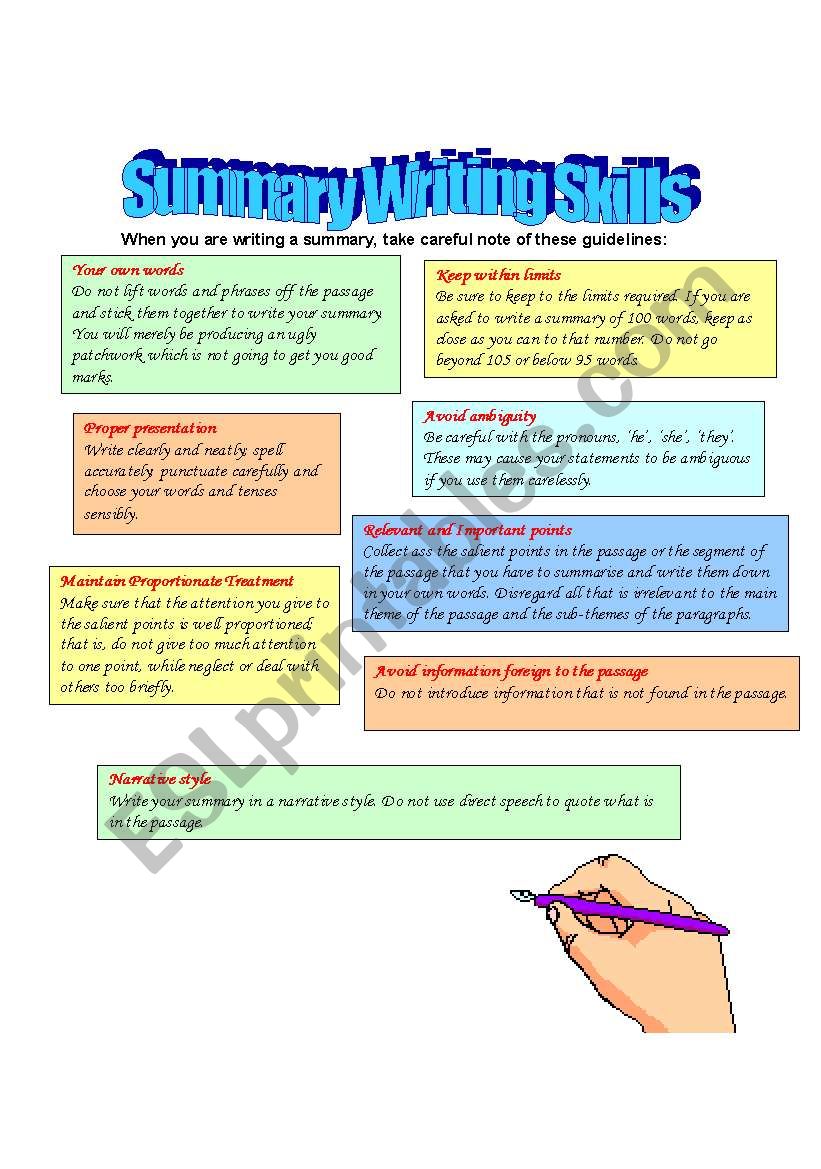
When summarizing a text, it’s important to rephrase the main ideas in your own words. Avoid copying the original author’s sentences verbatim. Here are some tips for effective paraphrasing:
- Simplify: Break down complex sentences and ideas into simpler terms.
- Change sentence structure: Rearrange the wording and sentence structure while maintaining the original meaning.
- Use synonyms: Replace original words with synonyms to create a unique summary.
- Condense: Aim to condense the information while retaining the essence of the original text. Remove any unnecessary details or repetitive statements.
By applying these techniques of Active Reading, Highlighting Key Points, and Paraphrasing, you’ll be well-equipped to write effective summaries that capture the essence of the text. Remember to practice regularly to master these skills and improve your ability to summarize information concisely and accurately.
Credit: www.eslprintables.com
Common Mistakes To Avoid
Summary writing is an essential skill that helps to condense lengthy texts into concise and coherent summaries. However, it is common for writers to make some mistakes while summarizing information. Being aware of these pitfalls can help you enhance your summary writing skills and produce effective and impactful summaries. In this section, we will discuss three common mistakes to avoid when writing summaries: including personal opinions, adding unnecessary details, and neglecting the main points.
Including Personal Opinions
One of the main objectives of summary writing is to provide a clear and unbiased overview of the original text. A summary should be objective and focus on presenting the author’s key points and arguments without injecting personal opinions or biases. When summarizing, avoid using phrases such as “I think” or “in my opinion.” Instead, strive to maintain an objective tone and accurately represent the author’s perspective.
Adding Unnecessary Details
A common mistake in summary writing is including unnecessary details that are not essential to understanding the main points of the original text. When summarizing, it is important to focus on the most relevant and significant information while omitting less important details. This helps to create a concise and succinct summary that captures the essence of the original text. Avoid overloading your summary with excessive information or examples that do not contribute to the central message.
Neglecting The Main Points
When summarizing a text, it is crucial to identify and highlight the main points and arguments presented by the author. Neglecting these key elements can result in an incomplete or inaccurate summary. To avoid this mistake, carefully read the original text and identify the central ideas and supporting arguments. Pay close attention to the introduction, conclusion, and topic sentences of each paragraph, as they often contain vital information that should be included in the summary.
In conclusion, summary writing is a skill that requires practice and attention to detail. By avoiding common mistakes, such as including personal opinions, adding unnecessary details, and neglecting the main points, you can enhance the clarity, objectivity, and effectiveness of your summaries.
Tips For Enhancing Summary Writing Skills
Are you looking to enhance your summary writing skills? Summary writing is a valuable skill that can be applied in various academic, professional, and personal situations. Whether you need to summarize an article, a book, or a presentation, having strong summary writing skills can help you effectively condense information and communicate key points concisely. In this blog post, we will discuss some tips to help you enhance your summary writing skills, allowing you to become a more effective communicator.
Practice Regularly
Regular practice is the key to mastering any skill, and summary writing is no exception. The more you practice, the more comfortable you will become with condensing information and extracting the most important points. Set aside dedicated time each day to practice summary writing. You can start by summarizing short articles or blog posts, gradually working your way up to longer and more complex texts.
Additionally, consider using prompts or exercises specifically designed for summary writing practice. These can help you focus on particular aspects of summary writing, such as identifying key ideas, making connections between different points, and maintaining the overall coherence of the summary.
Remember, practice makes perfect, so make an effort to incorporate summary writing practice into your routine. With consistent practice, you will see significant improvements in your ability to summarize effectively.
Seek Feedback
Seeking feedback from others is a valuable way to enhance your summary writing skills. Feedback allows you to gain insights and perspectives that you may have missed on your own. It can also help you identify areas for improvement and learn from your mistakes.
When seeking feedback, consider sharing your summaries with trusted individuals, such as teachers, peers, or mentors who have expertise in the subject area or writing skills. Ask them to provide specific feedback on the clarity, conciseness, and overall effectiveness of your summary. This feedback can help you refine your writing and make necessary adjustments to produce stronger summaries.
Additionally, consider joining a writing group or participating in online forums where you can share your summaries and receive feedback from a wider audience. Engaging in discussions and exchanging ideas with fellow writers can provide valuable insights and different perspectives, further enhancing your summary writing skills.
Analyze Well-written Summaries
Another effective way to enhance your summary writing skills is to analyze well-written summaries. Reading and studying high-quality summaries can help you understand the techniques and strategies employed by skilled writers.
Start by identifying summaries in your field of interest or specific topic area. Read these summaries carefully, paying attention to the structure, organization, and language used. Analyze how the writer has condensed the information and highlighted the key points, while maintaining the coherence and flow of the summary.
Make note of the techniques and strategies that resonate with you or that you find particularly effective. Consider how you can incorporate these techniques into your own summary writing. However, be mindful not to plagiarize or copy directly from the original summaries. Instead, use them as a source of inspiration and guidance to improve your own writing.
By regularly analyzing well-written summaries, you will develop a deeper understanding of effective summary writing techniques and enhance your own skills in the process.
Credit: leverageedu.com

Credit: www.youtube.com
Frequently Asked Questions Of What Are The Skills Of Summary Writing
What Are 5 Key Features Of Summary Writing?
Summary writing is a concise form of writing that highlights the main points of a longer piece. Key features include brevity, clarity, and active voice. It should be unique, plagiarism-free, and easy to understand. Avoid starting with certain words/phrases and passive voice.
Keep it under 50 words for optimal SEO.
What Are The Skills Of Summarizing?
Summarizing skills involve identifying key points, condensing information, and capturing the main ideas. It requires critical thinking, clarity, and the ability to communicate concisely. Good summarizers can grasp important details and effectively present them in a shortened form.
What Are The Five Techniques Of Summary Writing?
The five techniques of summary writing include condensing the original text, omitting unnecessary details, using your own words, focusing on main points, and highlighting key information.
Conclusion
Mastering the skills of summary writing is essential for effective communication. By condensing information and capturing the key points, summary writing enables readers to quickly grasp the main ideas without unnecessary details. With practice and focus on clarity, accuracy, and objectivity, anyone can develop this valuable skill.
Remember, concise and well-crafted summaries enhance understanding and readability, making them a valuable tool in various professional and academic settings. So, keep practicing and hone your summary writing skills to become a better communicator.


