Unleash the Power of Storytelling by Rob Biesenbach
In an era of relentless information overload, facts alone are no longer enough to move an audience. Unleash the Power of Storytelling by Rob Biesenbach serves as a no-nonsense, practical roadmap to mastering the most persuasive form of communication known to man. This book matters today because it demystifies the “art” of storytelling, providing a structured process to win hearts, change minds, and get results in a noisy world.
Who May Benefit
- Business Leaders seeking to align teams and build trust.
- Sales Professionals looking to close more deals through emotional connection.
- Job Seekers needing to construct a compelling career narrative.
- Nonprofit Advocates wanting to motivate donors via impactful stories.
- Public Speakers aiming to deliver more memorable presentations or tributes.
Top 3 Key Insights
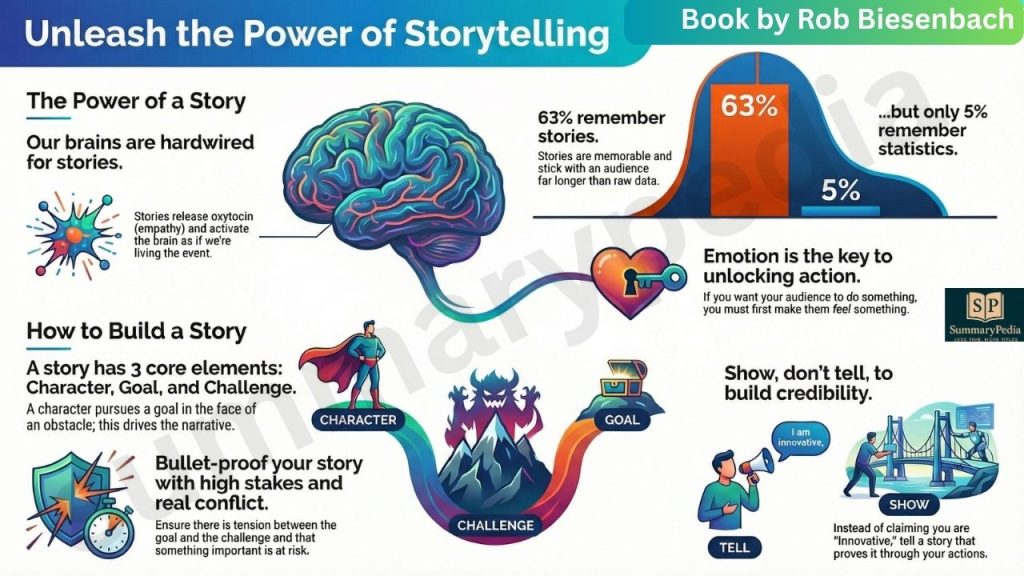
- Structure is Essential: Every story needs a character pursuing a goal against a challenge.
- Emotion Unlocks Action: People decide based on feelings and justify with logic; stories trigger the oxytocin necessary for empathy.
- Show, Don’t Tell: Replace hollow claims with specific stories that provide proof of your value.
4 More Takeaways
- Ruthless Editing: Focus on the “trunk” of the story and cut the distracting “twigs”.
- Personal Branding: Your brand is your reputation; use stories to define it before others do.
- Everyday Hunting: Great stories aren’t found on Google; they are collected daily through personal experience and observation.
- Origin Stories: Every company needs a narrative explaining its purpose and values to humanize the brand.
Book in 1 Sentence
A practical guide that applies performance techniques and simple structures to help professionals use stories to influence others and achieve success.
Book in 1 Minute
In Unleash the Power of Storytelling, Rob Biesenbach bridges the gap between the corporate world and the world of performance. He argues that because our brains are hardwired for narrative, stories are the “signal” that cuts through modern noise. By using a simple three-part structure—character, goal, and challenge—anyone can transform dry data into an emotional experience that sticks. Biesenbach provides a toolkit for finding, focusing, and delivering stories, whether for a high-stakes presentation, a job interview, or a personal brand. The emotional takeaway is clear: by being vulnerable and authentic, you create a human connection that data points simply cannot replicate.
1 Unique Aspect
Biesenbach draws directly from his experience as a Second City-trained actor, applying the principles of improvisational and sketch comedy to make business communication feel like a performance that connects with a live audience.
Chapter 1: What Makes Stories so Powerful?
“Stories are the signal that stands out amidst the noise.”
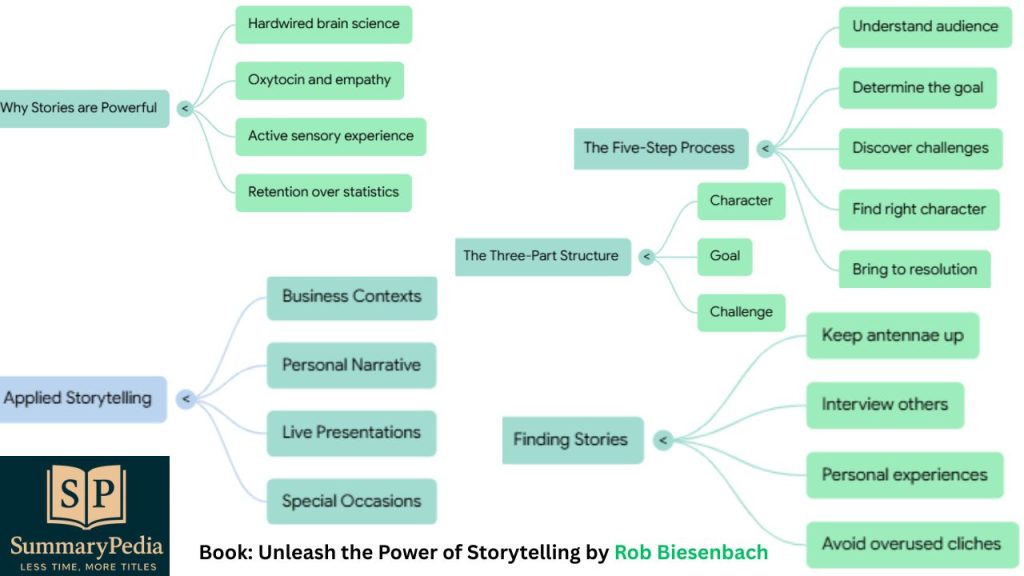
Stories are not just “soft skills”; they are backed by hard science. Our brains produce oxytocin when hearing stories, fostering empathy and making us more amenable to new ideas. Biesenbach explains that we are hardwired for narrative through a lifetime of “nurture,” making a well-told story more memorable than statistics. By putting a human face on an issue, stories raise the stakes and humanize the speaker. Instead of relying on “match.com syndrome”—making generic claims like being “resourceful”—the author urges us to show our qualities through actions.
Chapter Key Points:
- Oxytocin triggers empathy
- Stories trump statistics
- Show, don’t tell
Chapter 2: What is a Story?
“In its simplest form, a story is a character in pursuit of a goal in the face of some challenge or obstacle.”
Defining a “story” can be confusing, but Biesenbach settles on a three-part stool: Character, Goal, and Challenge. Without these, you have a timeline, not a narrative. He illustrates this with examples ranging from Romeo and Juliet to a factory worker named Estela. To “bullet-proof” a story, the character must be relatable, the conflict must be sufficient to hold attention, and there must be clear cause and effect. This simple structure allows an audience to mentally place themselves in the story, asking how they would measure up in similar circumstances.
Chapter Key Points:
- Character, goal, challenge
- Conflict creates drama
- Stakes must be high
Chapter 3: How to Create a Story
“Knowing your audience is the first rule of show business.”
Creating a story is a strategic process that begins with identifying the audience. You must understand their needs, fears, and “emotional hot buttons” to ensure your message resonates. The process involves five steps: identifying the audience, determining your goal, discovering the challenges, finding the right character, and ensuring a resolution. Biesenbach emphasizes that stories must address what the audience cares about, using a bridge to connect your goals with their desires. Technical jargon should be replaced with meaningful language that matches the audience’s knowledge level.
Chapter Key Points:
- Identify audience needs
- Start with the goal
- Find relatable characters
Chapter 4: Emotion Fuels Stories
“Winning hearts is the key to changing minds.”
While many professionals fear public displays of emotion, Biesenbach argues that emotion drives decision-making. He cites neuroscientist Antonio Damasio, who found that without emotion, humans are incapable of making even simple decisions. To trigger emotion in others, the storyteller must exhibit emotion themselves, whether it’s passion, joy, or righteous indignation. The author provides a roadmap for tapping into emotional triggers like loyalty, pride, and personal passions. He encourages leaders to reveal their humanity, as people want to follow humans, not machines.
Chapter Key Points:
- Emotion unlocks decisions
- Authenticity cannot be faked
- Vulnerability is leadership
Chapter 5: Stories at Work
“Major movements often turn on a series of small moments.”
This chapter provides real-world applications of storytelling to achieve specific business goals. For example, a sales leader used a story about her own early-career fears to establish common ground with a skeptical team. Another CEO used a personal story about his love for the company’s heritage to thaw a hostile relationship with factory workers. Biesenbach also explains how the National Park Service uses a tragic story about a hiker to motivate safe behavior more effectively than a list of rules. These examples demonstrate that stories provide the “why” behind the “what”.
Chapter Key Points:
- Disarm critics with humility
- Story justifies policy
- B2B requires emotion too
Chapter 6: How to Focus Your Story
“Just as important as what goes in to a story, is what you leave out.”
A common mistake is weighing down a story with excess baggage. Biesenbach compares a good story to a tree: you should stay on the “trunk” (the main narrative) and avoid wandering onto “twigs” or tangents. He offers seven ways to declutter, including eliminating minor characters, simplifying dates, and rounding off large numbers to make them more meaningful. Crucially, the author notes it is okay to “lie” by compressing timelines or omitting irrelevant details for the sake of the audience’s experience, as long as the fundamental truth remains.
Chapter Key Points:
- Cut extraneous details
- Simplify all numbers
- Avoid the “and then”
Chapter 7: How to Preserve the Integrity of Your Stories
“And that is where great stories go to die — the meat grinder that is the corporate approval process.”
Storytelling requires the courage to make bold choices. In business, however, stories often face a “meat grinder” of approvals from HR, lawyers, and committees that water them down. Biesenbach shares how he successfully produced a commemorative book for a law firm by restricting the approval process and focusing on client stories rather than internal self-promotion. He advises storytellers to negotiate for the big issues—character and conflict—while being willing to compromise on non-essentials. Ultimately, you must trust your audience to “get” a focused, specific story.
Chapter Key Points:
- Restrict approval committees
- Defend core integrity
- Trust your audience
Chapter 8: How and Where to Find Great Stories

“The worst time to look for a story is when you really need one.”
Effective communicators are lifelong collectors of stories. Biesenbach warns against “Googling” for stories, as this leads to overused anecdotes like the “starfish thrower” that feel inauthentic. Instead, he suggests using your goals and brand as a filter to keep your “antennae up” for stories in everyday life—at the gym, on vacation, or in conversation. He also recommends interviewing others (employees, customers, donors) to uncover their unique perspectives. Finally, he urges using a system like a notes app or spreadsheet to store stories so they are ready when needed.
Chapter Key Points:
- Be a story collector
- Avoid cliché Google stories
- Interview your constituents
Chapter 9: Story’s Cousins: Comparison, Analogy, and Metaphor
“Provocative metaphors… evoke feelings that bypass critical thinking.”
You don’t always need a full story to make an impact; figures of speech can fire the imagination just as effectively. Biesenbach highlights the power of sensory-stimulating words—using “soar” instead of “rise”—and visual verbs. Metaphors and analogies are “universal shorthand” for abstract ideas, like John F. Kennedy comparing rocket power to 10,000 automobiles. Comparisons are also vital for humanizing large numbers; for example, describing a forest fire’s size in terms of “Manhattan” rather than abstract acreage. These tools help transform complex data into tangible representations.
Chapter Key Points:
- Use sensory verbs
- Metaphors bypass critical thinking
- Scale numbers to touchpoints
Chapter 10: The Dark Side of Storytelling
“Our brains lie to us.”
Storytelling has a “dark side” where narrative can overshadow facts. Biesenbach discusses the “tyranny of the narrative,” where the media focuses on a “comeback story” or “shambles” regardless of underlying data. He also warns of the “Brian Williams effect,” noting that memories are not static; they are continuously reprocessed and can drift away from the truth over time. Because our brains are “storytelling machines,” they can even plant false memories. The lesson for storytellers is to fact-check accounts and be mindful of exaggerating one’s role in events.
Chapter Key Points:
- Beware the herd mentality
- Fact-check your memories
- Minimize self-aggrandizement
Chapter 11: How to Tell Your Company’s Origin Story
“Data points do not stick. Stories and characters do.”
Every business needs an origin story to humanize the brand for customers and employees. The author critiques the “corporate timeline” full of boring milestones like reorganizations, suggesting instead that companies focus on pivotal moments with flavor and conflict. He analyzes successful stories from John Deere (the plow that solved a farmer’s struggle) and Subway (the 17-year-old entrepreneur). A great origin story should be threaded with a theme like innovation or service and written in a conversational tone, as seen in Trader Joe’s “About Us” section.
Chapter Key Points:
- Ditch the boring timeline
- Humanize the founder
- Thread a brand theme
Chapter 12: How to Use Stories in a Presentation
“You should begin with story, end with story, and include stories throughout.”
Stories should be the centerpiece of any talk. Biesenbach advises against starting with an agenda; instead, “start with story” to hook the audience’s interest immediately. However, he warns against “story overload,” which can dilute the power of each narrative and make the speaker seem to lack substance. For delivery, the author emphasizes performance techniques: varying vocal expression, using the body to create a “stage picture,” and maintaining mental focus. Staying “connected” to the material, much like a stage actor, prevents a story from sounding scripted and inauthentic.
Chapter Key Points:
- Open with a hook
- Avoid story overload
- Stay present and focused
Chapter 13: How to Tell Your Own Story
“Framing your career in story terms makes it more entertaining… [and] distinguishes one person from another.”
Introducing oneself is often a boring “alphabet soup” of job titles and numbers. Biesenbach suggests finding the “implicit narrative” of your career—the common thread or pattern that ties your experiences together. He uses a five-part structure for personal stories: Normal State, Inciting Incident, Turning Point, Conflict, and Resolution. By sharing why you do what you do and what you stand for, you create a narrative that is both unique and compelling. The goal is to give a glimpse of your character so that others want to know more.
Chapter Key Points:
- Find your “implicit narrative”
- Connect your career dots
- Share your “why”
Chapter 14: How to Tell Your Personal Brand Story
“You’re building your brand daily, either by design or by default.”
Your “brand” is simply your reputation. Since it exists in the minds of others, you must work to influence their perceptions through consistent behavior and communication. Biesenbach suggests identifying your archetype—whether you’re the “Analyzer,” the “Bulldog,” or the “Cool Cucumber”—and capturing it in a brand story. To avoid sounding arrogant, use a tone of humility and frame yourself as an “accidental hero” or attribute the praise to others. A well-defined brand helps you say “no” to projects that don’t fit your strengths.
Chapter Key Points:
- Brand equals reputation
- Archetypes clarify your value
- Modesty ensures credibility
Chapter 15: How to Use Story for a Toast, Tribute, or Eulogy
“A story can help you frame and focus your thoughts… stories pack unparalleled power to move people.”
Delivering a tribute is often the most difficult storytelling task. Biesenbach uses Paul McCartney’s tribute to George Martin as a model: choose three simple adjectives and provide a single, specific story as “proof” of those qualities. He offers ten guidelines, including speaking from the heart, focusing on small sensory details, and drawing a lesson. For delivery, he suggests using notes, breathing deeply, and forgiving yourself if you lose composure. Even in “complicated” relationships, a story allows for detachment and honesty without lavishing empty praise.
Chapter Key Points:
- Use the “rule of threes”
- Provide specific story proof
- Breathe and pause
10 Notable Quotes
- “Win hearts, change minds, get results.”
- “Stories are the signal that stands out amidst the noise.”
- “Winning hearts is the key to changing minds.”
- “People buy on emotion and justify with logic.”
- “As far as the brain is concerned, there’s little distinction between story and experience.”
- “Narrower is better.”
- “Data points do not stick. Stories and characters do.”
- “Your brand is essentially what you’re known for.”
- “Passion sells.”
- “Stories are all around us. We may not recognize them, but they’re there.”
About the Author
Rob Biesenbach is an award-winning communication consultant who helps Fortune 500 executives at firms like Deloitte, Allstate, and Lockheed Martin communicate with purpose. A former Vice President at Ogilvy PR Worldwide, he co-founded their global employee communications practice. What sets Biesenbach apart is his second career as a Second City-trained actor and improviser, having appeared in nearly 200 stage and commercial productions. He is the author of other influential works, including 11 Deadly Presentation Sins and Act Like You Mean Business. Based near Chicago, he combines his background in public relations and show business to help professionals become more powerful and persuasive communicators.
How to Use This Book
Read this book as a field manual. Start by identifying one upcoming presentation or meeting and apply the character-goal-challenge structure to your key message to immediately boost its impact.
Conclusion
Storytelling is not a “soft” mystical talent—it is a practical tool that defines who we are and what we stand for. By embracing structure, emotion, and vulnerability, you can build authentic connections that set you apart in a competitive world. Don’t let fear hold you back; start collecting your stories today and allow your individuality to shine through!
Analogy for the Road: Think of your story like a lighthouse in a storm—if it is built on a solid structural foundation and shines with the bright light of emotion, it will guide your audience safely to your message through even the thickest fog of data.