Think and Grow Rich by Napoleon Hill
Napoleon Hill’s Think and Grow Rich is a timeless classic that explores the psychology of achievement. Based on a meticulous study of the lives of highly successful individuals, Hill unveils the principles that underpin their extraordinary success. This book is not merely about accumulating wealth but rather a comprehensive guide to achieving any desired goal, be it financial, personal, or professional.
Who May Benefit
- Entrepreneurs seeking definite purpose and strategy.
- Executives aiming for leadership by consent.
- Professionals desiring increased personal income.
- Students organizing acquired knowledge into applied power.
- Anyone seeking mastery over fear and poverty consciousness.
Top 3 Key Insights
- The Origin of Wealth: All earned riches start as definite thoughts backed by a burning desire, persistence, and carefully organized plans.
- Defeat is Informative: Temporary defeat is only feedback; successful people never quit the goal but reorganize and rebuild new, sound plans.
- The Master Mind: True power is achieved through a “Master Mind” alliance—coordinating knowledge and effort between two or more harmonious people for a definite purpose.
4 More Takeaways
- Transmutation of Energy: Transmute potent sex energy from physical desire into a compelling creative force, enabling genius-level achievement.
- Mastering Procrastination: Overcome procrastination and worry by immediately reaching prompt, firm decisions, as indecision is the destructive seedling of fear.
- Subconscious Magnet: The subconscious mind, the mental broadcasting station, translates dominant, emotionalized thoughts into reality, regardless of whether they are positive or negative.
- Knowledge vs. Power: Specialized knowledge is potential power only; it gains real value when organized into definite plans and actively directed toward a specific financial end.
Book in 1 Sentence
Success comes from training your mind to focus a burning desire into definite plans, backed by unwavering faith and persistence.
Book in 1 Minute
This classic text, inspired by Andrew Carnegie, reveals the immutable philosophy of individual achievement based on thirteen steps. The core message is that “thoughts are things,” powerful enough to dictate one’s financial destiny. By transforming a vague “wish” into a white-hot, definite desire, you initiate a process where your subconscious mind, aided by faith and auto-suggestion, works day and night to create a plan for its attainment. The book stresses overcoming internal enemies like procrastination and the six basic fears. Wealth is attracted only to those whose minds are prepared and persistently focused on a goal, understanding that there are no limitations except those we acknowledge.
1 Unique Aspect
The book posits that your brain is both a broadcasting and receiving station for thought energy via the ether, capable of attracting related ideas and influences—making organized, dominant thought crucial to material success.
What Is Think and Grow Rich About?
Think and Grow Rich is the combined wisdom from more than 500 of America’s most successful individuals. Their insights were then narrowed down into 13 principles and contribute to what Hill refers to as an overall “Philosophy of Achievement.”
However, refusing to let Think and Grow Rich be defined purely as a method or system for success, Hill stated that the goals of his book were:
- To help the reader become self-aware.
- To help the reader understand how to become more effective amidst the immutable laws of the universe.
What Are the 13 Principles of Think and Grow Rich?
Napoleon Hill’s 13 principles of success present a philosophy of achievement that is intended to be mulled over. This Think and Grow Rich summary will look at each of the 13 principles in turn. They are as follows:
- Desire
- Faith
- Auto-suggestion
- Specialized Knowledge
- Imagination
- Organized Planning
- Decision
- Persistence
- The Power of the Master Mind
- Sex Transmutation
- The Subconscious Mind
- The Brain
- The Sixth Sense
Uniquely philosophical and, at times, veering on spiritual, Think and Grow Rich has become a seminal book for entrepreneurs, CEOs, and individual thinkers alike. By reading the key points from this Think and Grow Rich chapter summary, you’ll learn how to master your subconscious and command your destiny.
Desire: The Starting Point of All Achievement
Hill states that the key to success is to define a goal and to pour all of your energy, power, and effort into achieving it. It may take many years before you are successful, but if you hold onto your desire, you will eventually attain what you seek.
Merely wishing for money will get you nowhere. However, to desire riches by way of an obsessive goal, a meticulous plan, and not accepting failure as an option, you’ll become rich. To help you do so, Hill presents the Think and Grow Rich six6 steps:
- Decide exactly how much money you wish to make, to the dollar.
- Determine what you are willing to give to receive this amount of money.
- Choose a date by which you want to have amassed this amount of money.
- Create a plan of how to achieve your goal and begin at once, whether you feel ready or not.
- Write all of the above down in a clear statement.
- Read this written statement aloud, twice a day – first thing in the morning and last thing at night. Visualize your life as if you already own this amount of money.
While being able to visualize yourself as rich may seem challenging at first, it’s only those individuals who are “money conscious” that become successful. To be money conscious is to see yourself in possession of great wealth before you attain it. You will only become rich if you possess a deep desire for money, and you stop at nothing to get it.
Chapter-wise Summary
Do you believe wealth is reserved for the lucky or the highly educated? After 25 years studying the world’s greatest fortunes, Napoleon Hill reveals that all achievement begins not with luck, but with a definite idea. This text provides the definitive thirteen steps—a tested philosophy to turn intangible thought impulses into tangible financial success. It’s a textbook for individual achievement, urging readers to harness the vast, untapped power of their own minds.
CHAPTER 1: Introduction
“TRULY, ‘thoughts are things,’ and powerful things at that, when they are mixed with definiteness of purpose, persistence, and a BURNING DESIRE…”.
This introductory chapter establishes the core thesis through the compelling story of Edwin C. Barnes, who, despite looking like a “tramp,” possessed a definite, burning desire to become a business associate of Thomas A. Edison. Barnes’s relentless focus and determination, which “burned all bridges behind him,” led him to a lucrative partnership that spanned over thirty years, proving that intangible thought can be transmuted into its physical counterpart. The chapter contrasts this victory with the cautionary tale of R. U. Darby, who quit his gold mining claim just “three feet from gold.” This story teaches that temporary defeat is merely a signal that the plan is unsound, requiring a new plan, not abandonment of the goal itself.
Chapter Key Points:
- Burning desire translates to reality.
- Defeat requires a new plan.
- Persistence mows down opposition.
CHAPTER 2: Desire (The First Step)
“WISHING will not bring riches. But desiring riches with a state of mind that becomes an obsession… will bring riches”.
Desire is the definite starting point of all achievement, demanding a state of mind that becomes a “consuming obsession”. The chapter outlines the Six Practical Steps—a method endorsed by Edison and Carnegie—to transmute desire into financial equivalent. These steps include fixing the exact financial amount, determining what is given in return, establishing a definite date for acquisition, and creating a plan immediately. Crucially, the plan must be written down and read aloud twice daily, visualizing and believing the money is already possessed, thereby saturating the mind and becoming “money conscious”.
Chapter Key Points:
- Riches require definite demands.
- Follow the six steps precisely.
- Visualize yourself possessing wealth.
CHAPTER 3: Faith (The Second Step)
“ALL THOUGHTS WHICH HAVE BEEN EMOTIONALIZED, (given feeling) AND MIXED WITH FAITH, begin immediately to translate themselves into their physical equivalent…”.
Faith is the “head chemist of the mind,” the emotional “elixir” that gives life and power to thought, instantly enabling the subconscious mind to communicate the impulse to Infinite Intelligence. Faith is not mystical, but a state of mind that can be created through repetition (auto-suggestion). The subconscious mind acts on any emotion-driven thought; therefore, destructive negative beliefs (like feeling “doomed”) are translated just as readily as positive ones, creating self-made misfortune. To cultivate faith, one must deliberately fill the mind with positive emotions (Faith, Love, Sex) and eliminate negative ones, transforming timidity into courage.
Chapter Key Points:
- Faith is key to Infinite Intelligence.
- Subconscious acts on dominant belief.
- Eliminate negative thought influences.
CHAPTER 4: Auto-Suggestion (The Third Step)
“Your subconscious mind recognizes and acts upon ONLY thoughts which have been well-mixed with emotion or feeling”.
Auto-suggestion is the crucial medium through which conscious thought reaches and influences the subconscious mind. Since the conscious mind acts as an “outer-guard,” auto-suggestion must be applied voluntarily and continuously to plant creative thoughts. Plain, unemotional words are insufficient; the subconscious only acts upon thoughts “well-mixed with emotion or feeling,” such as absolute FAITH. Successful use requires persistence and the capacity to concentrate on the desired amount of money until the desire becomes a burning obsession, forcing the subconscious to deliver the necessary, practical plan, often via a sudden “inspiration” or “telegram” from Infinite Intelligence.
Chapter Key Points:
- Control thought input via auto-suggestion.
- Mix emotion with mental orders.
- Concentrate until desire obsesses.
CHAPTER 5: Specialized Knowledge (The Fourth Step)
“Knowledge is only potential power. It becomes power only when, and if, it is organized into definite plans of action, and directed to a definite end”.
The accumulation of great fortunes requires specialized knowledge, which is distinct from the general knowledge typically taught in schools. Knowledge, alone, is only potential power; it becomes actual power only through effective organization and use. An “educated man,” such as Henry Ford, is defined as one who knows where to find needed knowledge and how to organize it, relying often on his Master Mind group rather than personal erudition. The modern world demands specialization, and successful individuals never stop acquiring knowledge related to their chief purpose. The chapter emphasizes that leveraging specialized knowledge with imagination to create a practical, marketable idea—like the unique brief for selling personal services—is the key to bypassing mediocrity.
Chapter Key Points:
- Knowledge must be organized and used.
- Leverage others’ knowledge (Master Mind).
- Continuous pursuit of specialized learning pays.
CHAPTER 6: Imagination (The Fifth Step)
“The imagination is literally the workshop wherein are fashioned all plans created by man”.
Imagination is the mind’s workshop where the abstract impulse of Desire is given shape, form, and action. The imaginative faculty has two forms: Synthetic (arranging old concepts into new combinations, used most often in planning) and Creative (the direct communication link to Infinite Intelligence, delivering basic, new ideas or “hunches”). Creative imagination is only activated when the mind is vibrating at an exceedingly rapid rate, often stimulated by strong desire. The chapter highlights that all great fortunes, including the vast empire of Coca-Cola, began as a single idea—an intangible form of energy—transformed into reality by mixing the secret formula with imagination.
Chapter Key Points:
- Imagination fashions all plans.
- Creative faculty delivers “hunches”.
- Ideas are the seeds of reality.
CHAPTER 7: Organized Planning (The Sixth Step)
“A QUITTER NEVER WINS–AND– A WINNER NEVER QUITS”.
Translating desire into money requires creating and carrying out definite, practical plans. This process absolutely necessitates forming a Master Mind alliance—a harmonious group whose collective experience, education, and imagination perfect the strategy. When the first plan fails, recognize that temporary defeat is merely a sign that the plan is unsound, not the goal. You must rebuild and persist until a working plan is found. For selling personal services, intelligent planning involves self-analysis, adopting the “QQS” formula (Quality, Quantity, and the proper Spirit of cooperation), and presenting qualifications using a meticulously prepared, highly detailed “brief”.
Chapter Key Points:
- Form a harmonious Master Mind group.
- Temporary defeat means plan needs fixing.
- Market services using QQS formula.
CHAPTER 8: Decision (The Seventh Step)
“LACK OF DECISION was near the head of the list of the 30 major causes of FAILURE”.
A primary quality shared by those who accumulate fortunes is the habit of reaching decisions promptly and changing them slowly, if at all. Indecision and procrastination are weaknesses that must be conquered. Individuals must guard their plans and counsel closely, rejecting the cheap, negative opinions of friends, relatives, and neighbors. The chapter uses the powerful example of the signers of the Declaration of Independence, who staked their lives on a single, definite decision, proving that freedom and great achievement are born of courage and resolute action. The deficiency of modern education is its failure to instill the habit of definite decision in youth.
Chapter Key Points:
- Decide promptly and firmly.
- Ignore negative opinions/ridicule.
- Courage is essential to decision.
CHAPTER 9: Persistence (The Eighth Step)
“There is no substitute for PERSISTENCE. The person who makes PERSISTENCE his watch-word, discovers that ‘Old Man Failure’ finally becomes tired, and makes his departure”.
Persistence—the sustained effort necessary to induce faith—is non-negotiable for transmuting desire into its monetary equivalent. Lack of persistence is conquered by building a stronger fire under one’s desires; weak desires yield weak results. Poverty consciousness naturally seizes an idle mind, but money consciousness must be created deliberately through persistent application. Those who succeed are those who refuse to accept defeat as anything more than temporary, proving to the “hidden Guide” that they are worthy of reward. The four simple steps to cultivating persistence are having a definite purpose, continuous action, a mind closed tightly against negative influences, and a friendly alliance for encouragement.
Chapter Key Points:
- Persistence is fueled by strong desire.
- Failure cannot cope with persistence.
- Poverty consciousness is automatic.
CHAPTER 10: Power of the Master Mind (The Ninth Step)
“The ‘Master Mind’ may be defined as: ‘Coordination of knowledge and effort, in a spirit of harmony, between two or more people, for the attainment of a definite purpose.'”.
Power, defined as “organized and intelligently directed KNOWLEDGE,” is essential for accumulating and retaining money. Great power is achieved solely through the Master Mind principle, which has both an economic and a psychic aspect. The psychic aspect is the invisible, intangible force created when two or more minds coordinate in perfect harmony, creating a third, more potent energy available to every individual in the group. Andrew Carnegie credited his entire fortune to the power accumulated through his Master Mind group. The highest source of power is Infinite Intelligence, which can be absorbed directly through this harmonious alliance.
Chapter Key Points:
- Power is organized knowledge.
- Master Mind creates psychic energy.
- Harmony is critical to alliance.
CHAPTER 11: The Mystery of Sex Transmutation (The Tenth Step)
“The men of greatest achievement are men with highly developed sex natures; men who have learned the art of sex transmutation”.
Sex desire is the most powerful human urge, and sex transmutation means redirecting this intense energy from purely physical expression into creative effort. When harnessed, this force instantly enhances imagination, courage, persistence, and creative ability, potentially elevating the individual to the status of a genius. Research across 2,000 years shows that men of outstanding achievement were highly sexed and often inspired by a woman’s influence. The key reason men seldom succeed before age forty is the dissipation of this energy. The highest creative output is achieved when the emotions of Love, Romance, and Sex are constructively blended, providing the poise, balance, and elevated thought necessary for mastery.
Chapter Key Points:
- Sex desire is powerful mind stimulus.
- Transmutation requires disciplined will-power.
- Love, Sex, and Romance build genius.
CHAPTER 12: The Subconscious Mind (The Eleventh Step)
“The subconscious acts first on the dominating desires which have been mixed with emotional feeling, such as faith”.
The subconscious mind is the connecting link between the finite mind and Infinite Intelligence, acting as a mental filing cabinet where all thought impulses are recorded. It works continuously, day and night, to translate dominating desires into physical reality. Since it feeds on whatever thoughts reach it (positive or negative), controlling this input is essential to success. The subconscious is best influenced by emotionalized thoughts—the “language of feeling”—rather than cold reason. The seven major positive emotions (Desire, Faith, Love, Sex, Enthusiasm, Romance, Hope) must be deliberately used to saturate the mind, thereby gaining control and blocking negative influences.
Chapter Key Points:
- Subconscious works day and night.
- Influenced best by emotion/feeling.
- Positive emotions must dominate.
CHAPTER 13: The Brain (The Twelfth Step)
“Every human brain is both a broadcasting and receiving station for the vibration of thought”.
Building on the Subconscious Mind, this chapter explains that the brain is a mental broadcasting and receiving station. Thoughts are energy traveling at high rates of vibration through the ether. The subconscious is the “sending station,” and the Creative Imagination is the “receiving set”. When stimulated by strong emotions (especially sex), thought vibration rates increase, allowing the Creative Imagination to become receptive to ideas and inspiration from external sources. This principle emphasizes that man is controlled by vast, unseen, intangible forces—such as gravity, electricity, and thought—and that the proper combination of the principles (Desire, Auto-suggestion, Creative Imagination) puts this system into action.
Chapter Key Points:
- Brain broadcasts and receives thought.
- Thought is high-vibration energy.
- Intangible forces control man.
CHAPTER 14: The Sixth Sense (The Thirteenth Step)
“Through the aid of the sixth sense, you will be warned of impending dangers in time to avoid them, and notified of opportunities in time to embrace them”.
The Sixth Sense is the final, apex principle and the “door to the Temple of Wisdom”. It is the portion of the subconscious known as the Creative Imagination, which provides “hunches” or “inspirations” without conscious effort. Understanding the Sixth Sense comes only through mastering the other twelve principles. The author reveals his successful technique of holding imaginary Council meetings with his “Invisible Counselors” (like Lincoln, Emerson, and Ford) to impress his subconscious mind with desired characteristics, thereby receiving superior guidance during emergencies. This ability to draw on spiritual forces matures slowly through years of meditation and serious thought.
Chapter Key Points:
- Apex of the philosophy.
- Functions through inspiration/hunches.
- Matures through meditation/use.
CHAPTER 15: How to Outwit the Six Ghosts of Fear
“The fear of criticism robs man of his initiative, destroys his power of imagination, limits his individuality, takes away his self-reliance, and does him damage in a hundred other ways”.
Success is impossible until the mind is cleared of the destructive trio: Indecision, Doubt, and Fear. The six basic fears are Poverty, Criticism, Ill Health, Loss of Love, Old Age, and Death. These are states of mind that paralyze reason, destroy initiative, and invite failure. The Fear of Poverty is the most destructive, stemming from man’s inherited tendency to prey upon his fellow man economically. Mastery is achieved through prompt and firm DECISION; for example, deciding to accept death as an inescapable transition, or deciding to pursue wealth without worry. The greatest weakness of all is susceptibility to negative influences—the “seventh basic evil”—which must be shielded against by using one’s will-power to keep the mind positive.
Chapter Key Points:
- Master Indecision, Doubt, Fear.
- Six fears paralyze reason.
- Control your thoughts absolutely.
10 Notable Quotes
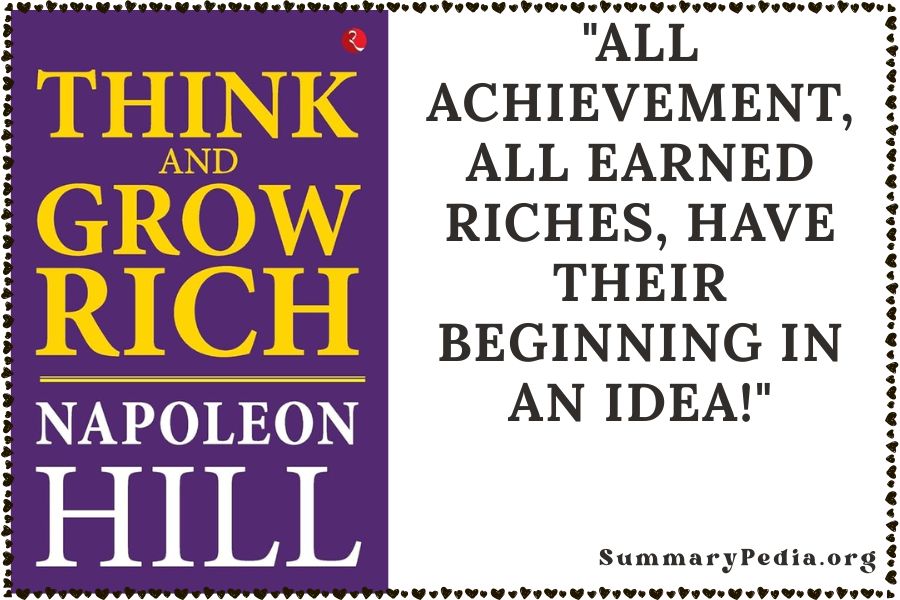
- “ALL ACHIEVEMENT, ALL EARNED RICHES, HAVE THEIR BEGINNING IN AN IDEA!”.
- “Truly, ‘thoughts are things,’ and powerful things at that, when they are mixed with definiteness of purpose, persistence, and a BURNING DESIRE for their translation into riches, or other material objects”.
- “EVERY FAILURE BRINGS WITH IT THE SEED OF AN EQUIVALENT SUCCESS”.
- “Riches come, if they come at all, in response to definite demands, based upon the application of definite principles, and not by chance or luck”.
- “There are no toll-gates between the finite mind of man and Infinite Intelligence”.
- “You have ABSOLUTE CONTROL over but one thing, and that is your thoughts”.
- “A QUITTER NEVER WINS–AND– A WINNER NEVER QUITS”.
- “Poverty needs no plan. It needs no one to aid it, because it is bold and ruthless. Riches are shy and timid. They have to be ‘attracted'”.
- “The major weakness of all educational systems is that they neither teach nor encourage the habit of DEFINITE DECISION”.
- “If you think you are beaten, you are…”.
About the Author
Napoleon Hill is the author of Think and Grow Rich, published in 1938, based upon his famous Law of Success Philosophy. At the request of Andrew Carnegie, Hill spent over twenty-five years analyzing the methods of more than 500 successful men—including Henry Ford, Thomas A. Edison, and John D. Rockefeller—to organize the universal principles of individual achievement. His philosophy has been extensively praised by great leaders in finance, education, and government, such as Woodrow Wilson and F. W. Woolworth. Hill asserted that mastery of his principles offers “an insurance policy against failure”. He personally utilized his philosophy to guide his son, Blair, to convert the serious handicap of being born without normal hearing equipment into a priceless asset.
How to Use This Book
Study this text, digest and meditate upon it, reading no more than one chapter nightly. Absorb the contents, underline key sentences, and begin applying the principles immediately, whether you feel ready or not.
Conclusion
The path to riches is not paved with luck, but with the transmutation of definite desire into action through persistence and faith. Your mind is your only boundary—break through the prison of mediocrity by controlling your thoughts and demanding success. Start your definitive written plan today, because Life will willingly pay any wage you are determined to ask.