The Triumph of Narrative: Storytelling in Mass Culture by Robert Fulford
In an era of relentless data, Robert Fulford’s The Triumph of Narrative serves as a vital reminder that we are, at our core, storytelling animals. This book explores how narrative—from back-fence gossip to Hollywood blockbusters—organizes our chaotic reality into meaning. Understanding these stories is essential today because they don’t just reflect our world; they construct our history, our news, and our very identities.
Who May Benefit
- Writers and Journalists: To understand the ethical and creative mechanics of their craft.
- Historians and Educators: To see how “master narratives” shape national and global understanding.
- Media Strategists: To learn how “star power” and structured storytelling command mass attention.
- Psychologists and Coaches: To help clients reclaim the “narrative thread” of their personal lives.
- Curious Readers: Anyone seeking to understand why they are drawn to certain films, books, or rumors.
Top 3 Key Insights
- Narrative is our primary tool for transforming a “terrifyingly haphazard” world into a structured, meaningful reality.
- Personal identity is a constructed story; maintaining a coherent “life thread” is essential for mental integrity.
- Objective truth is often a simulacrum, as news and history are selective, creative constructions shaped by their eras.
4 More Takeaways
- Gossip is the “foundational folk-art” from which all high literature eventually grows.
- Urban legends act as parables for modern anxieties, regardless of their factual truth.
- Postmodernism treats narrative as politics, viewing stories as sites of power and oppression.
- Movie stars are the “transcendent figures” of our age, carrying the flame of romantic heroism.
Book in 1 Sentence
An exploration of how storytelling, from gossip to mass media, serves as the essential, often dangerous, engine of human civilization and personal identity.
Book in 1 Minute
Robert Fulford argues that storytelling is a biological and social necessity, as vital to humans as food or shelter. He traces narrative’s evolution from humble gossip to the grand “master narratives” that define civilizations and the polished, calculated world of modern news. Fulford reveals that whether we are reading the “unreliable narrators” of high literature or basking in the glow of movie stars, stories are the maps we use to navigate life’s randomness. Ultimately, the book is a warning and a celebration: while stories foster essential empathy, they also possess a dangerous power to manipulate our perception of the truth.
1 Unique Aspect
Fulford insightfully positions gossip as the “peasantry” of the narrative world, illustrating how even the most “aristocratic” world literature relies on the same scandalous, neighborly energy found in everyday chatter.
Chapter I: Gossip, Literature, and Fictions of the Self
“No doubt narrative began its life on earth in the form of gossip.”
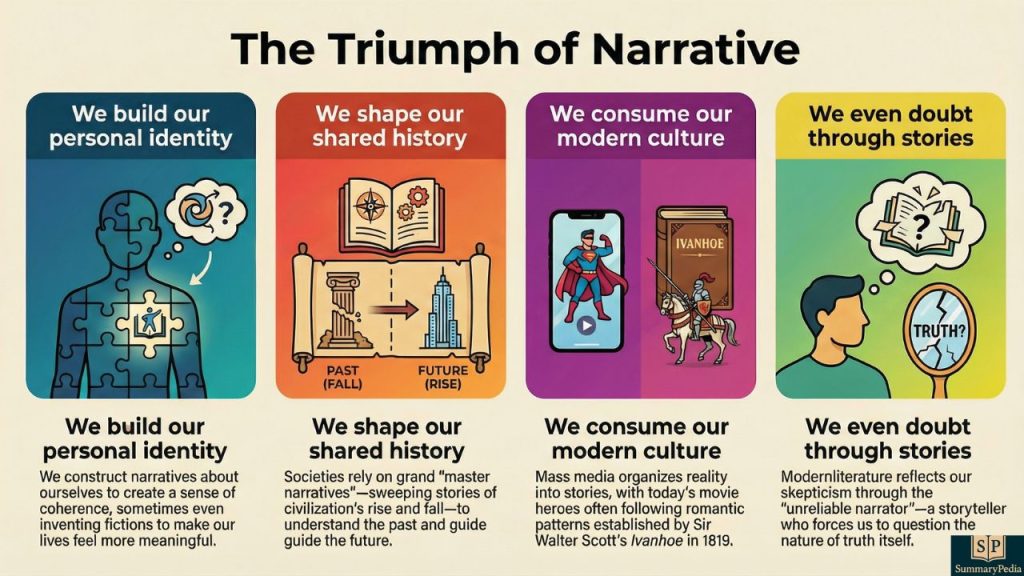
Fulford argues that gossip is the foundational folk-art of literature, compressing events and assigning moral judgment just like great novels. He illustrates this through the “Sasha story,” showing how a single scandalous event involving writer Saul Bellow evolved from simple gossip into the emotional fuel for the masterpiece Herzog. The chapter emphasizes that “there is no such thing as just a story”; every narrative is charged with meaning and serves to contain the “terrifyingly haphazard quality of life”. We construct personal narratives to maintain our identity; without this “thread,” our personalities risk disintegration.
Chapter Key Points:
- Gossip feeds sophisticated literary art.
- Stories manage life’s inherent randomness.
- Life stories sustain personal integrity.
Chapter II: Master Narratives and the Patterns of History
“A master narrative is a dwelling place. We are intended to live in it.”
Fulford examines the “master narratives” used to explain the sweep of history, citing historians like Edward Gibbon and Arnold Toynbee. These grand stories provide patterns of “challenge and response” that societies use to guide themselves. However, master narratives are often arbitrary constructions influenced by the intellectual tone of their era. In recent decades, these broad histories have fallen under suspicion for marginalizing the weak or prioritizing Eurocentric perspectives. Despite academic criticism, Fulford suggests humanity still thirsts for the universal certainties these stories provide, as education itself relies on narrative to make the past intelligible.
Chapter Key Points:
- Master narratives provide historical patterns.
- History is a creative construction.
- Education depends on historical storytelling.
Chapter III: The Literature of the Streets and the Shaping of News
“Journalism is an imaginative construction. It follows the rules of its maker as much as it imitates reality.”
This chapter explores “urban legends” as a modern form of folk narrative that reflects collective dread and a desire for control. Fulford then contrasts this with the professional “invention of news,” which standardized information as a commodity. He highlights how figures like Ernest Hemingway and Henry Luce (founder of Time) transformed chaotic facts into orderly, dramatic narratives. While modern journalism claims to be a simple mirror of reality, it is actually a carefully crafted likeness that uses literary and cinematic techniques. Fulford warns that this power is dangerous, as the desire for a “good story” can tempt writers to manipulate the truth.
Chapter Key Points:
- Urban legends mirror societal anxieties.
- News functions as a narrative commodity.
- Narrative journalism carries ethical risks.
Chapter IV: The Cracked Mirror of Modernity
“When we read the words of unreliable narrators, we stare into the cracked mirror of modernity.”
Fulford discusses the “unreliable narrator,” a device where the storyteller lacks full knowledge or self-understanding. This technique reflects the modern “age of doubt,” where straightforward truth is viewed with suspicion. The chapter links this literary trend to postmodern academic theories, such as those of Michel Foucault, which view narrative as a site of power struggles and oppression. Fulford also analyzes works like Nabokov’s Pale Fire, where complex layers of narration challenge the reader’s perception of reality. Ultimately, these “cracked mirrors” demonstrate narrative’s ability to heighten our understanding of identity and memory.
Chapter Key Points:
- Unreliable narrators reflect modern doubt.
- Postmodernism interrogates narrative power.
- Stories explore layers of identity.
Chapter V: Nostalgia, Knighthood, and the Circle of Dreams
“The movie star emerged as a new creature on the earth.”
Fulford traces the lineage of romantic heroism from Sir Walter Scott’s Ivanhoe to Hollywood superstars. Scott established the rules of “knighthood” and courtly love that still govern westerns, detective stories, and modern blockbusters like Titanic. In the age of mass culture, movie stars have become the primary carriers of these narratives. Their on-screen personas accumulate over time, creating a “master narrative” that often outweighs the scripts they perform. Fulford concludes that narrative remains our irreplaceable companion, allowing us to feel empathy and navigate the complexities of modern existence.
Chapter Key Points:
- Ivanhoe shaped modern romantic ideals.
- Stars carry the narrative flame.
- Stories foster essential human empathy.
10 Notable Quotes
- “There is no such thing as just a story.”
- “To discover we have no story is to acknowledge that our existence is meaningless.”
- “Narrative… has the power to mimic the unfolding of reality.”
- “I can only answer the question, ‘What am I to do?’ if I can answer the prior question, ‘Of what story or stories do I find myself a part?’”
- “The past is a foreign country: they do things differently there.”
- “Journalism… is always a likeness, a semblance, a simulacrum.”
- “Stories are the building blocks of human thought.”
- “Things are never what they seem.”
- “Art is not a mirror… but a hammer.”
- “Our brains are patterned for storytelling, for the consecutive.”
About the Author
Robert Fulford is a preeminent Canadian cultural journalist who began his career as a sports writer in 1950. He edited Saturday Night magazine for nineteen years and is a regular columnist for The Globe and Mail and Toronto Life. His influence stems from over fifty years of observing the narrative impulse across literature, media, and urban life. An Officer of the Order of Canada and a fellow of Massey College, Fulford has received honorary degrees from five universities. His major works include Accidental City and Crisis at the Victory Burlesk. The Triumph of Narrative originated as the 1999 Massey Lectures, a prestigious series co-sponsored by Massey College and CBC Radio.
How to Use This Book
Apply these lessons by identifying the “narrative thread” of your own life and critically deconstructing the media you consume to recognize the “cracked mirrors” and hidden agendas they often present.
Conclusion
Fulford’s journey through our modern “Niagara of stories” proves that we are inextricably bound to the tales we tell. Narrative is our most versatile, comfortable, and potentially dangerous tool for survival. Stop merely consuming content—start investigating the structures and stars that shape your reality. Reclaim your narrative thread today!.