The Leader’s Guide to Storytelling: Mastering the Art and Discipline of Business Narrative by Stephen Denning
Analysis of dry analytical data often fails to move audiences, but The Leader’s Guide to Storytelling reveals why narrative is the most powerful tool for transformational leadership. In an age of skepticism, this book teaches you to master the business narrative to inspire action and build trust.
Who May Benefit
- CEOs and Senior Executives seeking to implement large-scale organizational change.
- Middle Managers struggling to navigate corporate silos and move beyond command-and-control.
- Frontline Workers wanting to share knowledge or champion innovative new ideas.
- Brand Strategists looking to build authentic customer relationships through kept promises.
- Educators and Coaches who need to transmit values and foster deep collaboration.
Top 3 Key Insights
- Narrative is a core leadership discipline that supplements analytical thinking to win both hearts and minds during times of wrenching change.
- Different leadership goals require distinct narrative patterns; a story used to share technical knowledge will fail if used to motivate action.
- Interactive leadership replaces dictation with conversation, allowing leaders to connect with their audience as human equals rather than hierarchical ciphers.
4 More Takeaways
- Springboard stories must be minimalist to allow listeners the mental space to imagine their own future.
- Brands are promises that must be kept authentically to maintain customer trust.
- Parables transmit values by illustrating conflicts between competing ideals rather than moralizing.
- Taming the grapevine requires satirizing unreasonable rumors rather than attempting to deny or control them.
Book in 1 Sentence
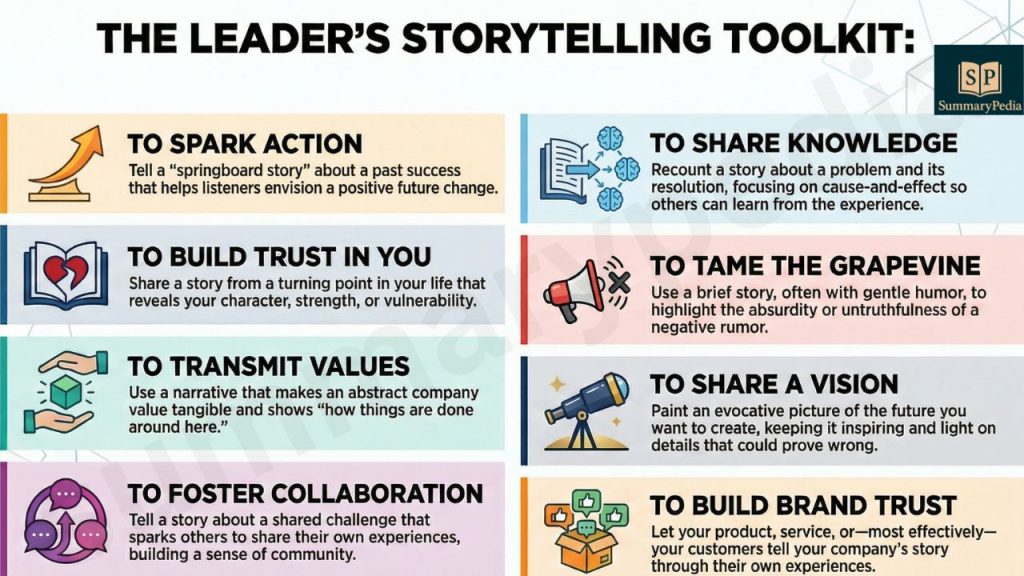
A practical masterclass in using eight distinct narrative patterns to spark action, build trust, share knowledge, and lead organizations into an innovative future.
Book in 1 Minute
Stephen Denning argues that while analysis informs the mind, only storytelling reaches the heart to spark transformation. He introduces the springboard story—a minimalist, true, and positive tale that enables listeners to visualize and co-create a new future. By identifying specific narrative tools for goals like building brand trust or sharing underground knowledge, Denning provides a roadmap for interactive leadership. Moving away from the rigid Napoleonic mode of control, the book encourages leaders to embrace a Tolstoyan approach that thrives on creativity, connection, and the restoration of beauty to the workplace.
1 Unique Aspect
The concept of Minimalist Detail in Action Stories: Denning asserts that for a story to spark action, it must lack sensory detail so the audience doesn’t get wrapped up in the teller’s world and instead focuses on their own.
Chapter 1: Telling the Right Story
Storytelling is fundamental to the human search for meaning.
Denning recounts his transition from a rational World Bank manager to a storyteller after discovering that data-heavy presentations left audiences dazed while a simple story about a Zambian health worker sparked enthusiasm. He identifies the ROI of storytelling as an amplifier of change, noting that for managers, “talk is work”. The chapter emphasizes that leaders must choose the correct narrative pattern for their specific challenge, whether it is motivating action or sharing technical insights.
Chapter Key Points
- Analysis informs, stories transform.
- Purpose dictates narrative form.
Chapter 2: Telling the Story Right
Who knows why certain notes in music are capable of stirring the listener deeply?
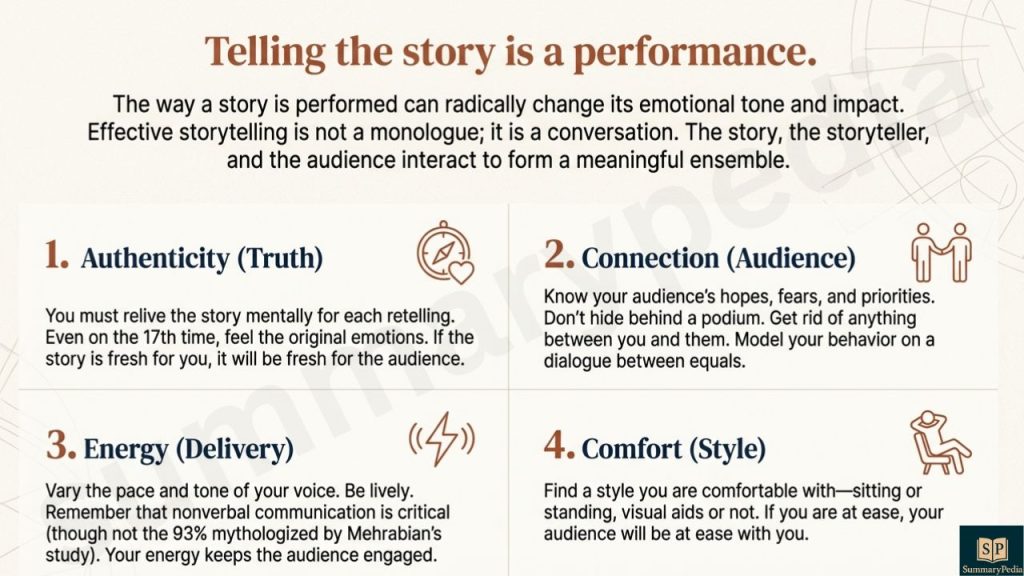
Storytelling is a performance art rooted in the voice of conversation. Denning advises a plain, direct style that avoids “hedges” or disclaimers, as these signal ignorance or a lack of conviction. To be effective, a leader must be rehearsed but spontaneous, mentally reliving the story to ensure the audience feels the original emotions. Authenticity is mandatory; you must speak the truth as you see it to achieve human parity with your listeners.
Chapter Key Points
- Relive stories to stay fresh.
- Eliminate distracting disclaimers.
Chapter 3: Motivate Others to Action
It is useless to attempt to reason a man out of what he was never reasoned into.
The springboard story is the premier tool for implementing new ideas. These stories must be authentically true, have a positive tone, and be told with minimalist detail. By providing just the “scaffolding,” a leader engages the “little voice in the head” of the listener, who then co-creates their own implementation plan. Phrases like “What if…” bridge the gap between a successful past example and an imagined future.
Chapter Key Points
- Minimalism invites audience ownership.
- Positive endings trigger action.
Chapter 4: Build Trust in You
Our fundamental tactic of self-protection… is… telling stories… about who we are.
To lead, you must stop being a stranger; identity stories establish your credibility and character. These stories often center on turning points or moments of adversity where the leader’s deeper feelings and values are revealed. Identity narratives are fractal, meaning a single well-chosen story reveals the DNA of your entire character. Consistency between the story you tell and the life you live is the only way to build enduring trust.
Chapter Key Points
- Turning points reveal character.
- Identity stories build rapport.
Chapter 5: Build Trust in Your Company
Capturing customers is all about creating brand promises and keeping them.
A brand is a relationship defined by a narrative promise. Since traditional advertising has lost its credibility, smart companies use their products to tell their story or rely on word of mouth. Brand authenticity cannot be papered over; the company’s actions must reflect its stated identity. Resonant brands often embody timeless archetypes, such as the Hero or the Outlaw, to connect with deep human desires.
Chapter Key Points
- Actions define the brand.
- Archetypes activate customer energy.
Chapter 6: Transmit Your Values
Acting on what matters is, ultimately, a political stance…
Leaders must distinguish between instrumental value and ethical values. Values are transmitted through narratives that demonstrate “how things are done around here” rather than through memos or posters. Parables are particularly effective because they can be projected onto various contexts and usually involve a conflict between competing ideals. For a value story to take root, the leader must consistently exemplify those values in action.
Chapter Key Points
- Live values, don’t preach.
- Parables provide infinite applications.
Chapter 7: Get Others Working Together
Stories are the language of communities.
High-performance teams function like communities, fueled by personal investment and shared passion. Managers cannot mandate this energy; they must catalyze it through narratives that set compelling but flexible objectives. Using story to discover what aspirations members have in common helps move people from “me” to “we”. Face-to-face story swapping is essential for building the trust required to solve complex problems.
Chapter Key Points
- Teams require narrative catalysts.
- Co-create the group story.
Chapter 8: Share Knowledge
We value stories because they are like reports… only easier to understand…
The knowledge-sharing story focuses on anomalies, near misses, and mishaps. These narratives require rich contextual detail so that experts can recognize patterns and beginners can learn “tricks of the trade”. Unlike action stories, they must include an explanation of why a solution worked. In low-trust environments, leaders must “tease out” these stories, as people are naturally reluctant to admit mistakes.
Chapter Key Points
- Explain causal relationships.
- Context enables case-based reasoning.
Chapter 9: Tame the Grapevine
Wisdom cries out in the streets, but no man regards it.
The grapevine is the underground river of corporate culture, filled with rumors that drive uncertainty. Attempting to control or deny rumors often only gives them more credibility. A leader can tame the grapevine by using gentle satire or self-deprecatory humor to highlight the absurdity of unreasonable gossip. If a rumor is true, the leader should admit it, fix the cause, and move on.
Chapter Key Points
- Fight story with story.
- Satire subverts unreasonable beliefs.
Chapter 10: Create and Share Your Vision
All human action occurs in time… facing a future which cannot be known.
Most strategic plans and mission statements are clogged with clichés and fail to be compelling. A visionary story should be evocative rather than precise, allowing the audience to adapt the narrative as reality shifts. Leaders can make the future familiar by setting stories in the near future or using business models to explain the “theory of the business”. Working backward from an image of success often increases enthusiasm for the plan.
Chapter Key Points
- Evocative visions spark dreams.
- Avoid jargon and clichés.
Chapter 11: Solve the Paradox of Innovation
If at first the idea is not absurd, then there is no hope for it.
Transformational innovation fails when firms protect their existing business models at the expense of disruptive ideas. Solving the paradox requires a leap of faith in a new story and the ability to persuade others through narrative. Innovation is a political process that management gadgets cannot solve; it requires a shift from a “Napoleonic” control mode to a “Tolstoyan” mode that embraces creative chaos.
Chapter Key Points
- Innovation requires narrative persuasion.
- Embrace the Tolstoyan mode.
Chapter 12: A Different Kind of Leader
To be understood is to be open to understanding.
Denning defines the interactive leader as someone who lead because they have something to give, rather than expecting something in return. This leadership style is independent of hierarchy and relies on authenticity and integrity. Narrative allows leaders to connect with the world as active participants, restoring meaning and beauty to the workplace. By offering an inspiring future, they turn opponents into unwitting allies.
Chapter Key Points
- Participation over observation.
- Narrative restores workplace beauty.
10 Notable Quotes
- “The best way to communicate with people you are trying to lead is very often through a story.”
- “Analysis might excite the mind, but it hardly offers a route to the heart.”
- “Storytelling and leadership are both performance arts.”
- “The brand narrative is owned by the customer, not the company.”
- “If value is what makes us wealthy, values… are what make us human.”
- “You can’t pull the stem, leaves, or petals to make it grow faster.”
- “One story leads to another… storytelling is naturally collaborative.”
- “When you dream alone it’s just a dream, but when you dream together it’s already the beginning of a new reality.”
- “Skating to where the puck is going to be… involves figuring out where the other players are going to put the puck.”
- “The ear enjoys a privileged passageway to the heart.”
About the Author
Stephen Denning, an expert in organizational storytelling and knowledge management, was born in Australia and educated at Sydney and Oxford Universities. He held several senior management roles at the World Bank before spearheading its organizational knowledge-sharing program in 1996. Recognized as one of the world’s Top Two Hundred Business Gurus, his influential works include The Springboard and Squirrel Inc.. His work focuses on how narrative can ignite action and solve the most difficult leadership challenges in the knowledge era.
How to Use This Book
Identify your specific leadership challenge, select the corresponding narrative pattern from the storytelling catalog, and use the provided templates to craft a story that authenticates your purpose and moves people.
Conclusion
Storytelling is not a rare gift but an innate human capability that you can harness to transform your organization. By moving from a control-based mind-set to one of interactive leadership, you invite your team to dream together and co-create a new reality.
Master the art of narrative today and lead with a voice that truly resonates! analogy or metaphor: Using analysis to lead is like reading a recipe to a hungry crowd; using narrative is inviting them into the kitchen to smell the bread and bake it with you.