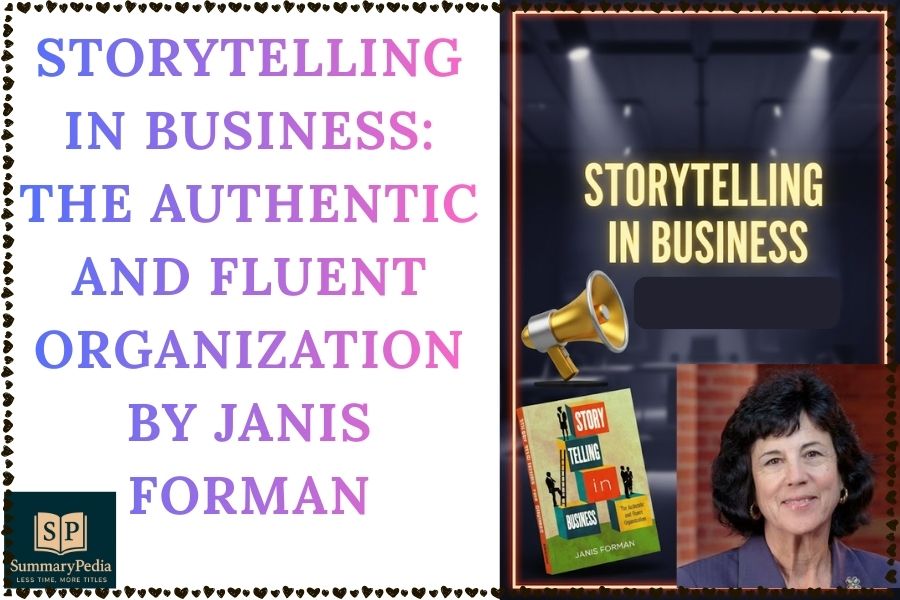
Storytelling in Business: The Authentic and Fluent Organization by Janis Forman
Storytelling in Business by Janis Forman reveals how narrative is more than “child’s play”; it is a vital management tool for building trust and executing strategy. In an era of soundbites and cynicism, Forman demonstrates how “authentic and fluent” storytelling helps leaders connect with stakeholders to drive organizational performance. This book provides a rigorous framework for humanizing the corporate edifice through the power of data-rich, emotionally resonant narrative.
Who May Benefit
- CEOs and executive leaders seeking to articulate a compelling strategic vision.
- Corporate communication professionals managing brand reputation and stakeholder engagement.
- Managers navigating organizational change, mergers, or cultural transformations.
- Technically trained professionals needing to translate complex jargon into human-centric benefits.
- Marketing experts looking to ground brand taglines in realistic, tangible human experiences.
Top 3 Key Insights
- Authenticity is foundational: Effective business stories must be data-based, fact-checked, and realistic to build lasting institutional trust.
- Fluency drives engagement: Success requires mastering narrative craft—emotions, intellect, and technology—to cut through modern workplace noise.
- Narrative executes strategy: Storytelling transforms abstract corporate goals into achievable “chapters” that motivate and align the entire workforce.
4 More Takeaways
- Listen before speaking: Authentic storytellers must assess stakeholder needs to ensure their narrative is responsive and inclusive.
- Celebrate culture heroes: Narrating “discretionary effort” by employees reinforces core values and inspires similar behavior.
- Humanize technical data: Personal stories bridge the gap between product specifications and the actual human needs they solve.
- Leverage digital platforms: Brief, character-driven digital content helps global, multilingual workforces share a unified organizational experience.
Book in 1 Sentence
Janis Forman provides a framework for using authentic, data-driven narratives to strengthen corporate strategy, brand identity, and culture across global business enterprises.
Book in 1 Minute
Janis Forman’s Storytelling in Business shifts the perspective of narrative from simple entertainment to a rigorous management tool. The book introduces a framework centered on authenticity (truth-telling) and fluency (persuasive craft). Through deep-dive case studies of Schering-Plough, Chevron, FedEx, and Philips, Forman illustrates how storytelling solves modern problems like declining institutional trust and information overload. The book emphasizes that for a story to work, it must be data-rich yet emotionally resonant, bridging the gap between technical jargon and human experience. By documenting how leading firms use “strategy in chapters,” “human energy” branding, and digital platforms, Forman offers a roadmap for leaders to humanize their organizations. The ultimate outcome is an organization where every employee can articulate the company’s future while remaining true to their own signature story.
1 Unique Aspect
The book uniquely blends comparative literature theory with corporate management, treating business strategy as an unfolding “story in chapters” that requires narrative logic and ethical representation. It moves beyond simple “tips” to provide a systematic framework validated by over 140 expert interviews.
Chapter-wise Summary
Chapter 1: Why Explore Storytelling in Business?
“The human appetite for [narrative] is too strong.”
Forman argues that humans are hardwired for stories, which serve as a critical tool for sense-making in a pressured, sound-bite-driven world. While business education often favors data alone, stories reach deeper into the psyche and live longer in memory. Leadership is described as a “contact sport” where storytelling acts as a survival tool for communicating vision and gaining trust.
- Humans crave narrative.
- Stories build trust.
- Leadership requires vision.
Chapter 2: A Framework for Organizational Storytelling
“Authenticity will be the coin of the realm.”
The author presents a framework based on Authenticity (truth/facts) and Fluency (emotional/intellectual engagement). Authentic stories must be fact-checked and “data-based,” working in concert with other corporate communications. Fluency requires mastering craft elements like novelty, significant details, and narrative logic to make messages stick.
- Foundation is authenticity.
- Capabilities require fluency.
- Objectives are practical.
Chapter 3: Stories About Strategy: Schering-Plough
“No one followed a committee into battle.”
CEO Fred Hassan used storytelling to lead a massive corporate turnaround at Schering-Plough. He conceptualized the company’s strategy as a “story in chapters”: Stabilize, Repair, Turn Around, Build the Base, and Break Out. By telling and retelling this story, the leadership team gained employee buy-in and made a complex future feel achievable and real.
- Strategy in chapters.
- CEO as storyteller.
- Building employee faith.
Chapter 5: Stories and the Corporate Brand: Chevron
“Human Energy is not just a slogan or tagline.”
Chevron’s “Human Energy” campaign demonstrates how stories bring a corporate brand to life. The campaign frames the “New Energy Equation”—rising demand vs. supply—as a challenge solvable through human ingenuity. The book highlights how Chevron uses diverse voices to illustrate that the brand is realistic and tangible.
- Brand as umbrella.
- Humanizing the corporation.
- Voice attribute guidelines.
Chapter 7: Digital Stories for Business: FedEx
“You’ve got to deconstruct the cold corporate edifice.”
FedEx leverages digital platforms to strengthen its culture through heroic stories of employees going the “extra mile”. The “I am FedEx” initiative allows staff to share personal narratives that link passions to company values. These stories must be brief and character-driven to go viral and build engagement in a global workforce.
- Digital story accessibility.
- Culture of heroes.
- User-generated content.
Chapter 9: Storytelling Workshops for Change: Philips
“How to move from lumen to human.”
Philips used storytelling workshops to facilitate a strategic shift from a technology-centric to a people-centric model. The workshops helped technical employees translate jargon into narratives about how products—like MRI machines—improve patient lives. By focusing on the “care cycle,” employees learned to see the human journey rather than just specs.
- Workshops drive change.
- People-centric model.
- Beyond product specs.
Chapter 11: Ending with a Beginning
“Rediscover your storytelling roots.”
Forman concludes by urging every professional to develop their own “signature story”—a personal narrative that reveals their character and values. These stories should be authentic to one’s feelings but tempered by business realities. Storytelling is a strategic asset and a legacy that continues to influence others long after a project ends.
- Find your roots.
- Signature story power.
- Strategic storytelling legacy.
10 Notable Quotes
- “Humans crave narrative… it builds a narrative for topics that goes deeper and lives longer in a person’s psyche.”
- “No one followed a committee into battle.”
- “Communication is a contact sport.”
- “Authenticity will be the coin of the realm for successful corporations and for those who lead them.”
- “Don’t tell stories that aren’t true.”
- “The platform is the other end of your gasoline hose.”
- “Content is king, so build content around authentic stories.”
- “A humble soul equals an open mind.”
- “My job is to teach our leaders… how to move from lumen to human.”
- “Your time is limited, so don’t waste it living someone else’s life.” (Steve Jobs cited by Forman)
About the Author
Janis Forman is the Director of the Management Communication Program at UCLA Anderson School of Management. She brings a highly unique perspective to the business world, holding a doctorate in comparative literature with a dissertation on autobiographical narrative. Her career has been dedicated to bridging the divide between the humanities and management, advising MBA students and senior executives at prestigious multinational corporations.
Forman is a respected consultant and scholar who has tackled strategy projects for firms like Coca-Cola, Disney, Johnson & Johnson, and Microsoft. She has spent decades teaching leaders how to bring together critical thinking and communication to embed data into compelling stories that substantiate their visions for the future. Storytelling in Business is the culmination of years of site visits and dialogues with filmmakers, CEOs, and communication experts. Her credibility rests on her ability to apply literary analysis to practical organizational problems such as building brand equity and managing strategic transformation.
Frequently Asked Questions
- What is a “signature story”? It is a unique, personal narrative about a significant experience or relationship that provides self-understanding and serves business purposes.
- Why is storytelling vital in business now? It cuts through information overload and soundbites to create a singular, memorable, and relevant impression.
- What are the two pillars of Forman’s framework? Authenticity (credibility/facts) and Fluency (craft/emotional and intellectual engagement).
- How does storytelling support strategy? It frames an organization’s trajectory as a “story in chapters,” making the future feel achievable and motivating.
- What is the “dark side” of storytelling? Faking authenticity through hyperbole, lying, or using “vaporware” scenarios to deceive investors and stakeholders.
- Can stories replace data? No; authentic organizational stories must be fact-checked and data-rich to remain credible to a skeptical audience.
- How do stories help technical fields? They “translate” technical jargon into human-centric solutions that nonspecialists can understand and value.
- What role do visuals play? Visuals fortify emotional appeal and act as a “universal language” that bridges cultural and linguistic divides.
- How can a story go viral? By being character-driven, novel, and resonant enough for stakeholders to share it across their own social networks.
- Who should be the lead storyteller? While everyone can tell stories, the CEO acts as the chief champion for strategy, culture, and brand narratives.
How to Use This Book
Apply the provided checklists in Chapters 4, 6, 8, and 10 to assess your current initiatives. Use the “topics-and-questions” approach to generate new stories for your team, and align your personal voice with corporate guidelines to ensure authenticity.
Conclusion
Storytelling in Business proves that narrative is the ultimate management tool for the modern, cynical marketplace. By mastering the “authentic and fluent” framework, you can transform cold data into a shared journey that inspires loyalty and action. Don’t just present the facts—start telling the story that will lead your organization into its next successful chapter.