Seven Secrets of Spontaneous Storytelling by Danyah Miller
Unlocking the hidden power of narrative can turn everyday parenting struggles into moments of profound connection and joy. In Seven Secrets of Spontaneous Storytelling, Danyah Miller introduces a revolutionary way to bond with children that requires no books, no preparation, and no special talent. In an age of digital distraction and sensory overload, this book provides the essential tools to nurture a child’s imagination and emotional resilience.
Who May Benefit
- Parents and Step-parents seeking creative ways to navigate daily transitions and conflicts.
- Teachers and Educators looking for narrative tools to enhance literacy and engagement.
- Grandparents wanting to connect their family’s past to the next generation.
- Caregivers of neurodiverse children searching for therapeutic communication techniques.
- Individuals interested in reclaiming the ancient human art of oral storytelling.
Top 3 Key Insights
- Spontaneous storytelling is an innate human ability that requires being present rather than being an expert.
- Stories help children navigate transitions and process difficult emotions like anxiety or grief.
- The imagination is a muscle that must be regularly exercised to foster innovation and problem-solving.
4 More Takeaways
- Ground stories in sensory observation to make them more vivid and calming.
- Repetition creates security and facilitates language acquisition in young children.
- Puppets and props act as therapeutic bridges for expressing complex feelings.
- Confidence grows by focusing on the story rather than the ego.
Book in 1 Sentence
Danyah Miller reveals how seven secrets of spontaneous storytelling can transform family relationships and nurture children’s creative and emotional development.
Book in 1 Minute
In this enchanting guide, Danyah Miller follows the fictional Dale family as they encounter Dorothy, a “Wise Woman” who teaches them to use storytelling to heal their fractured bond. Through seven pivotal secrets—ranging from imagination and sensory observation to memory and confidence—parents Adam and Darinka learn to turn mundane moments into magical adventures. The book serves as both a narrative and a toolkit, offering practical “story games” that boost literacy, improve behavior, and build resilience in children. Ultimately, Miller demonstrates that storytelling is not a rare gift for experts, but a natural human ability that nourishes families to their very core.
1 Unique Aspect
The book is masterfully structured as a fictionalized narrative of the Dale family, allowing readers to see practical storytelling techniques applied to relatable, real-world parenting crises.
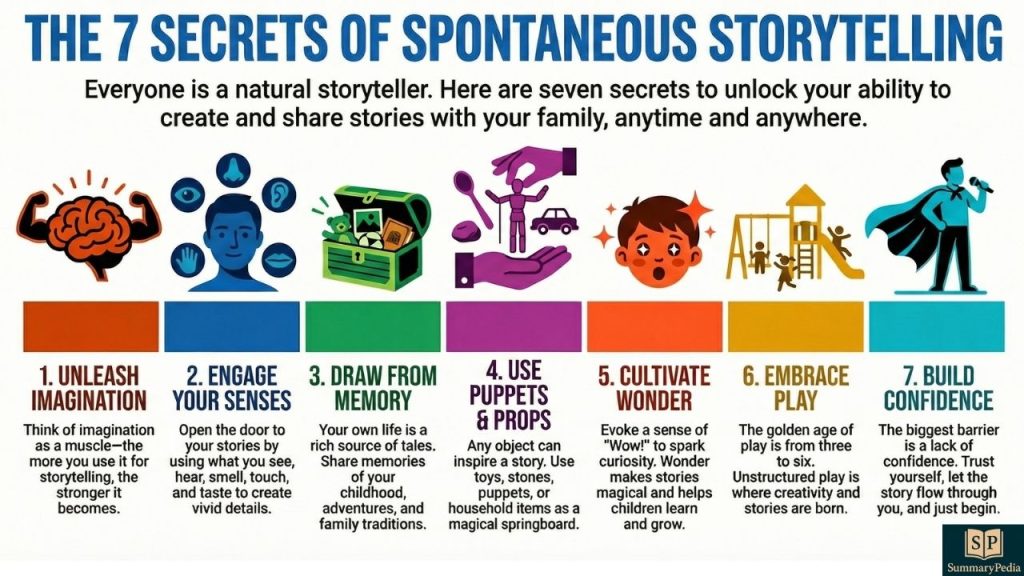
Chapter 1: A Welcome Stranger – The First Secret: Imagination
‘Logic will get you from A to B. Imagination will take you everywhere.’ — Albert Einstein
The story begins with the Dale family, where father Adam struggles to connect with his three energetic children, often prioritizing work to avoid the chaos at home. During a tense weekend, mother Darinka takes the children to a disused windmill where they encounter Dorothy, a mysterious woman who effortlessly captivates them with a story about a shy gnome. Dorothy explains that imagination is a muscle that weakens without use and that storytelling is the key to strengthening it. She introduces the ABC Game, proving that stories can be built collaboratively starting with simple, random letters.
Chapter Key Points
- Strengthen the imagination muscle.
- Play the ABC Game.
- Use stories for transitions.
Chapter 2: Is She For Real? – The Second Secret: Observation and Senses
‘Smell is a potent wizard that transports you across thousands of miles and all the years you have lived.’ — Helen Keller
Adam, skeptical of the windmill encounter, finds Dorothy in a hidden sinkhole and eventually opens up about his fears of being an inadequate father. Dorothy teaches him the Second Secret: the power of observation and the five senses. She explains that modern sensory overload often causes children to have “meltdowns,” but grounding a story in what one sees, smells, or touches can restore calm. By turning a trip to the supermarket into an “Aladdin’s Cave” treasure hunt, Adam discovers he can make mundane chores adventurous and manageable.
Chapter Key Points
- Ground tales in senses.
- Observe nature for inspiration.
- Calm meltdowns with sensory-play.
Chapter 3: There was Silence – The Third Secret: Memory
‘Memory is the diary that we all carry about with us.’ — Oscar Wilde
When a close family friend, Shubu, unexpectedly passes away, the Dales must navigate the heavy atmosphere of grief. Dorothy reappears to explain the Third Secret: tapping into personal memory and biography. She suggests that sharing “olden days” stories and family traditions helps children process loss and connect to their history. Through games like “Pass the Boot,” where random words trigger memories, Adam and Darinka learn that stories provide a safe space to name the deceased and release the “tsunami of emotions” associated with tragedy.
Chapter Key Points
- Use biography for depth.
- Process grief through narrative.
- Share family history regularly.
Chapter 4: In Search of Treasure – The Fourth Secret: Puppets and Props
‘I could never be on stage on my own. But puppets can say things that humans can’t say.’ — Nina Conti
During a visit to a farm, Dorothy helps Darinka understand how to support her niece Lucy, who is neurodiverse. She reveals the Fourth Secret: using puppets and props as therapeutic tools. Dorothy demonstrates that a simple silk handkerchief can become a “Story Bag” or a “radio” for elves, drawing in even the most disconnected children. She introduces the “POP” method (Person, Obstacle, Place) as a reliable framework for building stories “out of the air” without any prior preparation or script.
Chapter Key Points
- Use props as bridges.
- Apply the POP method.
- Bring objects to life.
Chapter 5: Ah, Snow! – The Fifth Secret: Wonder
‘The more I wonder, the more I love.’ — Alice Walker
A heavy snowfall provides a backdrop for exploring the Fifth Secret: Wonder. Dorothy explains that wonder is the internal feeling sparked by external awe, and it is a vital ingredient for effective learning. She advises Adam on how to create a “story corner” in the home—a calm, beautiful space where a simple candle or a melodic instrument can signal the start of a magical journey. They discuss using a bold, action-filled voice to inspire energy or a quiet, gentle voice to lull children into a dreamlike state.
Chapter Key Points
- Nurture natural awe.
- Create a story corner.
- Modulate voice for mood.
Chapter 6: Less is More – The Sixth Secret: Play
‘Play is the highest form of research.’ — Albert Einstein
As the Dales settle into a healthy routine, they struggle with their youngest son’s aggressive outbursts. Dorothy shares the Sixth Secret: the essential role of unstructured play. She cites a radical experiment where a nursery removed all toys for three months, resulting in children who were more creative, concentrated, and communicative. Dorothy explains that “play is in the child, not the toy” and that fewer commercial distractions allow children to invent their own “research” through imaginative narrative and problem-solving.
Chapter Key Points
- Encourage unstructured free play.
- Reduce toy-related distractions.
- Use “The Disrupter” game.
Chapter 7: One Step at a Time – The Seventh Secret: Confidence
‘We know what we are but know not what we may be.’ — William Shakespeare
A year after their first meeting, Darinka has become a teaching assistant but still battles an “inner critic” when telling stories in front of other adults. Dorothy reveals the final secret: Confidence. She emphasizes that one must “plant the seed” and trust that the story will do the work. By breathing into the heart and taking the “ego” out of the performance, a storyteller allows the images to flow through them naturally. Darinka learns that mastery comes from combining natural human talent with practiced storytelling skills.
Chapter Key Points
- Silence the inner critic.
- Trust the narrative flow.
- Practice builds mastery.
10 Notable Quotes
- “Humans are storytelling-beings.”
- “Stories feed us to our very core.”
- “Imagination is a powerful muscle.”
- “Repetition is how children learn language.”
- “Memory is the diary that we all carry about with us.”
- “Let the story do the hard work.”
- “Play is the highest form of research.”
- “The more I wonder, the more I love.”
- “Confidence is vital to health and wellbeing.”
- “Sharing a story is like planting a seed.”
About the Author
Danyah Miller is an award-winning solo performer, writer, and master storyteller with over 25 years of professional experience. She trained at Bretton Hall College and Lecoq in Paris, later starring in hit shows like Michael Morpurgo’s I Believe in Unicorns, which has been seen by over 100,000 people. Miller was a regular storyteller for BBC Three Counties Radio and spent a decade as a workshop leader at The International School of Storytelling. Her work extends into musical theater as a co-producer of the Olivier-nominated Soul Sister. As a trainer, she works across educational settings and festivals to help others find their narrative voice. Miller is also neurodiverse, which has shaped her deep connection to the oral tradition of learning.
How to Use This Book
Read the narrative for inspiration, then immediately apply the “Story Games” at the end of each chapter to transform your family’s daily routines into creative, bonding adventures.
Conclusion
Storytelling is a form of love that makes everyone at the table come alive. By embracing these seven secrets, you can move beyond the printed page to find a unique voice that inspires and heals. Start your first spontaneous adventure tonight—the magic is already inside you.
Like planting a seed, your only job is to begin; trust the imagination to handle the growing.