EntreLeadership: 20 Years of Practical Business Wisdom from the Trenches by Dave Ramsey
In EntreLeadership: 20 Years of Practical Business Wisdom from the Trenches, Dave Ramsey provides a definitive playbook for growing a business from scratch. The book solves the problem of balancing wild entrepreneurial passion with structured leadership, proving that thriving companies require both vision and discipline. Today, it matters because leaders desperately need practical, principle-driven methods to build resilient, debt-free, and highly unified organizations.
Who May Benefit
- Small business owners seeking sustainable, debt-free growth.
- Managers aiming to build unified, deeply loyal teams.
- Entrepreneurs looking to transition into effective leaders.
- Sales professionals wanting to close deals by serving.
- Anyone aspiring to build a highly profitable business culture.
Top 3 Key Insights
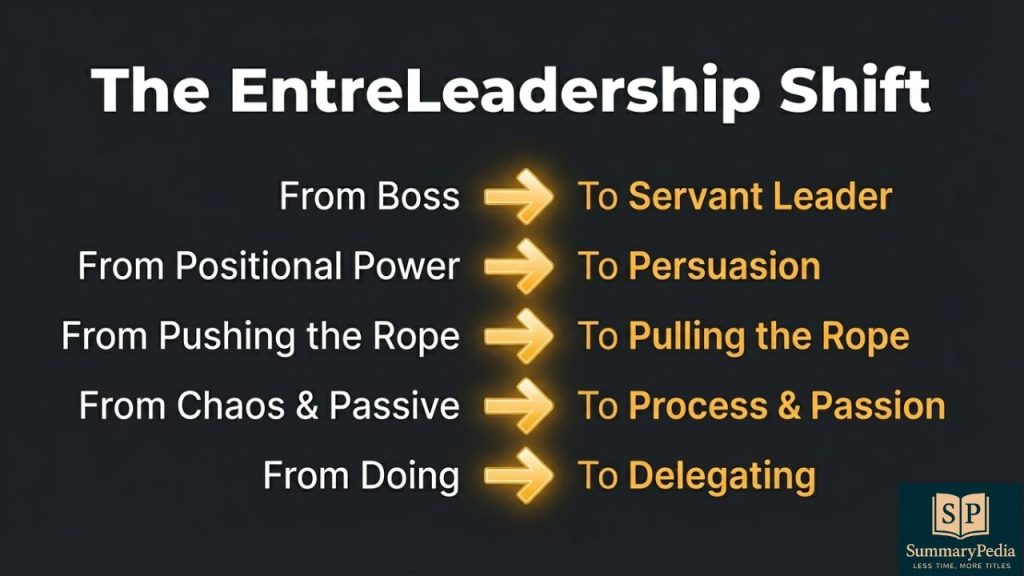
- Leadership is servanthood. True power comes from persuasion and serving others, not positional authority.
- Momentum is created. Focused intensity over time, multiplied by faith, yields unstoppable momentum.
- Debt magnifies mistakes. Financial peace requires avoiding debt and funding growth with cash.
4 More Takeaways
- Define winning: Establish clear Key Results Areas (KRAs) for roles.
- Hire slowly: Avoid turkeys by using a rigorous, multi-step interview process.
- Communicate heavily: Over-share to kill gossip, frustration, and workplace fear.
- Praise publicly: Recognize achievements in front of peers for extreme power.
Book in 1 Sentence EntreLeadership blends the maverick spirit of an entrepreneur with the disciplined guidance of a leader to build highly successful, principled, and debt-free businesses.
Book in 1 Minute EntreLeadership is Dave Ramsey’s practical playbook for building a business from a card table in a living room to a multi-million-dollar enterprise. It merges the passionate, risk-taking drive of an entrepreneur with the character, discipline, and servant-hearted nature of a leader. Ramsey emphasizes that a company’s success or failure rests entirely on the leader’s shoulders; if you want to fix your business, you must look in the mirror. The book covers the foundational mechanics of business: setting clear goals, managing time, hiring superstars, and firing gracefully. It also champions countercultural financial principles—specifically operating 100% debt-free—and treating team members with immense dignity. Ultimately, EntreLeadership offers a mindset shift: business isn’t just about transactions; it’s about serving customers deeply, empowering a unified team, and creating meaningful work.
1 Unique Aspect The book’s standout framework is the “Momentum Theorem”: Focused intensity over time, multiplied by God, equals unstoppable momentum. It proves that massive success isn’t a random lightning strike; it’s a meticulously crafted outcome built on sustained, passionate effort.
Chapter-wise Summary
Chapter 1: EntreLeadership Defined
“As goes the king, so goes the kingdom.”
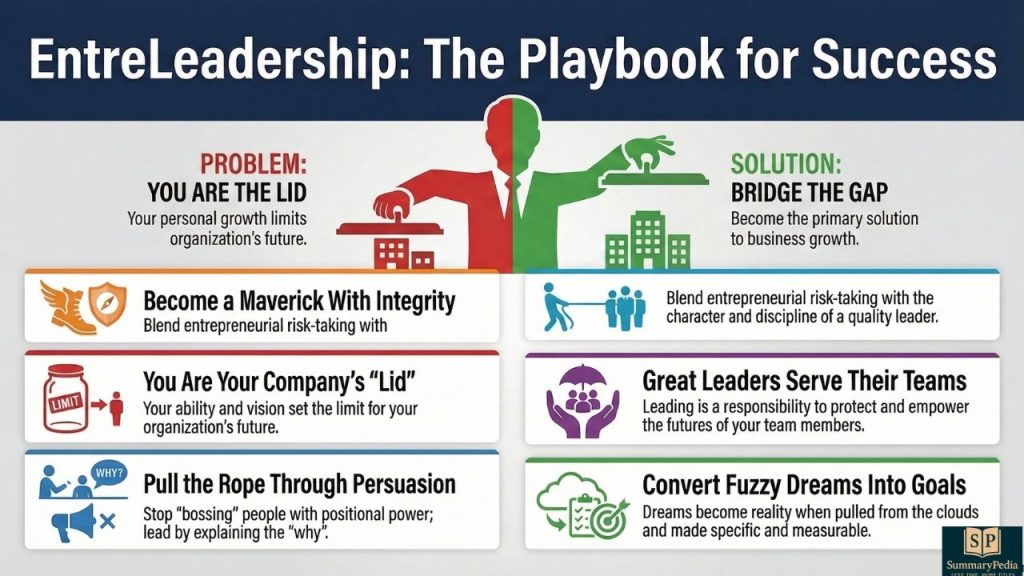
Ramsey explains that growing a business requires more than just pure entrepreneurial drive or sterile corporate leadership; it requires an “EntreLeader.” This unique hybrid combines the passionate, risk-taking maverick spirit of an entrepreneur with the disciplined, serving character of a leader. Ramsey stresses that leaders must take ownership of their company’s flaws, as a business’s limits directly reflect the leader’s own limitations. By focusing on persuasion rather than positional power, leaders can effectively inspire their teams to achieve greatness.
Chapter Key Points:
- Blend entrepreneurial passion with leadership.
- Your business’s limit is you.
- Lead by persuasion, not force.
Chapter 2: Start with a Dream, End with a Goal
- “Goals are visions and dreams with work clothes on.”
- Every great business starts with a dream, but dreams must be refined into actionable visions and concrete mission statements to avoid remaining mere fantasies. A solid mission statement keeps the company focused and dictates what opportunities to turn down. From there, visions are broken down into specific, measurable, time-sensitive goals. Ramsey insists that these goals must be uniquely yours and put into writing to create true traction. This structured approach pulls team members forward, converting raw vision into tangible energy.
- Chapter Key Points:
- Write down specific, measurable goals.
- Mission statements clarify your boundaries.
- Shared goals unify your team.
Chapter 3: Flavor Your Day with Steak Sauce
“You will either tell your day what to do or you will wonder where it went.”
Time management is essential to prevent the feeling of running frantically on a hamster wheel without traction. By mastering a prioritized to-do list, leaders can focus on “A1” tasks—the absolute most important activities of the day. Ramsey encourages classifying tasks into quadrants, focusing heavily on important but not urgent tasks like strategic planning and relationship building to prevent future crises. Mastering time and maintaining an organized environment drastically increases personal productivity and overall job satisfaction.
Chapter Key Points:
- Prioritize tasks using a ranked list.
- Focus on important, non-urgent tasks.
- Eliminate time-wasting distractions.
Chapter 4: “Spineless Leader” Is an Oxymoron
“Deciding not to decide right now is a decision.”
Indecision paralyzes organizations and frustrates talented team members. Leaders must develop the backbone to make difficult decisions without letting fear drive the outcome. Ramsey explains that the best way to make tough calls is by gathering copious amounts of information and developing multiple options; more data removes fear. Aligning decisions with unwavering core values, setting self-imposed deadlines, and consulting experts or spouses brings immense clarity. Ultimately, a principled decision—even if it sparks criticism—sets the organization free.
Chapter Key Points:
- Don’t make decisions based on fear.
- Gather information to ease choices.
- Base decisions on core values.
Chapter 5: No Magic, No Mystery
“There is no energy in logic, only in emotion.”
Effective marketing is not a mysterious lightning strike but a deliberate recipe. Ramsey introduces the Momentum Theorem, combining focus, intensity, time, and faith to generate explosive business growth. A successful marketing “stew” requires understanding the product life cycle, perfectly timing the market, and creating a funnel to draw customers in from free content to premium services. By passionately communicating the benefits rather than just product features, and injecting scarcity and urgency, a company can naturally pull customers toward a purchase.
Chapter Key Points:
- Momentum requires focused, prolonged intensity.
- Funnel customers from free to premium.
- Passion makes marketing truly persuasive.
Chapter 6: Don’t Flop Whoppers
“The right and the ability to take nothing and make something from it is inherently American.”
Launching a business doesn’t require massive debt or a fancy office; many titans start as part-time, home-based microbusinesses. Ramsey advises against jumping into a full-time endeavor until the business is generating consistent, sustainable income to prevent financial disaster. He warns against “business in a box” scams and emphasizes choosing a business aligned with your calling, skills, and values. When a leader is passionately engaged in a higher calling, work ceases to be a chore, transforming into a meaningful crusade.
Chapter Key Points:
- Start small and grow organically.
- Wait for consistent profits before jumping.
- Align business with your true calling.
Chapter 7: Business is Easy… Until People Get Involved
“We have a 95 percent turnover, before we hire them.”
High turnover is expensive and damages morale, making the hiring process the most critical operation in a business. Ramsey outlines a meticulous twelve-step hiring process that includes multiple interviews, a spouse interview, personality testing (DiSC), and reviewing personal budgets. Taking immense time to hire ensures the addition of driven “rock stars” and keeps workplace drama out. Conversely, if an employee exhibits integrity issues or chronic incompetence, a leader must gracefully but firmly release them to protect the culture.
Chapter Key Points:
- Take immense time when hiring.
- Check personalities and personal budgets.
- Fire quickly for integrity violations.
Chapter 8: Death of a Salesman
“Nothing happens until someone sells something.”
Everyone is in sales, as business fundamentally relies on the transference of emotion and belief. Instead of employing pushy, manipulative tactics, true salespeople serve their customers by walking them through a four-step process: qualifying, building rapport, educating, and closing. Qualifying ensures the buyer has the money, time, and authority, while rapport establishes necessary trust. By passionately teaching the customer about the product’s benefits, the perceived value outweighs the cost, leading naturally to a smooth, assumptive close.
Chapter Key Points:
- Selling is serving, not pushing.
- Always qualify your prospects first.
- Sell the product’s benefits, not features.
Chapter 9: Financial Peace for Business
“What kills companies is debt; without debt, companies have the wherewithal to survive.”
Following conservative, commonsense financial principles is the bedrock of a stress-free, resilient business. Ramsey strongly advises against utilizing debt to fund business operations, as debt merely magnifies mistakes and increases the risk of fatal failure. Instead, businesses must act their wage, operate on a strict written budget, and build cash reserves to seize opportunities and weather economic downturns. By paying cash, renting until purchasing is viable, and outsourcing smartly, a business can maintain powerful profit margins.
Chapter Key Points:
- Operate your business entirely debt-free.
- Use budgets to forecast forward.
- Save cash to capitalize on opportunities.
Chapter 10: The Map to the Party
“The greatest problem in communication is the illusion that it has been accomplished.”
A lack of clear communication breeds fear, frustration, and destructive gossip within an organization. To counter this, EntreLeaders must aggressively create a culture of proactive communication. This involves regularly sharing the company’s vision, over-sharing during times of crisis, and holding consistent, effective staff meetings. Furthermore, utilizing tools like weekly personal reports and detailed Key Results Areas ensures strict alignment between leadership and the team. By leading with transparency and practicing “management by walking around,” leaders foster deep trust.
Chapter Key Points:
- Over-communicate, especially during crises.
- Use weekly reports to stay connected.
- Management by walking around builds trust.
Chapter 11: People Matter Most
“Quality people—really all people—have a need to be treated with dignity.”
Building a legendary corporate culture requires intentional actions that generate unity and loyalty. Operating by the Golden Rule and showing fanatical integrity in every interaction are foundational. Ramsey warns against the five enemies of unity: poor communication, lack of shared purpose, gossip, unresolved disagreements, and sanctioned incompetence. When leaders genuinely care about their team members’ personal lives, ruthlessly eliminate gossip, and refuse to let mediocrity slide, they create an incredibly productive environment where highly talented people thrive.
Chapter Key Points:
- Treat everyone with immense dignity.
- Aggressively stamp out workplace gossip.
- Never tolerate or sanction incompetence.
Chapter 12: Caught in the Act
“Leaders are brokers of hope.”
Recognizing and inspiring team members amplifies a company’s success and fuels high performance. People have a deep, primitive yearning for appreciation, approval, and attention. Leaders must intentionally catch their team doing things right and offer sincere praise, particularly in front of peers and family, to make a lasting impact. Inspiration is systematically cultivated by repeatedly casting the vision, paying people well, sharing customer praise, and setting an unyielding personal example of hard work.
Chapter Key Points:
- Catch your team doing things right.
- Praise sincerely in front of peers.
- Your personal work ethic sets the tone.
Chapter 13: Three Things Successful People Never Skip
“Contracts are not protection against a lawsuit.”
Handling the mechanical details of business—contracts, vendors, and collections—dictates a company’s stability. Ramsey advises lowering expectations regarding contracts; they don’t fix character flaws but merely ensure a “meeting of the minds” between honest parties. When dealing with vendors, businesses must demand integrity, verify capacity, and relentlessly enforce quality standards. In collections, proper up-front sales practices prevent most issues; however, if debt goes bad, companies should forgive the genuinely broke but assertively collect from those who can pay.
Chapter Key Points:
- Contracts only work with honest people.
- Demand vendor integrity and capacity.
- Forgive debt from the truly broke.
Chapter 14: Show Me the Money!
“A company’s compensation system is a clear reflection of its corporate values and culture.”
A generous, well-structured compensation plan is vital for motivating and retaining top talent. Ramsey categorizes team members into aggressive, risk-taking “tigers” and stable, supportive “koalas,” requiring different pay structures for each. For tigers, uncapped commissions or profit-and-loss bonuses drive massive growth. For koalas, a stable salary combined with meaningful, transparent profit sharing builds a sense of ownership. A company must consciously align its pay structures to reward the exact behaviors it wants duplicated.
Chapter Key Points:
- Compensate generously to reflect team value.
- Tailor pay structures to personality types.
- Never cap a commissioned salesperson.
Chapter 15: Mastering “the Rope”
“You can only delegate to someone to the extent that I trust their integrity.”
Effective delegation is the ultimate step in transitioning from working in your business to working on it. It is not an instant process; it requires first building a strong culture, hiring the right people, and patiently training them. Ramsey explains that the magic formula for delegation relies entirely on a team member’s proven integrity and competency. As trust builds over time, the leader lengthens the “rope” of freedom. Crucially, a leader must always pair responsibility with the authority to execute.
Chapter Key Points:
- Delegation requires proven integrity and competency.
- Gradually lengthen the “rope” of freedom.
- Always match responsibility with authority.
10 Notable Quotes
- “Those who never make mistakes work for those of us who do.”
- “You become what you think about; this is the strangest secret.”
- “If you aim at nothing you will hit it every time.”
- “Goals are visions and dreams with work clothes on.”
- “A good plan, violently executed now, is better than a perfect plan next week.”
- “We fear things in proportion to our ignorance of them.”
- “There is no energy in logic, only in emotion.”
- “The only people who never fail are those who never try.”
- “Nothing happens until someone sells something.”
- “The greatest problem in communication is the illusion that it has been accomplished.”
About the Author
Dave Ramsey is a prominent American financial author, radio host, television personality, and motivational speaker. After experiencing immense early success in real estate, Ramsey famously lost everything and filed for bankruptcy in his twenties due to over-leveraged debt. This painful experience forced a deep personal and spiritual pivot, leading him to build his next enterprise entirely debt-free. He is the founder and CEO of Ramsey Solutions, an organization dedicated to providing biblically based, commonsense education and empowerment. His nationally syndicated radio program, The Ramsey Show, reaches millions of weekly listeners. He has authored multiple New York Times bestsellers, including The Total Money Makeover, Financial Peace, and EntreLeadership. Today, Ramsey’s credibility stems not just from theory, but from his proven track record of growing a massive, debt-free corporate empire while maintaining an intensely unified, mission-driven corporate culture.
Deeper Insights
Frequently Asked Questions
1. What is an “EntreLeader”? A hybrid professional combining the maverick, visionary passion of an entrepreneur with the disciplined, servant-hearted character of a leader.
2. Why does Ramsey advise against debt in business? Debt magnifies mistakes, increases operational risk, and drains cash flow, significantly raising the chances of business failure.
3. What is the “Momentum Theorem”? Focused intensity over time, multiplied by God, equals unstoppable momentum.
4. How should a business handle bad hires? Release them swiftly and with dignity, particularly if the failure involves a breach of integrity or chronic incompetence.
5. What is the “Golden Rule” in business? Treating others—employees, customers, and vendors—exactly as you would want to be treated.
6. Why do companies need a mission statement? It clarifies your calling, defines your boundaries, and keeps the team focused on shared, meaningful goals.
7. What is the most common mistake in hiring? Moving too fast. Leaders must take their time, conduct multiple interviews, and vet candidates thoroughly before hiring.
8. How does Ramsey view sales? Selling is an honorable profession when done by passionately serving and educating a qualified buyer about product benefits rather than pushing them.
9. What are “Key Results Areas” (KRAs)? A detailed, written job description that clearly defines exactly what winning looks like for a specific role within the company.
10. How do you successfully delegate? By building a strong culture and gradually releasing authority to team members only after they have proven their absolute integrity and competency.
Theories and Concepts
- The Momentum Theorem: Success is not random; it is generated by applying focused intensity over a long period, multiplied by faith.
- The Golden Circle (Simon Sinek): Great organizations start with the “why” (purpose) before the “how” and “what,” inspiring immense loyalty and passion.
- The Product Life Cycle: Products pass through introduction, growth, maturity, and decline stages, requiring vastly different marketing and pricing strategies at each phase.
- The Four Steps of Selling: Successful persuasion follows a strict sequence: Qualification, Rapport, Education/Information, and Close.
- DiSC Personality Profile: A powerful tool for understanding behavioral tendencies (Dominance, Influencer, Steady, Compliant) to enhance communication, management, and hiring.
Books and Authors
- The 21 Irrefutable Laws of Leadership by John C. Maxwell: Cited for the “Law of the Lid,” explaining that an organization is severely limited by its leader’s personal capacity.
- Good to Great by Jim Collins: Referenced for the “flywheel principle” of staying focused, and the concept of getting the right people “on the bus”.
- 48 Days to the Work You Love by Dan Miller: Advises individuals to carefully align careers with their natural skills, personality traits, and deep passions.
- Outliers by Malcolm Gladwell: Used to highlight that true mastery and business success require 10,000 hours of focused practice.
- The E-Myth by Michael E. Gerber: Teaches entrepreneurs to transition from working in their business to working on their business through delegation.
Persons
- Dave Ramsey: The author, who rebuilt his life and business completely debt-free after a painful bankruptcy, establishing a multimillion-dollar enterprise.
- Sharon Ramsey: Dave’s wife, whose deep wisdom heavily influenced major company decisions, including hiring via informal spousal interviews.
- Zig Ziglar: Legendary motivational speaker who profoundly influenced Ramsey’s early views on goal setting and relationship-based sales.
- John C. Maxwell: Renowned leadership expert whose principles on character and management heavily shaped Ramsey’s corporate framework.
- David Green: Founder of Hobby Lobby, cited as an inspirational example of bootstrapping a massive, values-driven business from a home garage.
How to Use This Book
Use this book as a practical, daily playbook for scaling your business. Apply its step-by-step methods to hire slowly, manage time ruthlessly, eliminate corporate debt, and cultivate a highly unified, passionate team. Implement its strategies immediately to transition from an overworked entrepreneur to an empowered EntreLeader.
Conclusion
EntreLeadership provides a battle-tested blueprint for creating a business that is not only highly profitable but rich in culture and integrity. By merging visionary passion with disciplined leadership, you can build a legacy that thrives in any economy. Take ownership of your company’s future today by leading with servanthood, executing with focused intensity, and operating completely debt-free!