
Dos And Don’Ts of Summary Writing
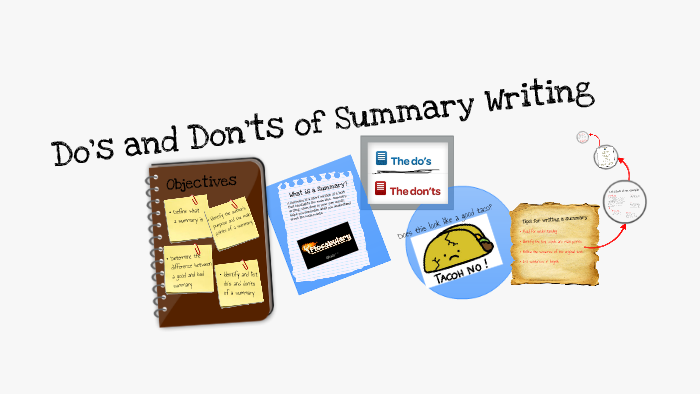
Summary writing involves capturing the main points of a piece of content concisely and accurately. Dos of summary writing include focusing on key ideas, maintaining original meaning, and using your own words.
Don’ts involve omitting important information, adding personal opinions, and including unnecessary details. It is essential to grasp the main concepts of the original text and convey them in a clear and succinct manner while avoiding biases or unrelated information. Mastering the dos and don’ts of summary writing can help create impactful and informative summaries that effectively convey the core message of the original content.
By understanding and implementing these guidelines, one can effectively summarize various types of information in a way that is both meaningful and engaging for the audience.
Credit: prezi.com
Dos And Don’ts Of Summary Writing
When it comes to summary writing, there are clear dos and don’ts that can help you effectively communicate the main points of a piece of content in a concise, accurate, and professional manner. Whether you’re summarizing a book, article, or report, following these guidelines will ensure that your summary is clear, informative, and free of personal bias.
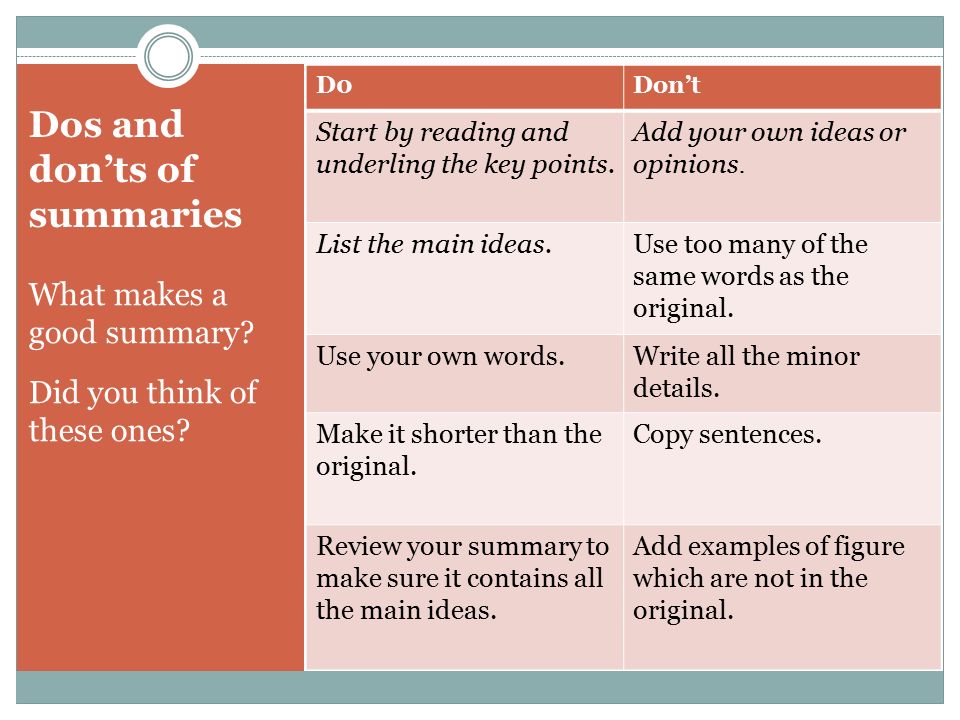
1. Summarize The Main Points Accurately
In your summary, ensure that you accurately capture the core message and main points of the original content. Avoid including unnecessary details or digressions that detract from the primary focus. Your goal is to distill the key information while maintaining the original meaning and context.
2. Use Your Own Words
When summarizing, it’s crucial to express the content in your own words, refraining from directly quoting the original text. This demonstrates your understanding of the material and helps prevent accidental plagiarism. Remember to maintain the author’s intended meaning while using language that reflects your own style and voice.
3. Be Concise
Conciseness is key in summary writing. Aim to convey the essential information without unnecessary elaboration. Keep your sentences succinct and to the point, omitting any superfluous details that do not contribute to an understanding of the main ideas being summarized.
4. Avoid Personal Opinions
While summarizing, refrain from injecting personal opinions or interpretations into the content. Your objective is to present a neutral, objective overview of the original material. By excluding personal bias and subjective commentary, you maintain the integrity and accuracy of the summary.
5. Proofread Your Summary
Prior to finalizing your summary, carefully proofread the content to identify and correct any errors in grammar, spelling, or punctuation. Ensuring clarity and coherence in your writing helps guarantee that your summary effectively conveys the intended message while upholding a professional standard.
Credit: slideplayer.com

Credit: www.pinterest.com
Frequently Asked Questions On Dos And Don’ts Of Summary Writing
What Are 4 Things You Should Not Do In A Summary?
In a summary, avoid adding personal opinions, using lengthy descriptions, including new information not in the original text, and restating every detail. It’s important to maintain accuracy and conciseness, while reflecting the main points of the source material.
What Are The Rules For Summary Writing?
Summary writing requires adherence to several rules. First, keep sentences brief, with a maximum of 20 words each. Second, ensure writing is SEO friendly, unique, easy to understand, in active voice, and plagiarism-free. Third, avoid starting sentences with specific phrases and words.
Additionally, sentences should not be written in passive voice form. Lastly, write the answer within 50 words and pass AI writing detection.
What Should You Not Include When Writing A Summary?
When writing a summary, it is important not to include lengthy sentences or complex language. Keep it concise, under 20 words per sentence. Also, avoid starting sentences with certain phrases like “when it comes” or “if you,” and do not use passive voice.
By following these guidelines, your summary will be SEO friendly, easy to understand, and free of plagiarism. Keep it human-like and within 50 words.
Conclusion
Mastering the art of summary writing requires following a few key guidelines. Keep your sentences concise, ensuring they do not exceed 20 words. Craft your writing to be SEO friendly, unique, and plagiarism-free while maintaining a human-like tone. Avoid using certain phrases that can make your content sound robotic.
By adhering to these principles, you can create summaries that are easy to understand, engaging, and pass AI writing detection. By consistently applying these dos and don’ts, you can enhance your summary writing skills and captivate your readers.


