Willpower: Rediscovering the Greatest Human Strength by Roy F. Baumeister and John Tierney
In Willpower, pioneering social psychologist Roy F. Baumeister and acclaimed science writer John Tierney reveal that self-control is one of the two most critical predictors of life success. By demonstrating that willpower operates like a muscle—fuelled by glucose and exhausted through overuse—they solve the age-old mystery of personal failure. This essential book provides a practical, science-grounded blueprint for building lasting habits, avoiding decision fatigue, and outsmarting temptation in an increasingly distracted world.
Super Summary
Who May Benefit
- Professionals and Executives: Leaders looking to optimize daily decision-making, prevent decision fatigue, and organize workloads.
- Habit Builders and Procrastinators: Anyone struggling to stick to routines, finish projects, or silence persistent mental distractions.
- Parents and Educators: Individuals seeking proven, consistency-based strategies to cultivate self-control in children without toxic narcissism.
- Dieters and Health Enthusiasts: People wanting to break the frustrating cycle of crash diets and understand the physiological limits of weight loss.
- Creatives and Writers: Artists looking to build consistent, low-strain daily routines to maximize creative output.
Top 3 Key Insights
- Willpower is a finite energy resource that behaves like a muscle, easily fatigued by daily self-control but strengthenable through regular, deliberate mental exercise.
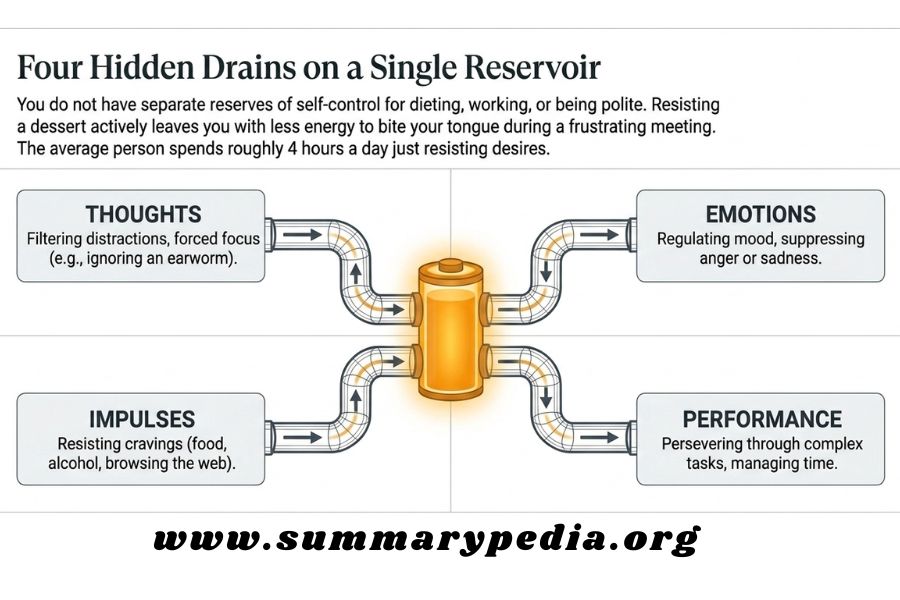
- All self-control tasks draw from the exact same reservoir, meaning resisting treats, making tough decisions, and ignoring physical pain actively compete for energy.
- Improving willpower is the single most reliable path to a better life, predicting higher grades, career success, superior physical health, and emotional stability.
4 More Takeaways
- Glucose is the biological fuel of self-control, meaning low blood sugar directly triggers impulsive choices, explosive tempers, and severe decision-making shortcuts.
- Making choices causes severe decision fatigue, forcing the brain to hoard remaining energy by defaulting to passive choices or the status quo.
- Uncompleted tasks trigger cognitive nagging (the Zeigarnik effect), which is silenced not by immediate completion, but by writing down a specific, actionable plan.
- High self-control individuals do not constantly resist temptations; instead, they proactively play offense by building automatic, low-strain habits and orderly routines.
Book in 1 Sentence
Willpower proves that self-control is a finite, glucose-fueled muscle that can be systematically trained to automate positive habits and prevent decision-making collapse.
Want to be the best 1% achiever! Find the 1% Blueprint resources here.
Book in 1 Minute
In Willpower, Roy F. Baumeister and John Tierney combine groundbreaking laboratory research with historical biography to redefine how we view human agency. The book debunks the late-twentieth-century obsession with unconditional self-esteem, showing instead that self-control is the true predictor of academic, financial, and personal success. By examining how willpower is drained by everyday tasks, the authors outline the “ego depletion” model and connect it directly to blood glucose levels. The outcome is a liberating shift in mindset: instead of viewing willpower as an emergency shield to be summoned in crises, readers learn to treat it as a budgetable resource. By establishing “bright lines,” precommitment strategies, and automated habits, anyone can structure their life to achieve goals with significantly less daily strain.
One Unique Aspect
The book’s most distinctive framework is the Dieter’s Catch-22, which reveals that while avoiding food requires willpower, fueling willpower requires eating—rendering traditional crash dieting a biological impossibility that triggers massive, counterregulatory overeating.
Chapter-wise Summary
Chapter 1: Is Willpower More Than a Metaphor?
“Sometimes we are devils to ourselves / When we will tempt the frailty of our powers, / Presuming on their changeful potency.”
This chapter establishes the scientific reality of willpower, starting with the career of street performer Amanda Palmer, whose grueling work as a living statue required intense, nonreactive focus. The authors detail the famous Radish Experiment, where hungry students who resisted warm chocolate chip cookies to eat raw radishes gave up on insoluble geometry puzzles in just eight minutes, compared to twenty minutes for those allowed to eat chocolate. This landmark study proved that willpower is a limited resource. When this resource is spent, individuals enter a state of Ego Depletion, where the brain’s conflict-monitoring system (the anterior cingulate cortex) slows down. Rather than causing negative moods, depletion intensifies all subjective feelings, making cravings and pain feel far more severe.
The Ego Depletion Model
- Finite Muscle Energy: Willpower acts as a muscle that tires after exertion but can be strengthened through practice over time.
- Shared Reservoir: Diverse tasks—such as suppressing giggles, squeezing handgrips, resisting cookies, or ignoring physical pain—deplete the exact same energy pool.
- Anterior Cingulate Cortex (ACC) Slowdown: Wires monitoring the skull show that ego depletion dulls the brain’s error-detection system, causing people to miss mistakes.
- Emotional and Sensory Amplification: Depleted individuals feel cravings, sadness, pain, and joy with heightened, uncontrolled intensity.
- Conservation Response: When anticipating future tasks, the brain automatically hoards remaining energy, slacking on immediate performance.
Chapter Key Points:
- Willpower behaves like a muscle.
- Ego depletion weakens error detection.
- Depletion amplifies all emotions.
Chapter 2: Where Does the Power in Willpower Come From?
“No glucose, no willpower: The pattern showed up time and again…”
The authors investigate the biological power source behind self-control: glucose. Comedian Jim Turner’s diabetic episodes highlight how low blood sugar can transform a gentle person into an irrational, volatile individual who can be instantly normalized by drinking a glass of juice. In the lab, small acts of self-control cause a measurable drop in blood glucose, and refueling the brain with sugar restores willpower in both humans and dogs. Hypoglycemics, diabetics, and prisoners with impaired glucose tolerance face severe self-control struggles, resulting in higher crime rates and explosive tempers. Similarly, the luteal phase of the menstrual cycle diverts massive glucose to the ovaries, precipitating PMS symptoms like emotional outbursts, shopping sprees, and sweet cravings due to depleted self-control energy.
The Glucose Fuel Model
- The Brain’s Power Cord: The brain consumes over 20% of the body’s energy, using glucose to manufacture critical neurotransmitters.
- Active Shifting: Low glucose does not stop brain activity; it shifts processing away from executive self-control centers, leaving emotional centers uninhibited.
- The Glycemic Index Rules:
- High Glycemic Index: Refined starches and sugars cause quick spikes followed by immediate crashes, worsening depletion.
- Low Glycemic Index: Slow-burning foods like vegetables, nuts, cheese, lean meat, fish, and olive oil provide a steady, durable supply of willpower energy.
- The Sickness Trade-off: The immune system consumes massive glucose when fighting a cold; forcing yourself to work sick starves the brain, making you highly prone to ethical lapses and poor decisions.
Chapter Key Points:
- Glucose is willpower’s biological fuel.
- Diabetics face unique self-control challenges.
- Low-glycemic foods prevent willpower crashes.
Chapter 3: A Brief History of the To-Do List, from God to Drew Carey
“‘Tis easy to frame a good bold resolution; / But hard is the Task that concerns execution.”
This chapter traces the evolution of goal-setting, starting with Benjamin Franklin’s 13-week virtue-charting ivory notebook, which failed because rigid goals like Order and Industry constantly conflicted. Modern research confirms that conflicting goals trigger painful rumination, reduce productivity, and cause physical illness. Warren Bickel’s work on addicts shows how a shortened future horizon—focusing on short-term payoffs rather than long-term objectives—undermines success. Albert Bandura’s research proves that specific, short-term (proximal) goals build confidence, while long-term (distal) goals are useless unless linked directly to daily steps. Crucially, monthly planning outperforms rigid daily schedules because it offers the flexibility to absorb unexpected delays. Comedian Drew Carey resolved his severe information overload by adopting David Allen’s Getting Things Done (GTD) system.
The GTD Framework & Zeigarnik Effect Plan-Making Model
- The Zeigarnik Plan-Making Model: The unconscious mind nags the conscious mind with reminders of incomplete tasks because it cannot make plans on its own. This nagging (the Zeigarnik effect) is silenced not by finishing the task, but by writing down a specific plan detailing what, where, and when.
- The 4-Step GTD Process:
- Collect: Empty your head. Capture every project, big or small, in an external notebook or digital list.
- Process: Apply the 4 Ds: Do it (if under two minutes), Delegate it, Defer it, or Drop it.
- Next Action (NA): Translate every vague project into a highly specific, immediately doable physical action.
- Someday/Maybe: Store non-urgent dreams in a separate folder to prevent current mental clutter.
Chapter Key Points:
- Conflicting goals cause severe rumination.
- Monthly plans outperform rigid daily schedules.
- Next-action plans silence mental nagging.
Chapter 4: Decision Fatigue
“Closing a door on an option is experienced as a loss, and people are willing to pay a price to avoid the emotion of loss.”
This chapter introduces “decision fatigue”—the depletion of willpower caused by the act of making choices. Postdoctoral student Jean Twenge’s wedding registry planning inspired lab tests proving that “deciders” give up on physical stamina and math puzzles much faster than “nondeciders” who only evaluate options. The Rubicon model of action phases illustrates that crossing the Rubicon of decision-making is the most fatiguing step. This is dramatically illustrated by Israeli parole board judges, who grant parole 65% of the time early in the morning and post-food breaks, but drop to under 10% late in the day as decision fatigue makes them default to the status quo (denying parole). Exhausted minds become “cognitive misers,” avoiding trade-offs, procrastinating on relationship commitments, and succumbing to default recommendations, which car dealers and checkout counters exploit to sell expensive add-ons and impulse sweets.
The Decision Fatigue & Rubicon Model
- The Action Phases:
- Predecisional Phase: Weighing possibilities and calculating cost-benefits. This is cognitively demanding but manageable.
- Casting the Die: The fatiguing act of deciding. Crossing the Rubicon drains the shared willpower reservoir.
- Postdecisional Phase: Step-by-step implementation of the choice.
- The Cognitive Miser Trap: When depleted by choices, the brain takes lazy shortcuts:
- Status Quo Bias: Postponing decisions and defaulting to the safest, passive option.
- Single-Dimension Evaluation: Evaluating options based on a single factor (e.g., price only or quality only) to avoid complex trade-offs.
- Default Option Vulnerability: Succumbing to pre-selected default settings, adding hidden costs.
- Evolutionary Bias: Evolutionary pressures make men highly susceptible to short-term discount bias when exposed to immediate mating cues.
Chapter Key Points:
- Making choices drains physical stamina.
- Judges default to status quo when tired.
- Decision fatigue drives impulsive consumer spending.
Chapter 5: Where Have All the Dollars Gone?
“A small daily task, if it be really daily, will beat the labours of a spasmodic Hercules.”
This chapter explores “monitoring”—the second crucial step of self-control. Brain scans show that spendthrifts have a sluggish insula that fails to register disgust at high prices, but a visual reminder of their unpaid balance activates this area. Objective Self-Awareness Theory, pioneered by Robert Wicklund and Shelley Duval, shows that focusing on oneself forces comparison against personal standards. A mirror in a room dramatically increases Halloween trick-or-treaters’ compliance with rules, whereas alcohol destroys self-control by crushing self-awareness. Novelist Anthony Trollope wrote 2,500 words before breakfast by keeping a daily log, treating any lazy week as a “blister to his eye”. Today, RescueTime, Mint.com, and the Quantified Self movement automate this monitoring. Sharing data publicly increases accountability, as we care more about what others know about us than what we know about ourselves.
The Objective Self-Awareness & Monitoring Loop
- Self-Awareness Mirror: Directing focus inward automatically forces you to evaluate your current state against ideal behavioral standards.
- The 3-Step Monitoring Cycle:
- Track: Record metrics consistently (e.g., daily weight, word counts, or dollars spent).
- Compare: Benchmark progress against standards or peer averages.
- Adjust: Mobilize willpower to close the gap between reality and the standard.
- Accountability Outsourcing: Public sharing (like uploading run logs or sharing progress with a close friend) leverages social networks, reducing the cognitive burden of private monitoring.
- Hyperopia (The Frugality Curse): An overactive insula that reacts with horror at spending cash, leading to saver’s remorse and a pathological focus on the future at the expense of enjoying the present.
Chapter Key Points:
- Self-awareness forces comparison to standards.
- Spendthrifts possess a sluggish insula.
- Public sharing boosts accountability.
Chapter 6: Can Willpower Be Strengthened?
“Getting your brain wired into little goals and achieving them, that helps you achieve the bigger things you shouldn’t be able to do…”
The authors investigate whether willpower can be built over time, starting with the extreme feats of endurance artist David Blaine. Blaine’s ability to withstand subfreezing ice and fast for 44 days stems from decades of structured training, proving that self-discipline expands through repetitive exercise. In the laboratory, Mark Muraven and colleagues proved that simple two-week tasks, like maintaining upright posture or recording daily food intake, significantly increased self-control stamina on unrelated tests. Conversely, trying to regulate moods did not improve willpower, as emotion regulation relies on cognitive distractions rather than direct willpower. Australian psychologists Meg Oaten and Ken Cheng verified that committing to a gym program, study schedule, or financial budget built willpower stamina, which cascaded into cleaner homes, reduced TV time, healthier diets, and even reduced tendencies toward relationship violence.
The Willpower Muscle Model
- The Dual-Strength Distinction:
- Power: The maximum momentary capacity of willpower. This remains relatively constant and did not increase significantly in posture tests.
- Stamina: Resistance to depletion. This increased dramatically. Trained participants did not exhaust their willpower muscle as quickly, leaving them with more stamina to handle late-day stress.
- The Global Spillover Effect: Exercising self-control in one narrow discipline (e.g., posture or budget logging) strengthens the shared muscle, automatically elevating performance in unrelated areas of life, such as hygiene, studying, and emotional control.
- The Licensing Effect Warning: The cognitive trap where performing a virtuous deed (such as working out) makes an individual feel entitled to indulge in a bad habit (such as overeating sweets).
Chapter Key Points:
- Willpower can be trained like a muscle.
- Posture exercises build self-control stamina.
- Self-control in one area cascades globally.
Chapter 7: Outsmarting Yourself in the Heart of Darkness
“I have learnt by actual stress of imminent danger, in the first place, that self-control is more indispensable than gunpowder…”
This chapter contrasts the legendary African explorer Henry Morton Stanley with his European officers in the Congo. While Stanley’s Rear Column descended into shocking moral decay and horrific cruelty, Stanley survived the brutal rain forest by maintaining rigid discipline, including shaving daily with cold water and blunt razors. Psychologists have confirmed that orderly environments unconsciously prompt self-control, while messy settings lower it. Stanley succeeded because he understood the limits of his willpower and avoided relying on it blindly. He circumvented the Hot-Cold Empathy Gap—our inability when calm to realize how we will act when tempted or aroused—by using precommitment. Precommitment involves locking oneself into a virtuous path, much like Odysseus tying himself to the mast to survive the Sirens. High self-control individuals do not struggle constantly; they establish automatic, low-strain habits.
Precommitment & The Hot-Cold Empathy Gap Framework
- The Hot-Cold Empathy Gap: In a calm (“cold”) state, humans fail to anticipate how severely their judgment and morals will warp when in an aroused, exhausted, or tempted (“hot”) state, leading to unrealistic planning.
- Precommitment Strategies:
- Physical Redirection: Removing temptations from your immediate environment (e.g., keeping unlit cigarettes out of reach).
- Commitment Contracts: Platforms like stickK.com leverage financial stakes and referees, boosting success rates to 80%.
- Digital Lockouts: Using software (like Freedom or Covenant Eyes) to block sites in advance.
- Orderly Cues: Keeping an immaculate desk and routine to trigger unconscious, low-strain self-discipline.
- High-Level Construals: Elevating your mindset to focus on long-term, abstract, and transcendent goals (e.g., Stanley’s “sacred task” of ending the slave trade) dramatically improves willpower stamina.
Chapter Key Points:
- Orderly environments unconsciously prompt discipline.
- Precommitment prevents hot-state failures.
- High self-control relies on automatic habits.
Chapter 8: Did a Higher Power Help Eric Clapton and Mary Karr Stop Drinking?
“The primal chattering in my skull has dissipated as if some wizard conjured it away.”
The authors examine why Alcoholics Anonymous (AA) and religious practice are highly effective at restoring self-control. Musician Eric Clapton and memoirist Mary Karr overcame severe, suicidal alcoholism by hitting rock bottom and “surrendering” to a higher power through kneeling prayer. AA succeeds because it helps members establish clear standards (“one day at a time”), monitor behavior (sobriety chips and daily sponsor contact), and leverage peer-group support to replace toxic social networks. Social networks are highly contagious; both quitting smoking and gaining weight spread through friends and families. Michael McCullough’s research reveals that active religious participation increases longevity by 25%, reduces goal conflicts, and acts as an “anaerobic workout” for self-control through structured prayers, fasting, and meditations. As temptation nears, humans suffer from hyperbolic discounting, devaluing future goals. To prevent this, individuals must establish “bright lines”—clear, simple, and non-negotiable rules.
Hyperbolic Discounting & The Bright Lines Framework
- Hyperbolic Discounting: The psychological distortion where immediate temptations warp judgment, causing a steep, hyperbolic devaluation of distant, long-term goals as the temptation draws closer.
- Bright Lines vs. Fuzzy Boundaries:
- Fuzzy Boundaries: Vowing to drink or eat “moderately” has no clear cut-off point, allowing the mind to rationalize gradual, destructive slips.
- Bright Lines: Unambiguous, clear-cut rules (such as zero tolerance or total abstinence) that make any violation immediately noticeable. This allows the current self to trust that the future self will not cross the threshold.
- The Social Accountability Multiplier: Explicit promises made to close peers or spouses are kept at far higher rates than private resolutions.
Chapter Key Points:
- Hyperbolic discounting warps long-term judgment.
- Fuzzy boundaries encourage self-control failures.
- Bright lines make rules non-negotiable.
Chapter 9: Raising Strong Children: Self-Esteem Versus Self-Control
“Brats are not born. They’re made.”
This chapter critiques the self-esteem movement, which claimed that praising children unconditionally would prevent drug abuse, crime, and academic failure. Baumeister’s review panel proved that boosting self-esteem without achievement simply creates narcissism, entitlement, and poor academic performance. Instead, parents must focus on cultivating self-control. Chinese-American families succeed not through intelligence, but through Confucian traditions of chiao shun (to train) and guan (to govern and love), fostering superior toddler self-control that translates into high academic and career achievement. Reality TV’s Nanny Deb shows that children crave structure and consistent rules. Effective discipline depends on consistency, speed, and severity—with consistency being the most important factor. Single-parent homes face disadvantages because they have fewer eyes to monitor children. Parents can build children’s self-control through structured play (Tools of the Mind preschool program) or video games that reward patience and concentration.
The Three Facets of Punishment & Tools of the Mind Framework
- The Three Facets of Punishment:
- Consistency: The single most crucial factor. Parents must discipline misbehavior every single time, calmly and predictably.
- Speed: Punishment must occur quickly after the infraction to form a strong mental connection.
- Severity: The least important factor. Harsh punishments are counterproductive, teaching children aggression rather than self-control.
- Tools of the Mind Framework: Structured play that teaches children self-regulation over time:
- Pretend Roles: Children stay in character (e.g., pretending to be guards on watch), forcing attention control.
- Pre-Planned Scenarios: Planning the play scenario in advance and sustaining it for days helps toddlers integrate behavior across time.
- The Super-Overjustification Myth: Rewarding children for hard tasks (like paying for outstanding grades) does not ruin their “intrinsic love of learning” but conveys the high value society places on effort.
Chapter Key Points:
- Unconditional praise breeds toxic narcissism.
- Consistency is the most vital facet of discipline.
- Fewer monitoring eyes lowers self-control.
Chapter 10: The Perfect Storm of Dieting
“It is a hard matter, my fellow citizens, to argue with the belly, since it has no ears.”
This chapter analyzes why dieting is the ultimate self-control trap—a “perfect storm” that causes the vast majority of dieters to fail. Oprah Winfrey’s lifelong struggles illustrate that even individuals with immense willpower cannot overcome basic biological defenses. When we restrict calories, the body treats it as a famine, slowing metabolism and aggressively fighting to retain fat. Peter Herman discovered the “what-the-hell effect” (counterregulatory eating): once dieters cross their strict daily calorie limit (for example, by drinking a milkshake), they write off the day as a failure, stop monitoring, and engage in massive binges. Dieters also fall into a Catch-22: they need willpower to avoid eating, but they need to eat to supply the glucose that fuels willpower. To succeed, dieters should avoid strict dieting and use implementation intentions (“if-then” plans), eat low-glycemic foods, weigh themselves daily, and use smaller plates to leverage external cues.
The Dieter’s Catch-22 & Postponed-Pleasure Ploy
- The Dieter’s Catch-22:
- In order not to eat, a dieter needs willpower.
- In order to have willpower, a dieter must consume glucose (food).
- The Postponed-Pleasure Ploy: Flatly denying oneself a food (“never”) causes the mind to fixate on it due to the Zeigarnik effect. Conversely, telling yourself “Not now, but later” clears the mental loop, reducing subsequent chocolate cravings and overall consumption.
- Mindless Eating Defenses:
- Scale Frequency: Weighing yourself every single day dramatically improves weight maintenance.
- Plate Size & Glass Height: Using small plates and tall, narrow glasses tricks the brain’s poor volume perception.
- Environmental Traces: Keeping discarded chicken bones or food packages in view does the monitoring work for you.
Chapter Key Points:
- Dieting triggers biological famine defenses.
- The what-the-hell effect causes dieter binges.
- Postponing treats works better than flat denial.
Conclusion: The Future of Willpower—More Gain, Less Strain
“Give me chastity and continence, but not yet.”
The authors review how to apply self-control to “play offense” rather than defense. Rather than using willpower for crisis rescue, high self-control individuals develop effective habits and routines that prevent crises entirely, resulting in far less daily stress. Procrastination is a pervasive vice driven by impulsiveness and short-term mood repair, rather than perfectionism. Tice and Baumeister’s deadline test proved that although procrastinating students are more relaxed early in the semester, they get significantly sicker at the end of the term and earn poorer grades. To beat procrastination, Raymond Chandler used the “Nothing Alternative”—setting aside time where you either work on your goal or do absolutely nothing else. Budgeting willpower, establishing rewards for successes, and automating monitoring using digital tools ensure that we can enjoy our free time and direct our self-control toward altruism and sharing joy.
The Nothing Alternative & Play Offense Framework
- The Nothing Alternative Rule:
- You don’t have to write (or do your specific task).
- You can’t do anything else (no reading, no checking emails, no cleaning).
- Play Offense Habit Loop:
- Avoid Temptation: Out of sight, out of mind. High self-control people stay away from all-you-can-eat buffets and keep candy in drawers.
- Automate Routine: Use willpower once to establish a habit (e.g., page-a-day writing or flossing), after which the behavior runs on autopilot without energy expenditure.
- The Yes… Damn! Effect: The tendency to overestimate future free time and agree to distant commitments we would reject today.
Chapter Key Points:
- High self-control avoids crises entirely.
- Procrastination is driven by impulsiveness, not perfectionism.
- The Nothing Alternative beats procrastination.
10 Notable Quotes
- “The highest possible stage in moral culture is when we recognize that we ought to control our thoughts.”
- “Improving willpower is the surest way to a better life.”
- “Self-regulation failure is the major social pathology of our time.”
- “A small daily task, if it be really daily, will beat the labours of a spasmodic Hercules.”
- “The digital tools and the data are just catalysts for people to motivate themselves and one another.”
- “Self-control is more indispensable than gunpowder.”
- “The best way to reduce stress in your life is to stop screwing up.”
- “No glucose, no willpower: The pattern showed up time and again…”
- “Closing a door on an option is experienced as a loss, and people are willing to pay a price to avoid the emotion of loss.”
- “Inner discipline still leads to outer kindness.”
Explore 100 more insightful quotes from this book here
About the Author
Roy F. Baumeister is one of the world’s most influential social psychologists, renowned for his extensive research on the self, social rejection, sexuality, and self-regulation. Over a career spanning several decades, he has published over 500 scientific articles and more than 30 books, including The Cultural Animal and Evil: Inside Human Violence and Cruelty. He earned his Ph.D. from Princeton and has held distinguished professorships at Florida State University, Case Western Reserve University, and the University of Queensland. Baumeister pioneered the “ego depletion” model of willpower, transforming modern psychology.
John Tierney is a highly acclaimed science writer, journalist, and long-time columnist for The New York Times. Known for his popular column “Findings,” Tierney has spent his career translating complex social science and physical research into engaging, accessible, and witty prose for the general public. He has reported from around the globe and co-authored books such as The Best Case Scenario Handbook. Together, their collaborative blend of academic rigor and narrative storytelling makes Willpower a masterwork of popular science.
Deep Diving
Frequently Asked Questions
- What is ego depletion? It is the temporary exhaustion of our self-control energy after exerting willpower, leaving us vulnerable to impulses.
- How does glucose affect willpower? Glucose is the brain’s fuel; self-regulation consumes glucose, and low levels shift brain activity to emotional centers, raising impulsiveness.
- What is decision fatigue? The mental exhaustion caused by making consecutive choices, which defaults the brain to passive status quo options.
- How does environmental order affect self-control? Neat environments unconsciously nudge the brain toward self-discipline and charitable acts, while messy settings lower self-control.
- What is the “what-the-hell effect” in dieting? The cognitive slip where exceeding a calorie limit causes a dieter to classify the day as a failure, stop tracking, and binge.
- Why are monthly plans better than daily schedules? Monthly plans offer flexibility to absorb unexpected disruptions, whereas rigid daily plans become demoralizing when missed.
- What is the hot-cold empathy gap? Our cognitive inability when calm (“cold”) to accurately predict how strongly our desires will warp our actions when tempted (“hot”).
- How do we silence uncompleted task reminders? By making a specific next-action plan detailing exactly when and where to act, which satisfies the unconscious mind.
- Does boosting self-esteem make children more successful? No. Research shows unconditional self-esteem praise breeds entitlement and narcissism; parents should focus on cultivating self-control.
- What is the “Nothing Alternative” to beat procrastination? Raymond Chandler’s technique: setting aside a block of time where you can either work on your goal or do absolutely nothing.
Theories and Concepts
- Ego Depletion Theory: Self-control is a limited, shared energy resource that fatigues with use.
- The Glucose Theory of Willpower: Self-regulation relies on the body’s glucose level, which shifts brain activity when low.
- Decision Fatigue: The state of cognitive exhaustion following a sequence of choices, leading to default bias.
- The Zeigarnik Effect: The cognitive phenomenon where the mind continuously reminds you of uncompleted tasks until a clear plan is made.
- The Hot-Cold Empathy Gap: The cognitive bias where people underestimate the power of future “hot” emotional or physical impulses while in a “cold” state.
- Objective Self-Awareness Theory: The process where focusing on the self triggers automatic comparison with behavioral standards, prompting self-control.
- Hyperbolic Discounting: The tendency to steeply devalue future gains in favor of immediate, smaller rewards as temptation nears.
Books and Authors
- Self-Help by Samuel Smiles: A 19th-century bestseller preaching self-denial and patience.
- The Power of Will by Frank Channing Haddock: A Victorian self-help bestseller seeking to build willpower systematically.
- How to Win Friends and Influence People by Dale Carnegie: A post-war feel-good book shifting focus to social pleasantry.
- The Power of Positive Thinking by Norman Vincent Peale: A bestseller promoting mental optimism over willpower.
- Beyond Freedom and Dignity by B. F. Skinner: A text arguing that human behavior is driven strictly by reinforcement contingencies.
- Losing Control by Roy F. Baumeister, Dianne Tice, and Todd Heatherton: A scholarly 1994 book establishing self-regulation failure as a core social problem.
- The Quest for Identity by Allen Wheelis: A psychoanalytic work identifying the shift from Victorian iron wills to modern lack of self-discipline.
- Getting Things Done by David Allen: A stress-free productivity manual detailing the next-action workflow to empty in-boxes.
- Lit by Mary Karr: A memoir describing her descent into alcoholism and rescue through spiritual prayer.
- Top of the Class by Soo and Jane Kim: A book on Asian-American parenting methods that cultivate achievement through self-control.
- Twilight by Stephenie Meyer: A popular vampire novel used to illustrate the conflict of adult impulses versus child self-control.
- Self-Control and Discipline by Mary Brunton: 19th-century romantic novels illustrating self-governance.
Persons
- Amanda Palmer: A Dionysian rock singer who trained her nonreactivity and willpower by performing as a living statue in Harvard Square.
- Don Baucom: A marital therapist who noticed that work-depleted couples fight over trivial issues at home.
- Sigmund Freud: Pioneer of psychoanalysis who proposed an energy-based model of the ego, presaging ego depletion.
- Bluma Zeigarnik: A Russian psychologist who discovered that waiters remember unpaid orders but forget them instantly once completed.
- David Allen: Developer of the Getting Things Done (GTD) system who personally coached Drew Carey to clear his cluttered workspace.
- Eliot Spitzer: The governor of New York whose career was destroyed by hiring a prostitute due to decision-depleted judgment.
- Jean Twenge: A postdoctoral researcher whose grueling wedding registry planning inspired experiments on decision fatigue.
- Dan Ariely: A Duke behavioral economist who studied people’s irrational behavior in keeping useless options open.
- David Blaine: An endurance artist who conducts extreme fasts, cold exposure, and breath-holding feats to expand his mental capacity.
- Henry Morton Stanley: A Victorian explorer who survived grueling African expeditions by maintaining rigid order, such as shaving daily.
- Mary Karr: A memoirist and poet who used prayer to conquer her severe alcoholism despite being a lifelong agnostic.
- Eric Clapton: A legendary guitarist who overcame drug addiction and alcoholism by surrendering his will to a higher power.
- Nanny Deb (Deborah Carroll): A reality TV nanny who restored order to chaotic American households using consistent discipline.
- Walter Mischel: Psychologist who conducted the Stanford marshmallow experiments and discovered fatherless children struggle to delay gratification.
- Oprah Winfrey: Bestselling talk-show host whose chronic weight-loss struggles illustrate the biological limits of dieting and willpower.
- Brian Wansink: A food researcher who demonstrated mindless eating through bottomless soup bowls and uncleared chicken bones.
How to Use This Book
Apply this book by building small, consistent daily habits like posture or writing. Silence mental nagging by making concrete next-action plans. Avoid major decisions or temptations when tired or hungry, and eat low-glycemic foods to maintain a steady glucose supply for your willpower muscle.
Conclusion
Willpower is your greatest natural strength, but it must be managed wisely. Stop fighting losing battles against immediate temptations; instead, design a life of structured habits, clear boundaries, and proactive routines. Take charge of your focus today, master your energy, and build the disciplined life you deserve!