How to Get a Return on Failure: Fail Smarter—Return Stronger by John C. Maxwell
How to Get a Return on Failure: Fail Smarter—Return Stronger by John C. Maxwell reveals how treating setbacks as investments transforms losses into stepping stones for achievement. The book solves the problem of failure avoidance, teaching readers to process missteps positively instead of letting them derail progress. In today’s rapidly changing world, mastering resilience and adaptability is essential for reaching your maximum leadership potential.
Who May Benefit
- Entrepreneurs navigating high business risks and continuous setbacks.
- Leaders managing teams through difficult transitions and projects.
- Professionals facing career stagnation, rejection, or self-doubt.
- Students and creatives battling paralyzing perfectionism.
- Anyone seeking greater emotional maturity and psychological resilience.
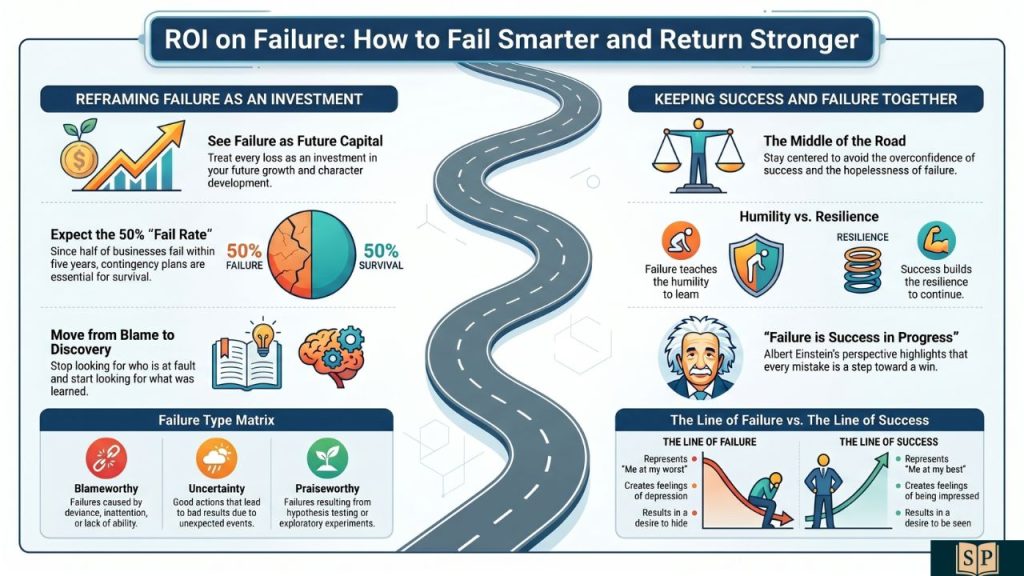
Top 3 Key Insights
- Keep success and failure connected to maintain humility and resilience.
- Practice the Cycle of Improvement: Test, fail, evaluate, learn, improve, reenter.
- Differentiate between good misses (evaluated) and bad misses (repeated).
4 More Takeaways
- Anticipate failure to shorten your emotional recovery time.
- Value progress over perfection to avoid the trap of inaction.
- Use the twenty-four-hour rule for fast emotional processing.
- Stop fearing others’ opinions; get over yourself.
Book in 1 Sentence
John C. Maxwell teaches that by adopting a resilient mindset and actively learning from mistakes, you can turn inevitable setbacks into long-term success.
Book in 1 Minute
How to Get a Return on Failure by John C. Maxwell challenges the conventional fear of failing. Maxwell argues that the key difference between successful and unsuccessful people is not avoiding mistakes, but extracting value from them. He presents a mindset shift where failure becomes a long-term investment, much like a financial portfolio. Through actionable frameworks like the Cycle of Improvement and the twenty-four-hour rule, readers learn to test ideas, fail fast, evaluate, and reenter the arena stronger. The book emphasizes keeping success and failure together to balance humility with resilience. Ultimately, Maxwell provides a blueprint for conquering self-centeredness, embracing the uphill climb of hard work, and leading others through their own inevitable missteps to achieve lasting personal and professional significance.
1 Unique Aspect
Maxwell introduces the concept of keeping success and failure together, rather than treating them as extreme opposites. By visualizing them locked together in the center of life, leaders can prevent the arrogant overconfidence bred by unchecked success and the hopeless despair caused by isolated failure.
Chapter-wise Summary
Chapter 1: See Failure as an Investment in Your Future “Failure will always be a part of your life.”
Maxwell urges readers to view failure not with apprehension, but as a valuable asset for the future. By expecting to fail, practicing self-compassion, and maintaining a positive life stance, we soften the blow of inevitable setbacks. He uses Harvard Professor Amy Edmondson’s spectrum to reframe failures from blameworthy deviations to praiseworthy exploratory tests. Ultimately, treating failure as an investment requires a long-term perspective where steady, evaluated adjustments compound into eventual success.
Chapter Key Points:
- Expect to fail often.
- Reframe failure’s context.
- Practice radical self-compassion.
Chapter 2: Keep Success and Failure Together “Success and failure are present in every person’s life, and we should intentionally keep them together.”
Separating success and failure leads to dangerous emotional instability. Success alone breeds arrogance, complacency, and a failure to ask tough questions, while failure alone causes deep hopelessness. By bringing both into the center of our lives, we maintain an authentic perspective, balancing humility with resilience. We should travel the middle of the road, avoiding the dangerous gutters of extreme success and extreme failure to achieve emotional strength and maturity.
Chapter Key Points:
- Avoid arrogant overconfidence.
- Failure brings essential humility.
- Success develops lasting resilience.
Chapter 3: To Get Over Failure, Get Over Yourself “To overcome failure, each of us needs to conquer our inner toddler.”
Our difficulty in handling failure often stems from self-centeredness and taking things too personally. Maxwell advises shifting focus from oneself to helping others to transition from mere success to true significance. By refusing to worry about what others think, distancing failure from fault, and rejecting perfectionism in favor of progress, we become emotionally stronger. Following Don Shula’s twenty-four-hour rule allows us to feel the emotion of a loss quickly, then move forward.
Chapter Key Points:
- Focus on helping others.
- Distance failure from fault.
- Apply the 24-hour rule.
Chapter 4: Use Failure to Make Yourself Better “The truth is that you can let failure beat you down, or you can use failure to make yourself better.”
Failure is the primary catalyst for developing resilience, good character, and wisdom. Maxwell introduces a personal reflection process—reviewing daily, asking tough questions, and directing immediate action—to turn losses into valuable lessons. He argues that true humility makes us teachable, while pride blinds us to growth. By eliminating excuses and learning from the failures of both ourselves and others, we forge the inner strength required to tackle greater life challenges.
Chapter Key Points:
- Reflect on daily actions.
- Adversity develops core character.
- Wisdom requires evaluated experience.
Chapter 5: Embrace the Value of Hard “Everything worthwhile is uphill.”
Success requires embracing the reality that meaningful achievements are inherently difficult. The path of least resistance only leads downward; growth demands consistent, uphill climbing. Maxwell warns against “destination disease,” reminding readers that the hard work never truly ends. Pain and legitimate suffering are the seeds of growth, forging authentic leaders who can point to their “scars” as proof of their capability, experience, and perseverance in the face of inevitable hardship.
Chapter Key Points:
- Hard work never ends.
- Growth requires facing adversity.
- Down is the way up.
Chapter 6: Practice the Cycle of Improvement “If we don’t change, we don’t grow.”
To break out of stagnation, leaders must adopt a reset mindset by actively learning, unlearning, and relearning every day. Maxwell details the continuous Cycle of Success: Test, Fail, Evaluate, Learn, Improve, and Reenter. Perfectionism stifles this cycle; instead, we must test ideas quickly, accept failure as a mapping tool, and ruthlessly evaluate the results. Intelligent, evaluated failures lead to layered learning, which compounds into continuous self-improvement and ultimate success.
Chapter Key Points:
- Test ideas without hesitation.
- Evaluate failures for insights.
- Reenter with improved strategies.
Chapter 7: Learn the Difference Between Good Misses and Bad Misses “All losses are not equal—some are good, and some are not.”
Not all failures are identical. A “good miss” involves early detection, quick correction, and learning within one’s area of strength. A “bad miss” happens when failures are hidden, repeated without adjustment, or occur in areas of natural weakness. Maxwell stresses cutting losses quickly and shifting perspective to see failure as simply an unfinished process. Taking positive action instead of wallowing in negative emotions is vital to successfully failing forward.
Chapter Key Points:
- Fail in your strengths.
- Cut your losses quickly.
- Make adjustments, not excuses.
Chapter 8: Lead Others Through Failure “Few things in life are more rewarding than adding value to others so that they can make a positive impact.”
Leaders must guide their teams through failure by setting realistic expectations from the start. Because fear of failure is highest at the beginning of any task, leaders must normalize mistakes and openly share their own past failures to build trust and credibility. Rather than just teaching from afar, leaders should mentor their people, working alongside them to close the gap between failure and success, continually reminding them of the bigger picture.
Chapter Key Points:
- Normalize early task failures.
- Share your own mistakes.
- Mentor through the process.
10 Notable Quotes
- “Successful people fail as often as unsuccessful people.”
- “Nothing happens TO you—it happens FOR you.”
- “Failure is success in progress.”
- “You don’t drown by falling into the water. You drown by staying there.”
- “The biggest failure is the failure to start, which is often caused by perfectionism.”
- “Everything worthwhile is uphill.”
- “Experience is not the best teacher. Evaluated experience is the best teacher.”
- “First drafts are always crap.”
- “In a time of drastic change, it is the learners who inherit the future.”
- “Anything I’ve ever done that ultimately was worthwhile initially scared me to death.”
About the Author
John C. Maxwell is a #1 New York Times bestselling author, speaker, and globally recognized leadership expert who has sold over 36 million books in 50 languages. He is the founder of Maxwell Leadership, EQUIP, and the Maxwell Leadership Foundation, organizations dedicated to training tens of millions of leaders across the globe. Recognized as the top leader in business by the American Management Association and the world’s most influential leadership expert by Inc. Magazine and Business Insider, Maxwell’s teachings focus on values-based, people-centric leadership. His vast bibliography includes classics like The 21 Irrefutable Laws of Leadership, Developing the Leader Within You, and Winning with People. He draws deep credibility from over 50 years of practical leadership experience and mentoring relationships with iconic figures like Coach John Wooden.
Frequently Asked Questions
- What is the “twenty-four-hour rule”? A rule by Don Shula: give yourself exactly 24 hours to celebrate a win or grieve a loss, then move on.
- Why is success a “lousy teacher”? Success breeds overconfidence and reduces our desire to ask tough questions about why we succeeded.
- What is the Cycle of Improvement? A continuous six-step process for growth: Test, Fail, Evaluate, Learn, Improve, and Reenter.
- What is a “good miss”? A failure that is discovered early, evaluated, corrected, and occurs in an area of natural strength.
- What is a “bad miss”? A failure that is hidden, repeated without adjustment, or occurs when focusing on an area of natural weakness.
- How can I get over failure? Get over yourself. Stop worrying about others’ opinions and focus on adding value to others instead.
- Why must we keep success and failure together? To maintain a balanced perspective—failure brings necessary humility, while success brings emotional resilience.
- What does “everything worthwhile is uphill” mean? Growth and success require strenuous, intentional effort; sliding downhill is easy but leads nowhere worthwhile.
- How should leaders handle team failures? Have up-front conversations expecting failure, share your own mistakes, and mentor them through recovery.
- Why is perfectionism dangerous? It paralyzes action and causes the biggest failure of all: the failure to start testing ideas.
Theories and Concepts
- The Cycle of Success: A continuous developmental process of testing, failing, evaluating, learning, improving, and reentering to ensure constant personal and organizational growth.
- The 5 Levels of Leadership: A framework showing leadership influence grows from mere Position (Level 1) up through Permission, Production, People Development, and Pinnacle (Level 5).
- The Failure Spectrum: Amy Edmondson’s model categorizing failures from blameworthy (deviance, inattention) to praiseworthy (hypothesis testing, exploratory testing).
- The Big Picture Principle: The realization that everyone else in the world is more important than our own isolated ego, shifting focus from self-preservation to serving others.
- Uphill Climbing vs. Downhill Sliding: The concept that achieving worthwhile goals requires intentional, difficult effort (uphill), while ease leads to aimlessness and regret (downhill).
Books and Authors
- Falling Upward by Richard Rohr: Discusses how the soul’s path to true success and fulfillment often involves experiencing deep losses or moving downward first.
- Atomic Habits by James Clear: Highlights how repeated behaviors shape our core identity and create our “repeated beingness”.
- The Road Less Traveled by M. Scott Peck: Opens with the profound truth that “Life is difficult,” which, once accepted, frees us from constantly complaining about hardship.
- Competing for the Future by Gary Hamel and C. K. Prahalad: Uses a monkey experiment to illustrate how organizations blindly follow outdated rules without evaluating them.
- The Obstacle Is the Way by Ryan Holiday: Warns against how assuming perfect conditions and demanding perfectionism delays necessary action and progress.
Persons
- John Wooden: Legendary UCLA basketball coach and mentor to Maxwell, who evaluated his wins as rigorously as his losses and embraced failure on the long path to NCAA dominance.
- Amy C. Edmondson: Harvard professor whose research highlights the importance of creating a culture that admits and evaluates “intelligent failures” quickly.
- Don Shula: Hall of Fame NFL coach who instituted the “twenty-four-hour rule” for managing the emotional toll of both wins and losses.
- Sara Blakely: Spanx founder whose father actively encouraged her to fail at the dinner table, redefining failure as simply not trying new things.
- John James Audubon: Great wildlife artist who only pursued his masterpiece, Birds of America, after going bankrupt and failing in numerous other business ventures.
How to Use This Book
Use this book as a daily guide to reframe your setbacks. Apply the Cycle of Improvement to recent mistakes, enforce the twenty-four-hour emotional rule, and actively mentor your team to view failure as a necessary stepping stone to success.
Conclusion
Embrace the climb, harness your missteps, and relentlessly extract a return on every failure. Don’t let the fear of getting it wrong keep you from starting; true success belongs to the bold who fall, learn, and rise again. Take action today, test a new idea, and let your next failure be the fuel for your greatest breakthrough!