Pour Your Heart Into It: How Starbucks Built a Company One Cup at a Time by Howard Schultz and Dori Jones Yang
Pour Your Heart Into It: How Starbucks Built a Company One Cup at a Time by Howard Schultz and Dori Jones Yang chronicles the rise of a massive global brand. The book details how to scale an enterprise while honoring employees and delivering superior customer experiences. Today, it serves as an essential guide for leaders striving to balance rapid expansion with uncompromised quality, proving that companies can indeed do well by doing good.
Who May Benefit
- Entrepreneurs seeking to scale businesses without compromising their core values.
- Business leaders aiming to construct strong, employee-centric corporate cultures.
- Marketers looking to foster enduring, authentic brand loyalty through word-of-mouth.
- Retail managers wanting to elevate customer service and the in-store experience.
- Coffee enthusiasts curious about the history and rise of specialty coffee.
Top 3 Key Insights
- Treat your employees as true partners to guarantee an unparalleled customer experience.
- Build an authentic brand using word-of-mouth, community connection, and uncompromised quality.
- Continuously reinvent your products and yourself to sustain long-term growth.
4 More Takeaways
- Naysayers shouldn’t dictate your vision or deter your biggest dreams.
- Invest in infrastructure and seasoned leadership ahead of the growth curve.
- Compromise on operations for customers, but never sacrifice core values.
- Authentic, enduring businesses always lead with heart and social responsibility.
Book in 1 Sentence
Pour Your Heart Into It reveals how Starbucks achieved global dominance through employee welfare, uncompromising product quality, and visionary, values-driven corporate leadership.
Book in 1 Minute
Howard Schultz’s Pour Your Heart Into It is a deeply strategic exploration of how Starbucks evolved from a modest Seattle coffee bean retailer into a massive international powerhouse. Driven by a transformative trip to Italy, Schultz envisioned bringing an authentic, community-centric espresso bar experience to America. The book delves into his early struggles of raising capital, fighting naysayers, and establishing a robust operational infrastructure ahead of rapid expansion. Beyond logistics, its central premise is the revolutionary idea that a company can prioritize its people by offering comprehensive health benefits and stock options while still delivering massive shareholder value. It offers a blueprint for sustainable business growth, emphasizing continuous reinvention, authentic brand-building, and customer-focused adaptability. Ultimately, the book instills the mindset that visionary leadership guided by moral responsibility is the ultimate competitive advantage.
1 Unique Aspect
Unlike typical corporate success stories, Starbucks deliberately scaled its massive brand primarily through word-of-mouth and employee advocacy rather than traditional mass advertising. By providing equity to part-time baristas, Schultz transformed a highly transient workforce into deeply invested brand ambassadors.
Chapter-wise Summary
CHAPTER 1 Imagination, Dreams, and Humble Origins
“Humble origins can instill both drive and compassion.”
Schultz recounts his childhood in the federally subsidized Bayview Projects in Brooklyn, where witnessing his father’s struggles with unfulfilling, low-paying blue-collar jobs deeply shaped his worldview. This hardship planted a deep-seated determination to build a company that wouldn’t leave its workers behind. Through athletics, he earned a scholarship to Northern Michigan University, ultimately becoming the first person in his family to graduate college. Following a successful early career in sales, Schultz discovered a small coffee retailer in Seattle that captured his imagination, sparking his true life’s passion.
Chapter Key Points:
- Humble beginnings forge entrepreneurial drive.
- Empathy fuels superior business models.
- Relentlessly seek your true life’s passion.
CHAPTER 2 A Strong Legacy Makes You Sustainable for the Future
“If it captures your imagination, it will captivate others.”
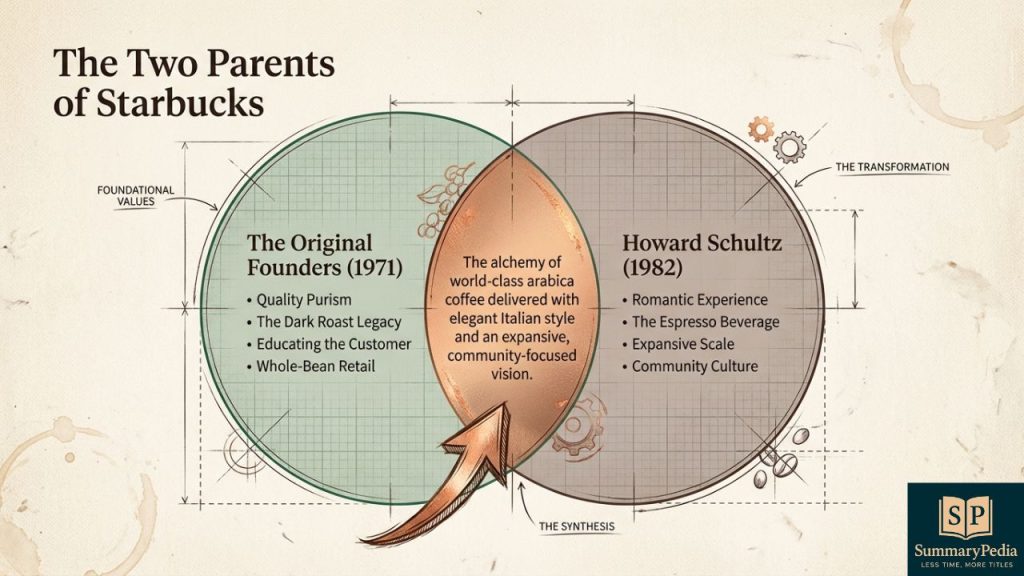
On a business trip, Schultz visits Starbucks Coffee, Tea, and Spice, discovering a profound devotion to dark-roasted, whole-bean coffee. He meets the founders, Jerry Baldwin and Gordon Bowker, who prioritized coffee education and product quality above all else. Inspired by their mentor, Alfred Peet, they maintained uncompromising standards that actively challenged the era’s stale canned coffee trends. Schultz is captivated by the company’s authenticity and product superiority, realizing that this niche passion could be scaled to revolutionize how Americans appreciate and consume coffee.
Chapter Key Points:
- Authenticity creates highly sustainable businesses.
- Never compromise on base product quality.
- Educate consumers to build intense loyalty.
CHAPTER 3 To Italians, Espresso Is Like an Aria
“The Italians had turned the drinking of coffee into a symphony, and it felt right.”
After a year of persistent lobbying, Schultz officially joins Starbucks as the head of marketing. During a trip to Milan in 1983, he experiences an epiphany while observing the vibrant culture of Italian espresso bars. He realizes that coffee is not merely a beverage to be brewed at home, but a powerful social ritual fostering deep community ties. Schultz recognizes that Starbucks is missing a massive opportunity by only selling beans, and he envisions bringing this romantic, communal espresso bar experience to the United States.
Chapter Key Points:
- Persistence opens vital career doors.
- Observe successful international cultural rituals.
- Combine superior products with community building.
CHAPTER 4 “Luck Is the Residue of Design”
“Good luck, it seems, comes to those who plan for it.”
Schultz’s proposal to open espresso bars faces steep resistance from Starbucks’ founders, who fear the concept will distract from their core business of selling beans. They briefly test his idea with a small espresso bar in a new Seattle store, which quickly becomes an overwhelming success. Despite its obvious popularity, the founders refuse to expand the concept, choosing to focus on their acquisition of Peet’s Coffee instead. Frustrated but resolute, Schultz realizes he must leave Starbucks to pursue his massive vision independently.
Chapter Key Points:
- Be willing to test new ideas.
- Never ignore clear consumer demand.
- Have courage to pursue massive visions.
CHAPTER 5 Naysayers Never Built a Great Enterprise
“Nobody ever accomplished anything by believing the naysayers.”
Leaving Starbucks, Schultz founds Il Giornale to bring the Italian coffee bar concept to life. Raising the necessary seed capital proves to be a grueling, humbling experience for the young entrepreneur. He pitches his business plan to 242 prospective investors, facing rejection 217 times from individuals who believe Americans will never pay premium prices for coffee in a cup. Relying on sheer perseverance and the backing of early believers who invest in his passion, Schultz eventually secures the $1.65 million needed to launch.
Chapter Key Points:
- Rejection builds strong entrepreneurial resilience.
- Investors buy into passionate, honest founders.
- Persevere against conventional business wisdom.
CHAPTER 6 The Imprinting of the Company’s Values
“The single most important thing you do at work each day is communicate your values to others.”
Schultz teams up with coffee expert Dave Olsen, whose deep operational knowledge and shared values become foundational to Il Giornale. They open their first stores, obsessing over every detail to authentically replicate the Italian experience, though they quickly learn to adapt to American preferences. When Starbucks’ founders decide to sell the company in 1987, Schultz orchestrates a frantic $3.8 million buyout. He fiercely defends his vision against a hostile investor takeover attempt, preserving the ethical foundation and integrity of his expanding enterprise.
Chapter Key Points:
- Partner with complementary, skilled experts.
- Adapt concepts to local market preferences.
- Protect your company’s core ethical values.
CHAPTER 7 Act Your Dreams with Open Eyes
“If you want to build a great enterprise, you have to have the courage to dream great dreams.”
Following the acquisition, Il Giornale is rebranded as Starbucks to leverage its stronger brand equity and customer recognition. Taking over as CEO, Schultz immediately addresses the low morale among Starbucks employees caused by previous management. He pledges to build a company that respects its workers and includes them deeply in its overall success. With a bold mandate to open 125 stores in five years, Schultz begins assembling a professional management team, emphasizing that rapid growth must be balanced with steadfast corporate responsibility.
Chapter Key Points:
- Build trust between management and employees.
- Rebrand strategically for broader consumer appeal.
- Aim high and overdeliver consistently.
CHAPTER 8 If It Captures Your Imagination, It Will Captivate Others
“Big opportunities lie in the creation of something new.”
To prove Starbucks can succeed outside the Pacific Northwest, Schultz aggressively expands into the challenging Chicago market. Despite initial financial losses and skepticism, the company persists until Chicagoans adopt the dark-roasted coffee habit. Concurrently, the introduction of FlavorLock packaging revolutionizes their supply chain, preserving bean freshness and enabling nationwide expansion without regional roasting plants. Ultimately, Starbucks recognizes it is providing a crucial “Third Place”—an inviting gathering spot between home and work that fulfills a deep societal need for community connection.
Chapter Key Points:
- Test concepts in highly challenging markets.
- Innovate to solve major logistical barriers.
- Provide a comforting community “Third Place”.
CHAPTER 9 People Are Not a Line Item
“Treat people like family, and they will be loyal and give their all.”
Driven by memories of his father’s hardships, Schultz implements unprecedented benefits for Starbucks employees. He successfully persuades the board to provide comprehensive healthcare to part-time workers and introduces “Bean Stock,” a stock option plan for all employees, transforming them into true business partners. These pioneering moves drastically reduce employee turnover and foster a highly passionate, dedicated workforce. Schultz proves that corporate benevolence is a massive competitive advantage, directly linking shareholder value to the well-being of the frontline people serving customers.
Chapter Key Points:
- Provide healthcare for part-time workers.
- Stock options create deeply invested partners.
- Benevolence is a massive competitive advantage.
CHAPTER 10 A Hundred-Story Building First Needs a Strong Foundation
“You can’t build a hundred-story skyscraper on a foundation designed for a two-story house.”
Anticipating explosive growth, Starbucks deliberately operates at a financial loss for three years to build out its infrastructure. Schultz convinces hesitant investors to fund world-class roasting facilities, advanced computer information systems, and a seasoned executive team long before the sales volume strictly requires them. By hiring ahead of the growth curve and securing multiple rounds of venture capital, Starbucks lays a rock-solid foundation. This proactive strategy successfully supports rapid national expansion without sacrificing operational integrity or base product quality.
Chapter Key Points:
- Invest heavily ahead of future growth.
- Build robust operational infrastructure early.
- Find investors with long-term strategic vision.
CHAPTER 11 Don’t Be Threatened by People Smarter Than You
“I hired you because you’re smarter than I am. Now go and prove it.”
Schultz recognizes his own operational limitations and strategically hires highly seasoned executives like Howard Behar and Orin Smith. Behar brings a fierce customer-first mentality and encourages open, candid communication, directly challenging the company’s previously rigid product focus. Meanwhile, Smith implements vital business processes and strict financial discipline to balance Schultz’s intense entrepreneurial zeal. By checking his ego at the door and empowering talented leaders, Schultz cultivates a dynamic, well-rounded management team capable of steering the company through immense global scale.
Chapter Key Points:
- Hire leaders far smarter than you.
- Encourage candid, open internal communication.
- Balance vision with strict operational discipline.
CHAPTER 12 The Value of Dogmatism and Flexibility
“As long as we remain respectful of our core product… we can feel comfortable offering customers different ways of enjoying our coffee.”
Starbucks faces intense internal debates regarding when to compromise for customer preferences without diluting essential brand integrity. Initially dogmatic about traditional Italian espresso, Schultz strongly opposes offering nonfat milk or flavored syrups. However, after consistently losing customers, management tests nonfat milk, which quickly becomes a massive success. The company learns to carefully balance strict quality control while adapting flexibly to customer requests that don’t fundamentally harm the core coffee experience.
Chapter Key Points:
- Compromise without losing core corporate values.
- Listen carefully to customer product requests.
- Never compromise on base product quality.
CHAPTER 13 Wall Street Measures a Company’s Price, Not Its Value
“Wall Street cannot place a value on values.”
Preparing for an Initial Public Offering in 1992, Schultz insists on partnering with investment bankers who genuinely understand and respect Starbucks’ culture, rather than those just chasing a lucrative transaction. The highly successful IPO provides immense capital for expansion but subjects the company to relentless quarterly scrutiny and stock market volatility. Schultz learns the crucial lesson of remaining focused on long-term business health, steadfastly refusing to let short-term stock fluctuations dictate operational, strategic, or ethical decisions.
Chapter Key Points:
- Partner with values-aligned investment bankers.
- Ignore short-term stock market volatility.
- Manage for long-term overall business health.
CHAPTER 14 As Long As You’re Reinventing, How About Reinventing Yourself?
“Nobody has a greater need to reinvent himself than the successful entrepreneur.”
As Starbucks aggressively enters new markets coast-to-coast, the sheer scale of operations begins to strain the corporate culture and Schultz personally. Realizing the company has grown far too large for his hands-on micromanagement style, Schultz transitions day-to-day operations entirely to Orin Smith. This vital reinvention allows Schultz to step into a true leadership role, focusing on long-term strategy, global vision, and preserving the company’s soul, proving that founders must constantly evolve as their enterprises scale.
Chapter Key Points:
- Delegate daily operations as you scale.
- Evolve from reactive manager to leader.
- Focus deeply on long-term strategic vision.
CHAPTER 15 Don’t Let the Entrepreneur Get In the Way of the Enterprising Spirit
“Rather than stifle the entrepreneurial spirit in our people… I’m convinced we should nurture it from the beginning.”
True corporate innovation often comes directly from the front lines. Store managers in California covertly develop a blended cold coffee drink, which Schultz initially dislikes and resists. After rigorous testing proves its immense popularity, Starbucks rolls out Frappuccino nationwide, creating a highly lucrative $52 million business line in its first year. Similarly, an in-store initiative leads to a successful partnership with Capitol Records to produce exclusive jazz CDs. Schultz learns to suppress his own entrepreneurial ego to foster grassroots innovation.
Chapter Key Points:
- Empower frontline employees to innovate freely.
- Don’t block ideas you personally dislike.
- Grassroots ideas yield massive corporate profits.
CHAPTER 16 Seek To Renew Yourself Even When You’re Hitting Home Runs
“Even when life seems perfect, you have to take risks and jump to the next level.”
To stay ahead of the curve, Starbucks seeks aggressive self-renewal by pushing coffee beyond the traditional store environment. Schultz partners with a biomedical researcher to develop a high-quality coffee extract, leading to a monumental joint venture with PepsiCo. Despite early cultural clashes and a failed test product, the alliance successfully launches bottled Frappuccino. Starbucks also partners with Dreyer’s to dominate the super-premium coffee ice cream market, successfully leveraging the brand into new categories without diluting its premium equity.
Chapter Key Points:
- Reinvent products during your peak success.
- Form strategic, powerful corporate joint ventures.
- Leverage brand equity into new categories.
CHAPTER 17 Crisis of Prices, Crisis of Values
“It is by presence of mind in untried emergencies that the native metal of a man is tested.”
Severe frosts in Brazil cause global coffee prices to skyrocket by over 300% in 1994, presenting Starbucks with a massive financial crisis. Instead of compromising on quality by using cheaper beans or entirely passing the cost to consumers, management absorbs much of the hit and secures expensive inventory to protect against further spikes. They launch a rigorous profit improvement plan to find backroom efficiencies, ultimately hitting earnings targets. The crisis solidifies the management team and proves their unwavering commitment to excellence.
Chapter Key Points:
- Never sacrifice quality during financial crises.
- Absorb costs; seek internal backroom efficiencies.
- Crises forge much stronger management teams.
CHAPTER 18 The Best Way to Build a Brand Is One Person At a Time
“The most powerful and enduring brands are built from the heart.”
Starbucks built its formidable national brand not through multi-million dollar ad campaigns, but by cultivating an intimate, word-of-mouth reputation driven by highly passionate employees. The company focused heavily on “romancing the bean” and providing superior customer service within a meticulously designed, sensory-rich store environment. As growth exponentially accelerated, Starbucks modernized its marketing by hiring top-tier agency talent and conducting deep consumer research, striving to communicate its authentic, soulful identity globally without losing the core community feel.
Chapter Key Points:
- Build brands through frontline employee passion.
- Word-of-mouth heavily beats mass advertising.
- Engage all five core customer senses.
CHAPTER 19 Twenty Million New Customers Are Worth Taking a Risk For
“Nothing truly great can ever be achieved without taking risks.”
Expanding its global reach, Starbucks partners with United Airlines, a highly risky move threatening brand integrity if the coffee is served poorly in flight. Starbucks demands rigorous quality controls and specialized flight attendant training before launching. Despite early equipment glitches that cause poor-tasting coffee and subsequent customer complaints, the companies patiently work through the issues, eventually delivering high-quality coffee to millions of passengers. The success underscores Starbucks’ strategy of forming selective, strategic wholesale partnerships to increase exposure without sacrificing standards.
Chapter Key Points:
- Take highly calculated risks for exposure.
- Demand strict quality control in partnerships.
- Solve problems instead of abandoning deals.
CHAPTER 20 You Can Grow Big And Stay Small
“The fundamental task is to achieve smallness within large organization.”
As Starbucks rapidly approaches ubiquity, it faces deep criticism for homogenizing neighborhoods and displacing local shops. Schultz passionately defends the company’s strong intent to add community value, while recognizing the inherent challenge of maintaining a small-company feel at a massive national scale. By continually prioritizing human resources, maintaining excellent employee benefits, promoting diversity, and actively encouraging open dialogue, Starbucks strives to ensure that every barista feels intimately connected to the corporate mission.
Chapter Key Points:
- Maintain small-company intimacy at scale.
- Prioritize human resources above all else.
- Communicate directly with frontline store employees.
CHAPTER 21 How Socially Responsible Can a Company Be?
“Companies do, in fact, do well by doing good.”
Starbucks establishes a deep corporate responsibility ethos, becoming the largest annual corporate donor to CARE to support health and literacy in coffee-producing nations. However, their visible success attracts targeting from activist groups demanding boycotts over Guatemalan labor practices. Realizing boycotts would severely harm workers, Starbucks pioneers a progressive, practical framework for a code of conduct for agricultural suppliers. Additionally, the company launches extensive environmental initiatives to steadily reduce store waste.
Chapter Key Points:
- Support coffee origin communities sustainably.
- Draft highly practical supplier conduct codes.
- Pursue bold, innovative environmental waste solutions.
CHAPTER 22 How Not to Be a Cookie-Cutter Chain
“Good design is not pretty colors. It’s putting something out of reach and making people go get it.”
To purposefully avoid the sterile feel of a fast-food chain, Starbucks places immense emphasis on highly innovative store design and visual branding. While standardizing back-end components to reduce soaring build-out costs, the company invests heavily in a specialized design team to create the “Store of the Future”. By developing distinct palettes inspired by the coffee-making process and utilizing local textures, Starbucks ensures that each location feels unique, elegant, and deeply romantic.
Chapter Key Points:
- Avoid sterile, cookie-cutter retail store design.
- Standardize back-end components for cost efficiency.
- Localize esthetics to maintain elegant intimacy.
CHAPTER 23 When They Tell You To Focus, Don’t Get Myopic
“A good chief executive keeps the broader picture in mind when everyone else is focusing on the details.”
A dismal holiday season in 1995 caused by bad weather, poor merchandising, and product missteps tests the entire company’s mettle. As daily sales comp growth drops precipitously, Schultz learns he can no longer micromanage the sprawling company like a agile “speedboat”. He candidly shares the highly disappointing reality with all employees, heavily fostering trust. Despite Wall Street criticism, Schultz refuses to abandon long-term R&D innovations for short-term fixes.
Chapter Key Points:
- Be transparent about painful company failures.
- Avoid narrow, incremental corporate decision-making.
- Balance short-term fixes with long-term vision.
CHAPTER 24 Lead with Your Heart
“Success is sweetest when it’s shared.”
Looking ahead to the new millennium, Schultz heavily reflects on the enduring vision of Starbucks: to remain a highly profitable global enterprise that never compromises its core values or its frontline people. He argues that true corporate leadership requires acting with heart, emphasizing that corporate benevolence and fierce competitiveness are highly mutually inclusive. Ultimately, Starbucks’ journey proves that by pursuing a noble purpose and sharing the immense rewards of success with the entire team, an underdog can transform an industry.
Chapter Key Points:
- Lead with heart and deep authenticity.
- Share financial success with the entire team.
- Benevolence and immense profitability are compatible.
10 Notable Quotes
- “Care more than others think wise. Risk more than others think safe. Dream more than others think practical. Expect more than others think possible.”
- “Humble origins can instill both drive and compassion.”
- “If it captures your imagination, it will captivate others.”
- “Luck is the residue of design.”
- “The single most important thing you do at work each day is communicate your values to others.”
- “Treat people like family, and they will be loyal and give their all.”
- “You can’t build a hundred-story skyscraper on a foundation designed for a two-story house.”
- “I hired you because you’re smarter than I am. Now go and prove it.”
- “The most powerful and enduring brands are built from the heart.”
- “Success is sweetest when it’s shared.”
About the Author
Howard Schultz is an American businessman and author best known for transforming Starbucks from a small regional coffee bean retailer into a massive global coffeehouse chain. Born in 1953 and raised in a subsidized housing project in Brooklyn, New York, Schultz’s humble beginnings profoundly influenced his highly benevolent corporate philosophy. After graduating from Northern Michigan University, he worked in sales before joining Starbucks in 1982. Following a brief departure to found Il Giornale, he acquired Starbucks in 1987, serving as CEO until 2000, and returning to the role during critical turnaround periods in 2008 and 2022 to guide the company’s strategic renewals.
Under his visionary leadership, Starbucks pioneered the concept of the “Third Place,” intertwining specialty coffee with deep community building. Schultz is widely lauded for establishing highly progressive labor policies, such as comprehensive healthcare and company stock options for part-time workers. His credibility stems from building a multi-billion-dollar empire while maintaining strong ethical commitments. He is the author of several best-selling business books, including Onward and From the Ground Up, making him a highly respected voice in modern ethical leadership and corporate social responsibility.
Frequently Asked Questions
- What inspired Howard Schultz to expand Starbucks? A trip to Milan, Italy, where he witnessed the romance and vibrant community of traditional espresso bars.
- What was Schultz’s original coffee company called? He founded a company named Il Giornale before acquiring Starbucks and merging the two.
- What is “Bean Stock”? A revolutionary program granting company stock options to all employees, including part-timers.
- Why did Starbucks refuse to franchise? To maintain absolute control over product quality and the intimate customer experience.
- How did Starbucks market itself in the early days? Through word-of-mouth, community events, and educating customers, rather than using mass advertising.
- How did Frappuccino originate? It was invented by frontline store managers in California, despite Schultz’s initial resistance.
- Why did Starbucks partner with PepsiCo? To leverage Pepsi’s massive distribution network for their innovative bottled Frappuccino product.
- How did Starbucks handle the 1994 coffee price crisis? They absorbed costs, locked in inventory, and found backroom efficiencies rather than sacrificing bean quality.
- Why did Starbucks offer health insurance to part-time workers? To reduce turnover, foster deep loyalty, and treat employees with dignity.
- What does Schultz mean by the “Third Place”? A welcoming, social gathering spot that serves as a comfortable oasis outside of home and work.
Theories and Concepts
- The Third Place: The sociological concept of a neutral, welcoming public space between home and work where people gather for community and conversation.
- Vertical Integration: Controlling the entire supply chain from purchasing raw green beans to roasting, packaging, and direct retail selling, thereby ensuring incredibly strict quality control.
- Benevolent Capitalism: The theory that providing excellent employee benefits (like healthcare and equity) directly boosts bottom-line profits through intense loyalty and superior customer service.
- Brand Authenticity: The principle that enduring brands are built on unwavering product quality and human connection rather than mass advertising and marketing gimmicks.
Books and Authors
- The Great Good Place by Ray Oldenburg: Explores the deep societal need for informal public gathering spaces, successfully validating Starbucks’ “Third Place” strategy.
- Built to Last by James C. Collins and Jerry I. Porras: Cited for its core concept of “Big Hairy Audacious Goals” (BHAGs) and building visionary, enduring organizations.
- Growing Pains by Eric Flamholtz: Used by Starbucks to carefully navigate the difficult transition from a scrappy entrepreneurial start-up to a professionally managed corporation.
Persons
- Dave Olsen: The coffee purist and Schultz’s trusted partner who sourced and managed the exceptional quality of Starbucks’ roasts.
- Howard Behar: A seasoned retail executive who championed a customer-first approach, pushed for nonfat milk, and fostered open corporate communication.
- Orin Smith: The disciplined CFO and later President who provided the financial frameworks and operational processes necessary for Starbucks’ massive scale.
- Gordon Bowker & Jerry Baldwin: The original founders of Starbucks who established the company’s uncompromising commitment to dark-roasted coffee.
How to Use This Book
Use this book as a highly effective blueprint for scaling an entrepreneurial vision without compromising core values. Apply its vital lessons on benevolent leadership, uncompromising quality, and continuous innovation to build passionate teams, resilient operations, and authentic, enduring brand loyalty.
Conclusion
Pour Your Heart Into It proves that deep compassion and immense profitability are not mutually exclusive. It challenges business leaders to dream audaciously, prioritize people over line items, and build highly resilient businesses steeped in total authenticity. Lead with your heart, treat your team as true partners, and start building an enterprise that deeply inspires the human spirit today!