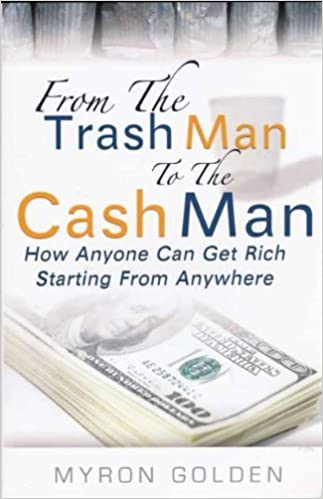
From the Trash Man to the Cash Man by Myron Golden
From the Trash Man to the Cash Man by Myron Golden is a transformative guide on financial success, rooted in the author’s inspiring journey from humble beginnings as a trash truck driver to becoming a successful entrepreneur. Golden provides practical strategies for wealth-building, mindset transformation, and financial independence, making it a valuable resource for anyone seeking to improve their financial situation and build lasting wealth.
Who May Benefit from the Book
- Aspiring entrepreneurs seeking wealth-building strategies
- Individuals desiring a mindset shift toward financial success
- People interested in learning practical money management tips
- Those aiming to build passive income and financial independence
- Readers looking for simple, actionable financial principles
Top 3 Key Insights
- Mindset is Key: Your financial success begins with adopting the mindset and habits of the wealthy.
- Multiple Streams of Income: Owning systems and investing in income-producing assets are essential for building sustainable wealth.
- Financial Education: Continuous self-education is vital for mastering the principles that generate wealth.
7 More Lessons and Takeaways
- Window of Opportunity: Understand the four ways to make money, prioritizing owning systems (O.A.S.) and sowing money seeds (S.M.S.) for long-term wealth.
- Passive Income Focus: Building income-producing assets like real estate, royalties, or e-commerce ventures is key to financial freedom.
- Marketing Mastery: Your success hinges on how well you market your product or service, even more than its quality.
- Leverage Technology: Embrace digital tools to automate your business, expand your reach, and increase efficiency.
- Avoid Money Traps: Stay aware of common financial mistakes, such as excessive consumerism or neglecting financial education.
- Freedom over Security: Financial freedom comes from diversifying income streams, not relying on a single job for security.
- Virtual Millionaire Reality: Achieve a millionaire lifestyle by generating substantial passive income, even if you don’t have a million dollars in the bank.
The Book in 20 Words
This book guides readers from financial struggle to independence through mindset shifts, passive income, and financial education.
The Book Summary in 1 Minute
From the Trash Man to the Cash Man by Myron Golden emphasizes transforming your mindset to mirror that of the wealthy. The book discusses practical steps for creating multiple income streams, such as investing in income-producing assets and mastering business systems. Golden also highlights the importance of financial education and marketing, urging readers to prioritize financial freedom over job security. With actionable tips on budgeting, saving, debt management, and entrepreneurship, this book is a roadmap for those seeking financial success and independence.
1 Unique Aspect
The book defines the Virtual Millionaire (V.M.) as someone who has built business systems generating at least $5,000 in passive cash flow monthly, equivalent to the interest income of $1 million invested at 6%. This concept prioritizes achieving consistent, automated income streams—which delivers a millionaire lifestyle—over simply accumulating paper net worth.
Chapter Summaries in 10 Minutes
CHAPTER ONE: What Are Your Chances of Becoming Rich?
“In the wealthiest country that has ever existed in the history of the world, you have a 95% chance of not making it and only a 5% shot at making it”.
Statistics show that of 100 people working from age 20 to 65, only 5% achieve financial independence (1 becomes rich, 4 become independent), while 95% remain financially challenged or broke. This clear separation necessitates a radical change in approach. To move into the top 5%, you must adopt the Two-Sentence Wealth Formula. The first step is identifying and emulating the financial habits of the rich; the second, and more crucial step, is identifying and avoiding the financial habits of the bottom 95%. Wealth is not luck, but a result of understanding and diligently following consistent financial principles.
Chapter Key Points
- 5% make it financially.
- Follow the rich; ditch the poor.
- Financial principles always work.
CHAPTER TWO: The Difference Between The Rich and The Poor
“Rich people understand how money works. Poor people only understand how to work for money”.
The core difference is knowledge: the rich know how money works, while the poor only know how to work for it. Rich people understand the time value of money and the magic of compound interest, which Einstein called “the most powerful force in the universe”. Poor people often use debt and savings rates that allow institutions to use compound interest against them. Crucially, the rich understand that time is infinitely more valuable than money, so they seek to put systems in place to make passive income, rather than trade time for a paycheck (J.O.B.). Rich people prioritize self-education (books, mentors, seminars) while poor people focus on entertainment (television, which fosters consumption and victim mentalities).
Chapter Key Points
- Leverage compound interest.
- Stop trading time for money.
- Educate yourself; minimize TV.
CHAPTER THREE: The Window of Opportunity
“It’s not about what happens, as much as it is about how you view what happens”.
Financial results are shaped by perspective, visualized through the Window of Opportunity. The two worst ways to earn money are in the bottom panes: H.A.J. (“Have A Job”), where income is limited by time and you are never paid your worth; and O.A.J. (“Own A Job”), where self-employment increases money but severely reduces time. Both carry high risk, as income halts if you stop working. The wealthy look through the top panes: O.A.S. (“Own A System”), which involves building business systems that generate residual income; and S.M.S. (“Sow Money Seeds”), which means investing money so it reproduces and grows wealth.
Chapter Key Points
- H.A.J. and O.A.J. limit income.
- O.A.S. and S.M.S. generate wealth.
- Building systems requires courage.
CHAPTER FOUR: What Kind of House Do You Live In?
“The biggest difference between the rich, the poor, and the middle class is not how much money they make; but what they do with money after they make it”.
Every person lives in a “Financial House” built on the Foundation of Truth. The Poor House directs all income immediately out the “Outgo Window,” spending money as soon as it arrives, believing consumption is the main purpose of money. The Middle Class House focuses on buying “Wealth Reducing Liabilities” (W.R.L.)—like expensive cars or boats—on credit to maintain status, blowing money out the Outgo Window in the form of debt. The Rich House focuses on the I.P.A. (“Income Producing Asset”) Window, dedicating early income to assets like real estate, licensing (like Bill Gates), or Network Marketing. Eventually, the IPA window grows so large that it generates enough cash to pay all bills, liabilities, and even fun purchases.
Chapter Key Points
- Poor spend everything immediately.
- Middle class buy W.R.L. with debt.
- Rich focus on Income Producing Assets.
CHAPTER FIVE: The Hands-Free Money Business Plan
“A dream cometh through a multitude of business”.
The Hands-Free Money Business Plan is designed to buy back your time. Inspired by scripture, the author chose to use his hands to create business concepts rather than continue working in ditches or hammering nails. The goal is to start multiple, totally different businesses, each generating $10,000 a month in income within two years. Crucially, after this initial two-year build period, each business should require no more than “one finger’s worth of effort” to run, ensuring it never interferes with one’s life purpose or passions, like playing golf. This simple plan creates a cumulative, powerful income derived from multiple streams.
Chapter Key Points
- Start multiple businesses.
- Goal: $10,000/month per business.
- Requires minimal maintenance effort.
CHAPTER SIX: All Businesses Are Not Created Equal
“You want to make sure you start a business that is not a job. You want to start a business that is a system”.
To build systems instead of jobs, focus on product-oriented businesses rather than service-oriented businesses, as product sales are not limited by time. Network Marketing is highly recommended for most people because it teaches essential business skills like networking, sales, and leadership development. It provides an unlimited income upside, pays for results, and, most importantly, allows you to multiply or leverage your time by getting paid for the hours your team works. Furthermore, a successful Network Marketing business is willable and transferable, creating a lasting legacy for your family.
Chapter Key Points
- Product businesses avoid time limits.
- Network Marketing leverages time.
- Develop business owner skills.
CHAPTER SEVEN: Leverage Your Business Through Technology
“The television is an electronic income reducer”.
Technology, especially the Internet, offers leverage to reach hundreds of millions of people quickly, making it a powerful tool for wealth creation. The “technophobic” are left behind. Essential digital strategies include building large email lists, as the customer’s name and email address are “gold” for future marketing. Websites should be designed as “Capture Sites” (squeeze pages) to collect contact information before offering solutions, or as powerful “Sales Sites” (sales letters) that generate fast cash, rather than being mere “Brochure Sites”. Another leverage tool is the use of teleseminars and conference calls, which can generate thousands of dollars in a single hour by teaching value and driving traffic to product sales sites.
Chapter Key Points
- Use technology for leverage.
- Build email lists (digital gold).
- Teleseminars drive sales traffic.
CHAPTER EIGHT: It’s Better To Be A V.M. Than It Is To Be A V.P.
“Cash flow is king. Positive cash flow is really what you want”.
While many chase the title of Vice President (V.P.), the better focus is becoming a Virtual Millionaire (V.M.). A V.M. is defined by cash flow, not just equity. Since $1,000,000 invested at a 6% rate of return yields $5,000 monthly, a V.M. is someone who builds a business system that generates at least $5,000 a month in passive income, thereby living a millionaire lifestyle without being a liquid millionaire yet. Accumulating passive income streams of $10,000 or $15,000 per month means you have built assets valued at $2 million or $3 million, respectively. Focusing on passive income (V.M. status) is the key to achieving time freedom faster than saving 100% of a regular salary.
Chapter Key Points
- V.M. equals $5,000 monthly passive income.
- Cash flow is better than net worth.
- Passive systems free up time.
CHAPTER NINE: Know What Business You’re Really In
“The real business you are in and every other business owner is in, is the business of marketing”.
Business owners often fail because they mistake their trade (plumbing, writing, singing) for their true enterprise. Every business, regardless of industry, is ultimately in the business of marketing. An average product with great marketing will earn more than a great product with poor marketing. Business should always begin with the marketplace, asking: “What do people want?”. Marketing is defined as the art and science of discovering and developing in other people the desire for more of your product. A great marketing strategy involves providing immense value for free (like a free course or item) to build trust and demonstrate quality, ensuring customers return to purchase paid products.
Chapter Key Points
- Marketing is the core business.
- Start business with marketplace desire.
- Be an expert in selling, not just creating.
CHAPTER TEN: Find A Financial Guide Who Has Already Found Their Fortune
“Don’t listen to your broke friends anymore, you know, the ones that try to convince you that everything is a scam”.
A crucial factor in finding wealth is finding a financial mentor who is as rich as you, or richer. The poor often tragically seek financial advice from equally broke peers, resulting in stagnation, described as “continuing to do the same things and expecting a different result”. Mentors provide the necessary perspective—they can see the entire financial “playing field”—which those “in the game” cannot. If a mentor’s advice seems counter-intuitive, trust them until the results manifest and clarify your new perspective. To change your income, you must change who you take advice from, following only those who have already reached the financial “promised land”.
Chapter Key Points
- Only take advice from the rich.
- Broke peers give bad financial advice.
- Mentors provide critical outside perspective.
CHAPTER ELEVEN: You Have No Competition
“The economy is not a pie. The economy is more like a fruit”.
The belief in competition is rooted in a “Lack Mentality” which sees the economy as a fixed “pie”—meaning if one person takes a piece, there is less for everyone else. The author rejects this, viewing the economy as a fruit tree, representing infinite abundance. When the rich generate wealth, they increase the wealth of the economy. For example, when the author went from driving a $50 car he washed himself to driving new luxury cars he had serviced and washed by others, he created jobs and income for mechanics and car wash owners. The principle is: the more money everyone makes, the more there is for everybody to make.
Chapter Key Points
- Abundance is infinite, not limited.
- The economy is a reproducing fruit.
- Your wealth benefits those around you.
CHAPTER TWELVE: Since You Can’t Beat ‘Em, Join ‘Em
“You can never become wealthy if you are a person who hates wealthy people”.
Many people hold an “us against them” philosophy, despising the wealthy. However, you cannot become something that you despise. Instead of being a “hater,” one must choose to be a “participator” and join the elite. Becoming wealthy provides control over your future and offers necessary choices. The financial mountain top is not crowded, as “there is plenty of room at the top of the economic heap, it’s the bottom of the heap that’s crowded”. The invitation is to cease hating wealth and to intentionally take steps to join the ranks of the prosperous.
Chapter Key Points
- Do not despise wealth.
- Join the participators.
- The top is not crowded.
CHAPTER THIRTEEN: You “Can” If Your Cans Say You Can
“Get all you CAN. CAN all you get. And your Cans mean you Can!”.
Financial success is determined by money management, regardless of income level. The “Money Management Principle of Millionaires” requires dividing your gross income into six distinct categories, symbolized by literal paint cans or accounts. The breakdown is: 10% to “I Can Tithe”; 10% to “I Can Finish Free” (used only to buy passive Income Producing Assets and never spent); 10% to “I Can Educate Myself” (for books, seminars); 10% to “I Can Save for What I Want” (vacations, large purchases, emergencies); 10% to “I Can Have Fun” (must be spent monthly on pleasure to conquer “deserve issues”); and the remaining 50% for “I Can Pay My Bills”. To succeed, you must simplify your lifestyle to live comfortably off half your income.
Chapter Key Points
- Manage money using six Cans.
- Never spend “I Can Finish Free” money.
- Live off 50% of your income.
CHAPTER FOURTEEN: Eleven Mental Money Traps That Can Keep You From Your Fortune
“Be skeptical, but don’t be negative”.
Mental Money Traps are destructive thought patterns that keep people poor. Trap #1 is mistaking negativism for skepticism; never shut down an opportunity by saying, “It sounds too good to be true,” without investigation. Trap #2 is being too myopic, focusing only on the present five minutes instead of planning for a long-term future and legacy. Trap #3 is disliking money, which leads people to settle for “just enough to get by”. Trap #4 is valuing consumption over production, spending seed money instead of investing it to produce “fruit money”. Trap #8 is valuing formal education over self-education, despite self-education being the path to wealth. Trap #11 is maintaining a Renter’s Mentality, wasting money on rent and rented furniture instead of building equity.
Chapter Key Points
- Investigate all opportunities.
- Avoid consumption focus.
- Reject Renter’s Mentality.
CHAPTER FIFTEEN: Thirteen Practical Money Traps That Can Keep You from Your Fortune
“Good debt is any money that you borrow and somebody else pays back”.
Practical Money Traps are habits that deplete wealth. Trap #2 is failing to invest in your greatest asset, your mind (self-education), which always yields the highest returns. Trap #3 is owning only wealth-reducing liabilities, making it critical to start building Income Producing Assets immediately. Trap #5 is being paralyzed by a paycheck—the “golden handcuffs”—making you too exhausted to pursue profitable opportunities. Trap #6 is doing everything yourself; you must outsource menial tasks (like washing the car or cutting grass) to focus your valuable time on growing your business. Trap #8 is operating on a cash-only basis, which prevents utilizing technological and business opportunities. Trap #9 is lacking a financial mentor or coach who can see the whole “game” and hold you accountable. Trap #13 is using bad debt (money you pay back, like a car loan) instead of good debt (money an asset pays back, like a rental property tenant).
Chapter Key Points
- Outsource menial, low-value tasks.
- Always hire a financial coach.
- Use assets to pay your debts (good debt).
CHAPTER SIXTEEN: How to Get Started On the Road to Riches
“I didn’t write this book because I want you to know this information. I wrote this book because I want you to do this information”.
This final chapter stresses that knowledge is useless without application. Readers must immediately start practicing the advice: stop trading time for money, follow the rich, invest in self-education, and diligently apply the money management principles to their lives. The reward for implementation is moving from merely “getting by” to thriving, securing time freedom to pursue personal passions, like travel or golf. The immediate next step is seeking mentorship and getting started in a profitable, product-oriented business. The author offers thousands of dollars in bonuses, including free tuition to his “Six Figure Business School,” to ensure readers take action and start their journey to financial freedom now.
Chapter Key Points
- Action is required for results.
- Seek mentorship to get started.
- Freedom means doing what you want.
10 Notable Quotes
- “Rich people understand how money works. Poor people only understand how to work for money”.
- “Compound interest is the most powerful force in the universe”.
- “Time is not money; time is infinitely more valuable than money”.
- “Whoever puts the most money in your mind, that’s who has most of your money”.
- “The biggest difference between the rich, the poor, and the middle class is not how much money they make; but what they do with money after they make it”.
- “The main purpose of money is reproducing more money”.
- “You can never become wealthy if you are a person who hates wealthy people”.
- “Get all you CAN. CAN all you get. And your Cans mean you Can!”.
- “Formal education will make you a living, but self education will make you wealthy”.
- “Good debt is any money that you borrow and somebody else pays back”.
About the Author
Myron Golden is a celebrated entrepreneur, best-selling author, motivational speaker, and business coach who has transformed the lives of countless individuals and businesses through his teachings on financial success, personal development, and entrepreneurship. He is known for his remarkable journey from humble beginnings to financial prosperity, and his ability to help others unlock their potential and achieve their financial goals.
Golden is known for his straightforward, relatable advice on personal finance and entrepreneurship, and he is widely recognized for his online content, including YouTube videos and live seminars.
Myron Golden’s story begins with a backdrop of struggle and determination. Born into a modest family, Myron faced adversity early in life, including physical disabilities. Diagnosed with polio as a child, he had to wear a leg brace for years, but instead of allowing these challenges to define him, he used them as motivation to build a future full of opportunities. This resilience has been a defining characteristic throughout his life, influencing his perspective on overcoming obstacles and achieving success.
Myron began his career working low-wage jobs, including as a trash collector. These experiences laid the groundwork for his life-changing transformation, where he moved from being “the trash man” to becoming a successful entrepreneur—a theme central to his motivational speeches and best-selling book.
How to Get the Best of the Book
To maximize the value of From the Trash Man to the Cash Man, engage deeply with its financial strategies. Study each lesson, apply the mindset shifts Golden emphasizes, and consistently work toward building multiple streams of income.
Implement the Six-Can Money Management System and commit to fanatical self-education. Find a financial guide and start building a product-oriented business today.
Conclusion
This book is your powerful lever, proving that poverty is not destiny and wealth is an attainable goal for everyone, regardless of their starting point. By rejecting the 95% mentality, prioritizing Income Producing Assets, and leveraging technology, you can build a system that delivers not just money, but infinite time freedom. Stop being paralyzed by a paycheck and start constructing the life you deserve, funded by cash flow. Don’t just read about wealth; choose to be a doer and contact a mentor immediately to transform your financial future.